| Author |
 Replies: 8 / Views: 2,371 Replies: 8 / Views: 2,371 |
|
|
Pillar of the Community
Austria
566 Posts |
I have stumbled upon this unusual coin, wchich is obviously a counterfeit with a cuban counterstamp.   I have found the same dated counterfeit type in the spanish counterfeits catalogue (Catálogo General de la Moneda Falsa Espanola by Luis Barrera Coronado, page 83, no 272), but the countermark there is on a different spot. Is it possible, that these counterfeits were made in cuba during the spanish occupation or were they made later for collectors? Also what about the countermark, is it an official one or also immitated? To me the latters seems more plausable , but if the countermark is authentic, than we could assume, that the coin circulated in cuba, and was accepted by the spanish authority to do so. Any oppintions? |
|
|
|
Pillar of the Community
United States
1674 Posts |
Very nice and interesting piece, one that I would bid on if I saw it at auction :)
I do not believe the countermark is genuine either and I agree that it is a contemporary counterfeit. Very cool find.
|
|
Pillar of the Community
United States
1761 Posts |
Yes - to have both (i.e., countermark and host) as a counterfeit is a prize. These do not enter as Kleeberg CCC 2Rs as this counterfeit FAMILY only deals with Spanish American mints and not Spain. In my new book "Forgotten Coins" I do their final treatment for upcoming varieties roughly Varieties 100-150.
Nice high grade piece as we can tell this by the die polishing lines running NS in the obverse. Estimate ~ ($100-200) ... if properly cataloged.
John Lorenzo
Numismatist
United States
|
|
Pillar of the Community
United States
564 Posts |
|
|
Pillar of the Community
United States
1962 Posts |
(2) others... Note different positions (and fullness of stamp) on all (3) examples - clearly the stamp was applied separately after the manufacture of the "coin". The coin is, of course, not regal - its incorrect "mintmark" apparently being an upside-down "JD", a correct Madrid ASSAYER mark for those years. Then regarding the stamp... while figuring these Cuba stamps is a bit challenging, I'd say this is pretty clearly a counterfeit stamp as well. So - fake stamp on a fake host. Certainly old... looks like some honest wear is present across examples - I see no reason to think that these aren't contemporary counterfeits, produced expressly to pass in Cuba as the countermarked peninsular Spain coinage. Many different CC varieties of the Cubas C/Sed 2R exist. 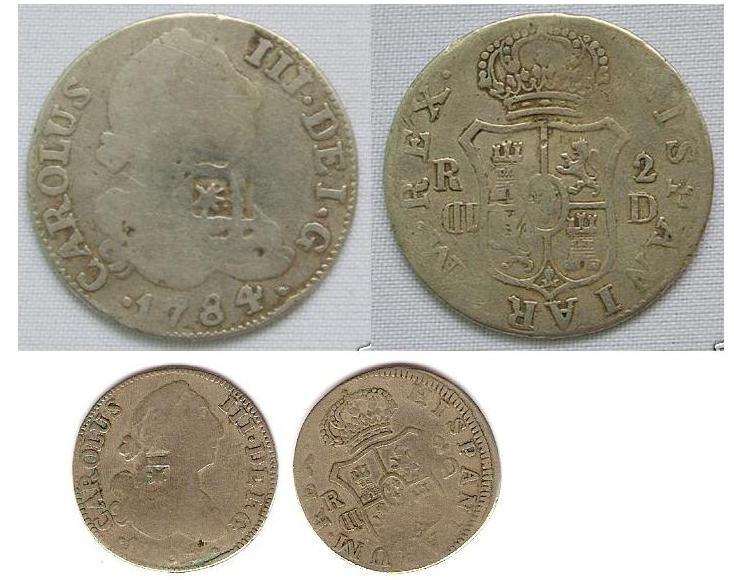 |
|
Pillar of the Community
 Austria
566 Posts |
Thank you realeswatcher, now I do appreciate this coin even more.
If this coin was counterfeited during it´s time, than it would be probably safe to suggest, that this is the first coin actually being struck in Cuba.
I guess, that the value of such coins would rise in future, such as the one issued in Venezuela and Honduras.
|
|
New Member
United States
7 Posts |
Realeswatcher, if you notice this thread (or if someone can get me in touch with him), I've been researching a series of counterfeit Madrid-mint two reales that I suspect may have been struck for importation to Cuba. I would love to see if you are aware of anything that could fit the bill.
|
|
Pillar of the Community
United States
1761 Posts |
This is a rare combination even for these common ubiquitous counterfeit 2 Reales of Spain. $100-200 IMO.
John Lorenzo
United States
|
|
Pillar of the Community
United States
1962 Posts |
Bumping this thread from way back as it came up in doing some searching on the 1784 cont. ctft. mold someone posted... Sorry in advance for an unfocused, rambling post; just some random thoughts on a specific area of contemporary counterfeits that I've never much explored simply b/c no one seems to care much (as reflected by market prices).
John, as is, these just don't bring nearly that. As coinworldtv had touched on, these in theory could/should be more valuable as they are colonial pieces for them. There just doesn't seem to be much interest in them either in Spain (CC 2R with or WITHOUT the counterstamp) OR from the Cuban community stateside... and obviously, the situation in the country itself doesn't help.
It's such a wide-ranging series... and hard to catalog, not enough research done, etc. It would really involve developing a strong grasp on the situation/pipeline of (illlicit) coinage from homeland Spain to the island, as Ardatirion seems to want to (have wanted to?) undertake. I want to say I've seen some writeup or publication on these at some point; if not, I'm sure some good specific knowledge could be cobbled together from various works.
Much like British contemporary counterfeit Spanish Colonial 8R, you also have the situation here where some of the known pieces come with or without the lattice stamp. And also, as John knows, there were a LOT of falsas de epoca of the peninsular portrait 2R produced (a whole lot of basically EVERY Spain coin from 1700-1875 was produced!!!)
I would speculate most of these were actually made in Spain and exported to Cuba rather than made there locally... but again, would have to really investigate the series to get an accurate picture.
|
| |
Replies: 8 / Views: 2,371 |
|










 Posted 04/23/2017 09:20 am


