The
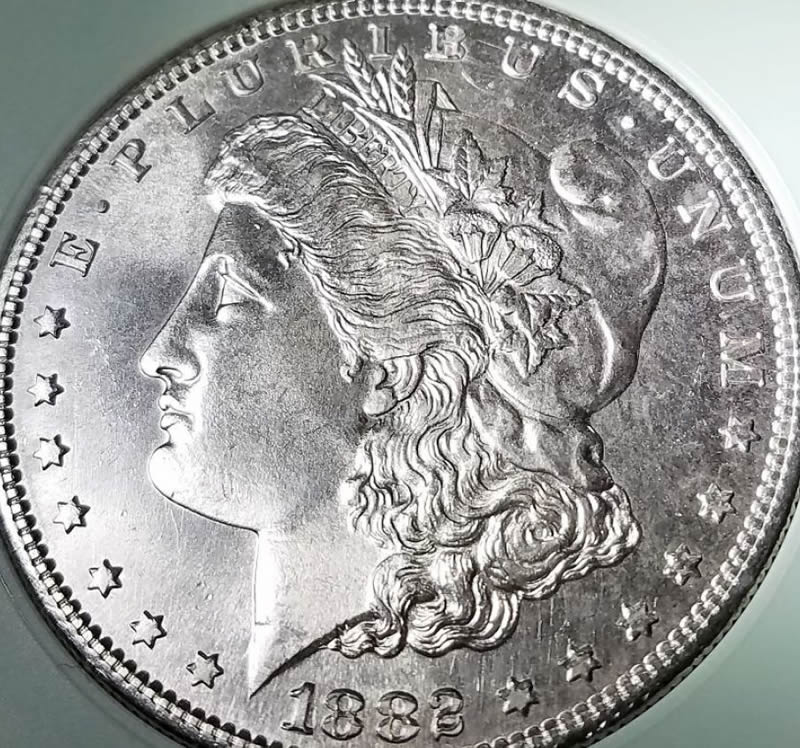
Morgan dollars, because of the large field surface area, are good for spotting die polishing lines. Mint workers, when dealing with new dies, would sometimes polish them up quite a bit more than required -- a matter of pride, or boredom, or just individual work ethic -- who knows. The first coins struck from these dies would often have deep mirror surfaces (prooflike) and that made the die polishing lines much more visible. The San Francisco coins of 1878 to 1882 are well-known for this "feature", having a large number of both prooflike coins and coins with large amounts of die polishing lines, as well as better-than-average strikes in most cases. At other mints, such as New Orleans between the mid 80s to mid-late 90s, strike pressures were reduced in order to lengthen die life, and the workers tended to be somewhat more apathetic in their jobs, resulting in lots of poorly-struck coins with dull luster, even when new.
As the dies wore, and developed chips, cracks, and clash marks, sometimes they would be polished a second time to remove the witness marks. However, this 2nd polish tended to be pretty rough on the dies, and coins from these dies will not have the mirror prooflike surfaces, but will still show heavy die polishing lines, especially in common clash areas such as the upper right inner wreath on the reverse, between the date and the lowest hair curls, or the area in front of the neck and lips. Sometimes the polishing would be so severe that major design features would be obliterated, having been polished away from the dies, creating the "overpolished" VAMs.
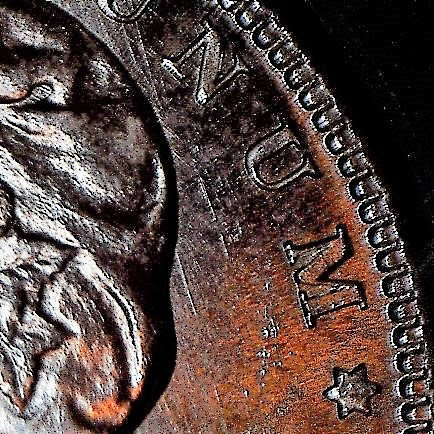
Because the areas on the coin that are raised are actually lowered or incuse on the dies, the polishing lines tend to affect mainly the fields, and not the devices. Looking at the polish lines under a microscope or strong triplet loupe will show you that these lines are actually slightly raised above the surrounding field; compared to post-mint damage such as cleaning or scratches, which are LOWER than the surrounding field and often cross the devices.
Another thing to look for is that most (but far from all!) die polishing lines run roughly parallel to each other and are oriented on a relatively similar axis.
PMD polishing/cleaning tends to be much more random and much less uniform in nature.
Since they are in shallow relief as it is, the polishing marks tend to disappear pretty quickly if one of these early-state coins gets into circulation. Below AU most of the early die state polishing marks will be long gone, and only the marks left by overpolishing / clash-crack removal will remain, and even those wear off below F+/VF where the devices start to merge with the fields.
Hope this helps. Any errors are mine alone!
Member
ANA - EAC - TNA - SSDC - CCT #890
"Most of the things worth doing in the world had been declared impossible before they were done." -- Louis D. Brandeis












 Posted 05/02/2017 9:15 pm




 Scratches.


