| Author |
 Replies: 6 / Views: 1,844 Replies: 6 / Views: 1,844 |
|
|
Valued Member
United States
54 Posts |
I am unable to find this note at RealBankNotes .com. I've searched under 1923, German, 500, and none of the results matched up. Then I tried the other variations on German, and still nothing. Any thoughts? 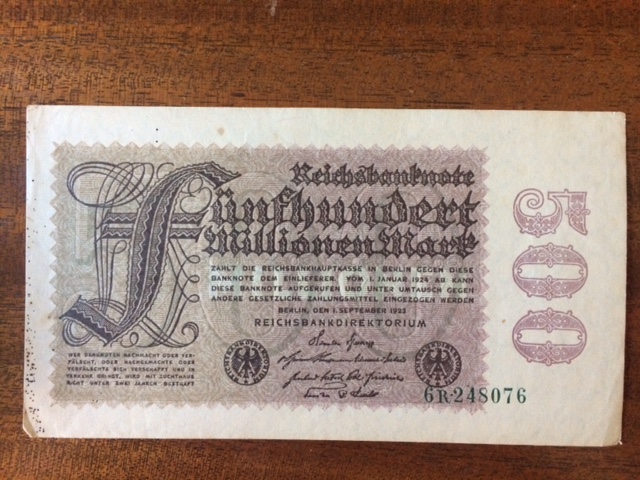 |
|
|
|
Pillar of the Community
Poland
3201 Posts |
Yes, Germany 500,000,000 mark, 1923-09-01, P-110.
Edited by DL20K
05/14/2017 11:19 am
|
|
Valued Member
 United States
54 Posts |
Thanks very much.
It did not cross my mind that the 500 portion was just the header to a bunch of zeros.
I'll keep that in mind as I search up the rest of my old, foreign currency.
|
|
Rest in Peace
United States
2668 Posts |
Coconice, that's what great about CCF there's usually a knowledgeable person along shortly. Followed by a discussion on the (coin, currency, token, medal, private minting, bullion, or counterfeit) attributes and possible grade. I have learned interesting things and empirically increased my knowledge of numismatics.  |
|
Pillar of the Community
Poland
3201 Posts |
Well, that provides a thing to discuss. Namely: - at which point did the Germans decide to drop the long lines of zeros in favor of writing the face value in words instead? The 5,000,000 mark ( P-90) still had all the zeros written out... seven times in total... |
|
Pillar of the Community
United States
992 Posts |
Good question. I think the Germans started looking at the money being worth less than the cost of the paper and ink components in late 1920, and got progressively more serious in 1921-1922, and then 'anal' by 1923. Note design was first, along with paper size. Then uniface, then number of colors on the note, then the real anality began. Nunber of zeros, and even color of ink.
|
|
Bedrock of the Community
 United States
12921 Posts |
That's a really cool note. Thanks for sharing... and to everyone for all the good info.
|
| |
Replies: 6 / Views: 1,844 |
|










 Posted 05/14/2017 2:46 pm


