| Author |
 Replies: 12 / Views: 2,676 Replies: 12 / Views: 2,676 |
|
|
Pillar of the Community
Canada
2786 Posts |
So very excited to have picked this up. It will be the centerpiece of my collection for some time to come. 1837 City Bank REVERSE married to the 1842 Bank of Montreal OBVERSE. VF20?   |
|
|
|
Pillar of the Community
United States
840 Posts |
Wade,
Another nice token.
A strong VF 20. The rims and field are clear, and on a good day VF 30. The token shews honest wear, but no significant abuse, aside of the ding in the O in OF.
Dr. Courteau variety 88. To wit:
"88. Obv. Resembles No. 87, but the door is perfectly plain - no mouldings or knob, and there is no defect
in the die above [the] O in OF. Perfect A's. Perfect fence to the left.
[note- others within the series shew varying degrees of door mouldings and knob placements, and some shew
defective pilings (fence posts), etc.].
Rev. Similar, but CITY BANK on [the] ribbon ends and dated 1837. [The] outer rim of [the] garter [is] broken at the top. There is a V-shaped crack in the die; the base of the crack rests on the lower angle of [the] St. Andrew's cross, while each arm extends respectfully to the left and the right angels of [the] same cross. R. 8.
This token is lighter than any of the foregoing ones.
Collectors have long been divided in their opinions of this token; different theories have been advanced concerning
it. In fact there are almost as many theories as known specimens. It has been generally considered as a result of
intercrossing of dies; the obverse of a front-view token with a reverse of a Habitant - a so-called 'mule.'
But after a careful comparison of the penny with the different obverses of the former type and the different reverses of the latter, I have come to the conclusion that it is a variety by itself, with [the] obverse entirely different from others and [the] reverse [is] different also, though slightly, from the Habitant tokens. Consequently, this piece deserves a well-justified place in any collection of Canadian coins, as a regular one. It is quite probable that the obverse die for this token was cut before those of [the] front-view penny of the Bank of Montreal."
Note- absent the brackets, the above is an exact quotation from Dr. Courteau's work.
enjoy
doug
Edited by colonialtokens
05/15/2017 02:02 am
|
|
Bedrock of the Community
Canada
10743 Posts |
Nice one Wade.  I look at a coin for the grade and see if it's fairly nice for my collection Doug, looks at door knobs and mouldings and such...   |
|
Pillar of the Community
United States
840 Posts |
Concerning the above token, the detail provided is moot as there is but one variety.
However, on the similar token dated 1842, Dr. Courteau identified some 16 different varieties.
And diagnostics for these involves a scrutiny of the door moulding and placement of the knob,
and a host of other details. Akin to the 1858/9 Victoria large cent, one ensample will suffice
for a type, but Mr. Turner's tome identified many more, and some are considerably rarer than others.
doug
|
|
Pillar of the Community
 Canada
2786 Posts |
Interesting theory. My natural instinct would've been to think that it was made in '42 with the '37 reverse making it's way into production by mistake.
But from what I understand you feel that these are from dies of their own, and therefore not a mule?
Is there a consensus on how many known specimens there are?
and as always, thank you
|
|
Pillar of the Community
 United States
2843 Posts |
NGC calls this a mule. Might not mean anything.
BTW, jyst trying to gauge the value on this, because I just found one, in nicer condition. Do you care to share what this cost you? I undersatnd if you don't want to...
|
|
Pillar of the Community
Canada
2786 Posts |
$470 US, which would be high if it grades a 20, but in the ball park if it hit 30. I am comfortable with my purchase regardless as this is one of those coins that can anchor a collection & separate it from 99% of the everyday masses.
|
|
Pillar of the Community
Canada
5342 Posts |
Congrats, must pay for cool coins.
|
|
Pillar of the Community
United States
2843 Posts |
|
|
Pillar of the Community
United States
840 Posts |
Wade,
The comments previously posted were an exact quotation [absent my brackets], from Dr. Courteau's narrative of the series.
And yes, I fully agree with Dr. Courteau's astute assessment. As mentioned, the obverse die is distinctly unique and unlike any of the other obverses of the 1842 series, howbeit, they are similar. The same premise holds true concerning the reverses.
Absent insightful knowledge of the specific diagnostic characteristics of the others within the series, one has insufficient evidence to draw a conclusive scientific conclusion, thus they willingly settle for a SWAG (Scientific Wild-Ass Guess).
And in the opening paragraph of variety PC-2A, on page 193 of the current Charlton's Canadian Colonial Tokens catalogue, Charlton even discusses these thoughtful observations. In all truthfulness, Charlton also mentions the 'muling' theory. But, Charlton fails to rock-the-boat and commit one way or the other.
doug
Edited by colonialtokens
05/15/2017 3:03 pm
|
|
Bedrock of the Community
United States
94367 Posts |
Hardly my specialty, but a beautiful example!
|
|
Pillar of the Community
United States
2843 Posts |
A little bump for this thread. Wade- I was just looking at my example of this coin and I noticed that the date is repunched. I imagine that only one die would have been used for this issue. So I came back to look at yours. I think I can see doubling on the tail of the 7 on yours. Here is a close up of the date on mine. Oh does the magnification make slight verdigris look bad... 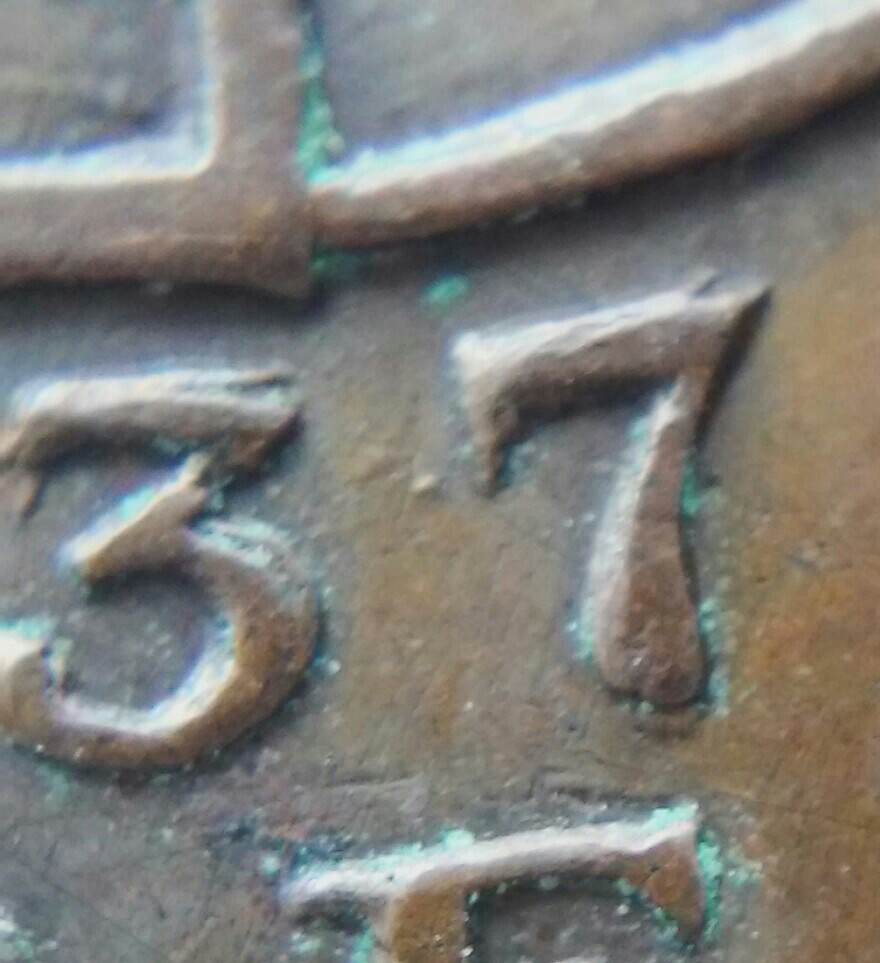 |
|
Pillar of the Community
United States
840 Posts |
To the best of my knowledge, this appears generic to the variety.
doug
|
| |
Replies: 12 / Views: 2,676 |
|










 Posted 05/15/2017 06:19 am


