| Author |
 Replies: 24 / Views: 5,754 Replies: 24 / Views: 5,754 |
|
Pillar of the Community
United States
3343 Posts |
Hey, everyone. While I was at the coin shop this afternoon, I mentioned my 1861 silver 3 cent piece and the fact that it was holed. The dealer said that on these particular coins a hole might not necessarily detract from the value. Their comment dealt with the fact that it was common practice during the civil war to keep a Three Cent coin attached to ones self along with a family letter in case of death. Apparently, it cost Three Cent to mail a letter at that time. Anyone else ever hear about this? "Nummi rari mira sunt, si sumptus ferre potes." - Christophorus filius Scotiae
|
|
|
|
Rest in Peace
United States
7075 Posts |
Interesting ---  |
|
Pillar of the Community
United States
1696 Posts |
Quote:
I mentioned my 1861 silver 3 cent piece and the fact that it was holed. The dealer said that on these particular coins a hole might not necessarily detract from the value. Since the presence of a hole affects grading negatively, it would seem necessarily to affect value negatively. The only exception would be a piece that that is unique, which is not the case with trimes. |
|
Pillar of the Community
United States
564 Posts |
 The only time when this is true in my opinion is when the coin is a rare variety with like only a few examples known in the world or so, unless there's a story behind it  ? |
|
Pillar of the Community
United States
1475 Posts |
Hey Bump111,
It's neat story, but I would disagree with the dealer.
Most of us will prefer coins without a hole than with one, including 3 cent pieces.
|
|
Pillar of the Community
 United States
3343 Posts |
I think I agree with you all. It is an interesting thought that the coin may have been carried by a soldier in the manner the dealer discussed. Since I'm not worried about the value of the coin, it is certainly ok for the hole to be there. Coincidentally, I got this coin from my grandfathers estate and his father was a civil war veteran. Makes you wonder...
"Nummi rari mira sunt, si sumptus ferre potes." - Christophorus filius Scotiae
|
|
Formerly coinlover1899
 United States
3058 Posts |
Quote:
It's neat story, but I would disagree with the dealer.  www.InGodWeTrustCoins.com
|
|
Rest in Peace
10197 Posts |
I have a 1865 3c w/ a hole in it, similar story, my in-laws would have been Confederates in Central MO, may explain the why of a hole, I'd always thought it had something to do with a special family date, birth, marriage, etc. Now another theory... |
|
Pillar of the Community
United States
4432 Posts |
IMHO, being a "dealer" does not invoke instant credibility on obscure subjects like this. I would challenge this dealer to produce but one historical piece of evidence to support his claim about the "hole" story. As someone who's been researching nineteenth century newspapers for articles relating to the use of coins back then, I have yet to see even one mention of a trime being holed and used as such. Is it possible ... yes. It certainly was not a "common practice" by any stretch of the imagination. Coins were holed for many reasons. The trimes were indeed used to pay for postage. These are facts. To say that a holed trime has no less value than an unholed specimen is, IMHO, generally unfathomable. Of course, if there can be some historic value attached to a holed coin, the value can increase. Here's an example .... 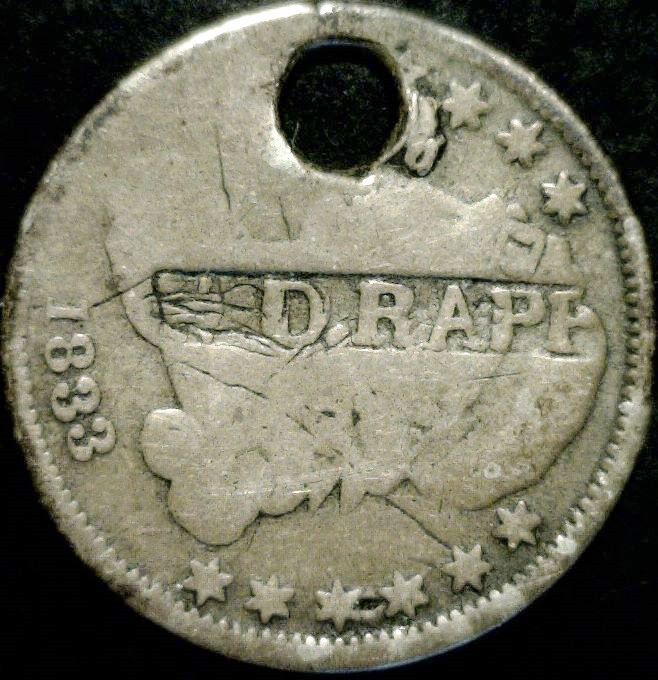 The above 1833 dime, holed and otherwise grading fair, condition-wise, would be a $5-$10 coin without the hole or the stamp. This historic hallmark, dating back to the Hard Times era, elevates the value. The hole detracts from the value. William D. Rapp was a jeweler and watch case maker, located on Sassafras Street in Philadelphia. About thirty of his counterstamped coins have so far been recorded, with the latest coin being dated 1835. At auction, I would estimate this piece to realize $100 or so, despite the damage. Note that this hallmark matches those known for Rapp. It's history is real and NOT based on hearsay, like the trime. Edited by ExoGuy
05/31/2017 10:11 pm
|
|
Pillar of the Community
United States
3343 Posts |
I can't imagine anybody going out looking for a holed coin and I wouldn't buy one. But it's an interesting thought as to why some coins have holes in them. Who would want to wear this tiny little coin on a necklace? I always wondered that. Like I said, this is a family heirloom of sorts and the coin dealer gave me something interesting to think about. As always thank you for the responses.
"Nummi rari mira sunt, si sumptus ferre potes." - Christophorus filius Scotiae
|
|
Bedrock of the Community
United States
12477 Posts |
Very interesting discussion! It made me think of a token I have. I know it doesn't belong in this forum but, with tokens, sometimes being holed is intentional. Through my research, this piece is ca. 1900 and was holed by/for the merchant because it was used as a tag on a pair of shoes. You never know!  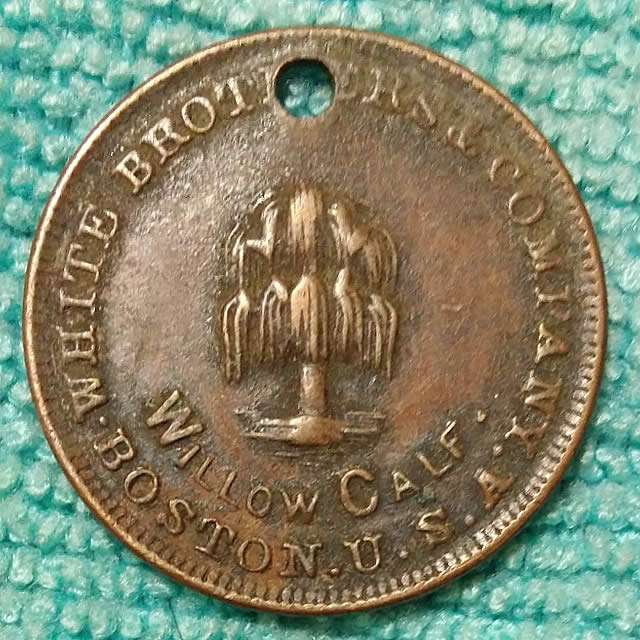 In Memory of Crazyb0 12-26-1951 to 7-27-2020
In Memory of Tootallious 3-31-1964 to 4-15-2020
In Memory of T-BOP 10-12-1949 to 1-19-2024
|
|
Pillar of the Community
United States
3343 Posts |
I like the willow tree associated with the city. Very nice token.
"Nummi rari mira sunt, si sumptus ferre potes." - Christophorus filius Scotiae
|
|
Bedrock of the Community
United States
12057 Posts |
I would think this is folklore and also probably a shameless attempt by a dealer to overvalue damaged coins. As MythBusters would say, "plausible", but unlikely.
A few thoughts:
- Sutler tokens were the most common (relatively speaking) means of self-identification for Union soldiers (merchant tents were not nearly as available to Confederate soldiers) followed by engraved metal items such as buckles.
- After August 1861, thanks to a Post Office ban, scarcely any "standard" mail was sent between the North and South except at dedicated truce points, and often only during POW exchanges. What little mail did make it through was delivered by private delivery companies, often at extreme risk of harassment from blockades and interdiction efforts from the other side. The mail exchanged at truce points was opened, read, and censored or discarded/destroyed if found to be objectionable or containing material that could be used by the enemy such as troop locations, movements, etc.
- Heading through 1862, SILVER small change was so scarcely encountered that by mid 1863 Fractional notes and even US Postage Stamps themselves were pressed into use as currency. This was a side effect of the government suspension of specie payments in exchange for paper currency. There was a surplus of small change coinage prior to the War, but it was quickly vanished from circulation into hoards by citizens and merchants who were worried about the war's effects on the economy, a feeling that if the Confederates won the war the value would be only in the metal and that the South would not honor the Federal face value (same thing for Northerners who worried about convertibility with Confederate money), a lack of faith in Federal and Confederate currency, etc.
- At any rate, the price did not remain 3 cents for long outside of the Union; by the end of 1861, in the Confederacy, it was already at 5 to 5.5 cents depending on means of delivery.
- It would have been easier, and much more effective, to purchase postage BEFORE you were given your marching orders; a stamped envelope would be less vulnerable to theft and battlefield corpse looting. A soldier wearing a silver coin on a necklace or string who was KIA would most likely find the coin gone (taken by the enemy as war spoils or even by their own fellow soldiers.)
- Soldiers who did write out "family notes" often exchanged them with trusted friends and fellow soldiers, who were most likely to know if one or the other had been killed and therefore in a position to send the mail. It would have been folly to carry the letter on yourself, and then rely on luck and blind faith that should you be killed in the chaos of a Civil War battlefield, someone would find your letter and actually deliver it on your behalf, assuming they were literate and could read and understand the contents (far from a given in the 1860s.) Furthermore, even if you were fortunate and someone of good intentions found your silver 3 cent piece and your letter, the odds of them being able to purchase postage stamps were only viable if they were a Union soldier posted near an encampment which had a mail tent or a sutler's tent; Confederate KIA's were pretty much out of luck given the price increase and the gouging by the private delivery wagons, and the lack of sutler-type merchant services.
Member ANA - EAC - TNA - SSDC - CCT #890 "Most of the things worth doing in the world had been declared impossible before they were done." -- Louis D. Brandeis Edited by paralyse
05/31/2017 11:55 pm
|
|
Bedrock of the Community
Australia
21789 Posts |
For me at least, it is easier to find holed U.S. small silver of the 1800's, than it is to find un holed U.S small silver of the same period. It is also very common to find holed British Maundy coins of the 1800's; I have found that their occurrence is about equal to their un holed equivalents. I have about a dozen holed U.S. dimes, Half Dimes and Three Cent'ers. I am thinking of using them on a small silver trinket bangle for my daughter. They were holed by the jewelry trade originally, for this purpose. Keep and collect them anyway; they are a memento of U.S. history, quite apart from having almost no numismatic value. A hole in a coin ALWAYS = damage = severe loss of value to the coin. No different for U.S. small silver. Edited by sel_69l
06/01/2017 02:42 am
|
|
Valued Member
United States
309 Posts |
Follow this thought to its logical conclusion that a most rare and historical type set of holed coins could be bought by collectors with limited means. Type set hole fillers could be filled with holed coins. I saw an impressive collection of Flowing Hair, Heraldic, Bust, and Seated holed coins at the Whitman coin show in Baltimore some years back. Those holed examples all held the same historical interest as their non-holed counterparts at less than 10% of the cost. There were gold and silver coins, unusual varieties, and some higher (mechanical grade) coins worth a second look. Some of the hardest to find were the more modern holed coins with common types now turned scarce as holed examples found in the wild. Another friend collected Spanish colonial coins with holes for their history regardless of Numismatic grade and formed another worthy collection. Best of all the entire collection was raw, not needing slabbing and could be acquired at prices not seen for fifty years if you can overlook as insignificant a thing as a hole. In fact the type of hole mattered. Square nail holes and slow speed drills with wear on the spruces lended authenticity to the period of use over high speed drilll holes of modern and perhaps questionable manufacture. The Beatles animated movie Yellow Submarine featured a scene where the boys collected holes (from the Albert Hall) in a surreal sequence picking up the holes and putting them in their pockets, giving new meaning to the phrase "I've got a hole in me pocket." Why not try collecting holes in coins? They won't cost you an arm and a leg.
|
|
Pillar of the Community
United States
6370 Posts |
In my experience, a hole almost always knocks the value down to a tenth of its problem-free value.
|
| |
Replies: 24 / Views: 5,754 |










 Posted 05/31/2017 8:30 pm


