Thank you for the kind words, guys.
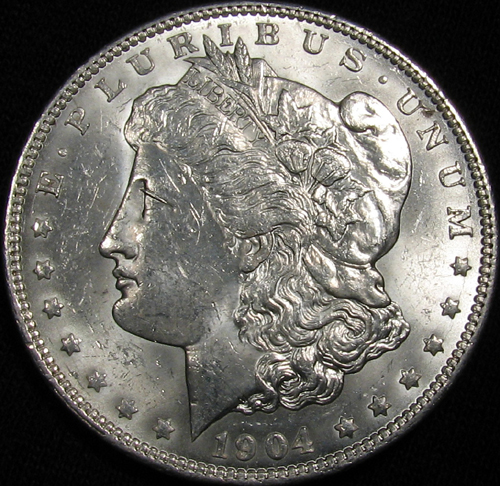
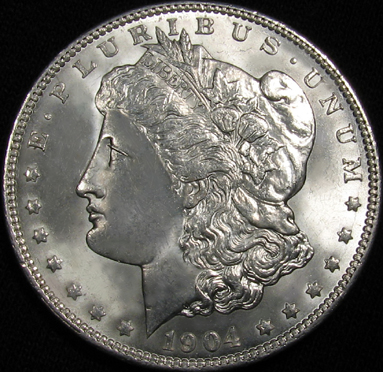
It should be noted that, counterintuitively, the better the photo, the easier the deception. The sharper your focus, the more pixel-clear the divisions between "good" and "bad" areas will be, making the defects easier to mask. My original shot of that coin was 2000 pixels in diameter; I could have easily replaced details pixel-by-pixel and obtained a 1000px (half-size) image of a coin which anyone here would have called MS66. Furthermore, the color will be more consistent throughout, allowing you to transplant coloration more easily. Had I planned on a true deception with the 1904, I would have shot it under one light instead of two, leaving more of the surface in shadow while keeping it sharp enough to convince anyone that it was a "good" shot.
There are two main avenues for the coin investor, saiyo, each with their own unique hazards.
First are the bullion coins, American Eagles, Krugerrands, etc. These bullion-only coins tend to trade at some small premium over their actual metal value, and are less subject to price inflation in that their value is more easily defined. However, this arena has a greater proportion of fly-by-night "dealers" whose inventory is the scam itself - you may send money, but you'll never see the coins. There are dealers who will refuse to fulfill your order if the price of the base metal rises much during the transaction process, as well.
Second are the collectible rarities. You had best be a strong swimmer before you jump into these waters. As I mentioned before, condition plays a very important role in the value of all but a very few extreme rarities - the term we use is "conditional rarity" and can be illustrated by one particular coin: the 1884
Morgan dollar issued by the San Francisco Mint. Circulated versions of these are common in the market. Coins having seen very little circulation, referred to as Almost Uncirculated (forgive me if I belabor the obvious; I'm unaware of your specific level of knowledge), bring a couple hundred dollars each, being rather rare. 1884-S Morgans which have not been in circulation are significant rarities, bringing multiple thousands of Dollars each when they come to market. An MS64 1884-S Morgan is a $100,000 coin.
This illustrates one of the prerequisites for successful rare coin investing: grading ability. The ability to grade accurately is not learned quickly, and each individual series has its' own particular features which must be understood by the grader. The fact that I'm comfortable grading
Morgan dollars in no way qualifies me to grade Lincoln Cents, and I do not attempt to.
On the subject of Lincoln Cents: the 1909-S VDB
Lincoln Cent is a very popular "investment" coin, enjoying great popularity among collectors and bringing a 4-figure price in Uncirculated condition. I believe 484,000 were minted, and a large number of them remain, having been held by the original owners. Below, I present my 1905 Jamaica One Penny, one of fewer than 50,000 ever minted and certainly among the finest remaining extant:

I paid less than $100 for it, from a dealer who knew precisely what it was worth. My point? "Rarity" and "value" are not necessarily congruent. There are more than a few truly rare coins which carry lesser value than more-popular and more-common issues. The hopeful rare coin investor needs to be aware of the true street value of his coins, rather than just seeing a low mintage number and naturally assuming high intrinsic value as a result.
Next, the collector/investor needs to understand the Third-party grader (
TPG) system, the independent companies which authenticate, grade and slab coins. There are, in my opinion, only three companies whose opinions can be consistently trusted: PCGS, NGC and ANACS. A fourth, ICG, is currently in a state of upheval and I'm in "wait and see" mode with them. Of those, PCGS coins tend to bring the highest resale value, the result (in my opinion) of perception rather than any measurable advantage in quality.
A few other grading firms may be considered honest yet somewhat lacking in consistency and believability across the board. This puts the onus of grade evaluation on the perspective buyer, rather defeating the purpose of a
TPG.
In addition to those mentioned above, there are a great number of what we call "basement" or "alphabet" slabbers, people who purchase plastic enclosures and encapsulate coins with grades totally unrelated to their true condition. I do not exaggerate when I say that there are more coins on the market in these slabs than in the reputable ones;
ebay is especially notorious for them. These frauds will encase plainly-circulated coins and call them Gems, and the unwary collector will cheerfully throw their hard-earned money at the seller based on incomplete knowledge of the hazards.
Maybe not daily, but at least weekly, someone here at Coin Community has to break the news to a new collector that they've just been ripped off. It's
that common.
I have more to say, but it's time to give my fingers a rest.









 First Page


 Posted 04/25/2008 07:15 am