| Author |
 Replies: 10 / Views: 2,094 Replies: 10 / Views: 2,094 |
|
|
Valued Member
Australia
110 Posts |
    *** Moved by Staff to a more appropriate forum. *** *** Moved by Staff to a more appropriate forum. ***
|
|
|
|
Pillar of the Community
United States
564 Posts |
Yeah, these guys are pretty common.
|
|
Valued Member
 Australia
110 Posts |
|
|
Bedrock of the Community
Australia
21789 Posts |
Coins look quite genuine to me but the C of A doesn't mean much.
A recognized slab would have more standing, or an assessment by a leading auction house, such as Heritage.
|
|
Pillar of the Community
United States
6130 Posts |
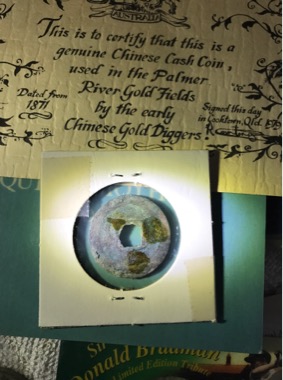
Looks like it has glue on the back. You might want to take it out of the holder and soak in acetone to remove the glue residue.
|
|
Pillar of the Community
 United States
2843 Posts |
Anyone with a printer and a computer can create a COA. A COA is only worth the company that issued it.
|
|
Moderator
 Australia
16985 Posts |
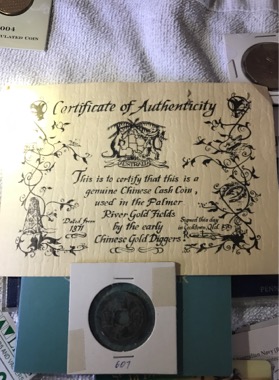
The certificate claims this coin comes from the Palmer River goldfields in north Queensland, just inland from Cooktown; it was presumably sold in a tourist trap in Cooktown or Cairns, since there's no tourist shop at the actual goldfields. I have seen these particular certificates sold by coin dealers before.
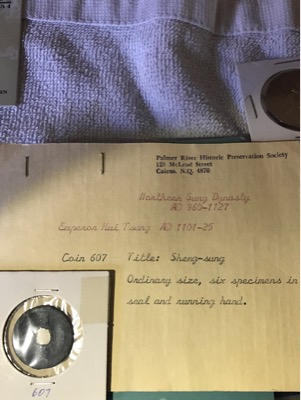
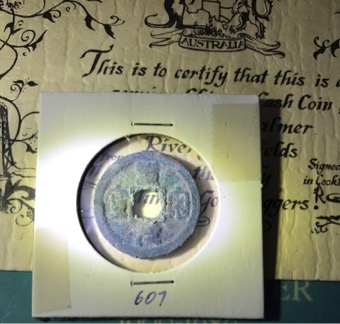
As for the coin itself: despite its age, it is quite common, and almost certainly genuine, although whether it actually was found on the goldfields site or not is impossible to prove; one would tend to assume that a local historical society wouldn't lie about such things. But you can purchase coins just like it, fully identified but without the certificate, for less than $10.
Don't say "infinitely" when you mean "very"; otherwise, you'll have no word left when you want to talk about something really infinite. - C. S. Lewis
|
|
Moderator
United States
34542 Posts |
I see nothing about the coin that makes me think it is fake, although the pictures are not big enough to let me look too closely. If it is a cast cash of the Northern Song Dynasty, then I agree that some of these are readily available. However, I do question why a Chinese miner pressed into service no earlier than 1872 (when gold was discovered in the Palmer River) would have carried with him a coin minted between 1101 and 1125 AD.  "If you climb a good tree, you get a push."
-----Ghanaian proverb
"The danger we all now face is distinguishing between what is authentic and what is performed."
-----King Adz
|
|
Rest in Peace
10197 Posts |
Oh Spence, you spoil all the fun!  |
|
Valued Member
Australia
110 Posts |
Thankyou everyone you are a great help,
My mother lives in Cooktown so the next time I'm up there I will look into it a bit better.
|
|
Pillar of the Community
Russian Federation
5186 Posts |
Quote:However, I do question why a Chinese miner pressed into service no earlier than 1872 (when gold was discovered in the Palmer River) would have carried with him a coin minted between 1101 and 1125 AD. Yeah... chronologically speaking, it's the equivalent of an English convict carrying a long cross penny. That said, the style of Chinese coinage didn't change that much since 1125 AD, so it's perfectly possible that some Song cash (hoard finds?) were still circulating back then, being mistaken for Qing cash. Similar stories are, in fact, known in Europe (stuff like Roman coins with 17th century Spanish counterstamps). It does seem extremely unlikely, however (as in, such coins would be a very small minority, and it's terribly unlikely that one of them would be found on the fields). Then again, nowadays, if a Northern Song coin was actually found in Australia, it would probably be a newspaper item and invite discussions of Chinese colonization of Australia. I doubt they would just calmly CoA it just as if it came from the 19th century. |
| |
Replies: 10 / Views: 2,094 |
|






 Posted 07/26/2017 9:33 pm





