India, Gandhara
AR Shatamana bent bar
"Long Medium" type 38x6mm, 11.49g
c. 600-450 BC
Obv: Two "flower" punches, various banker's marks between
Rev: Blank

To give the full 3D effect:
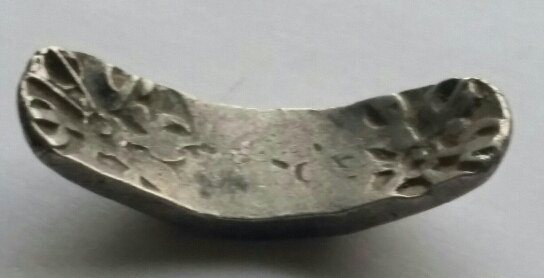

This is one of the most important coins of my Indian collection, because this is the fist Indian coin! Minted in what now stretches from Afghanistan, through Pakistan, and into NW India, their appearance either coincides or even predates the invasion of the Achaemenid empire under Cyrus the Great.
Their fabric and manufacture is certainly unique to ancient numismatics, but speaking strictly in terms of weight standards, the Shatamana was equal to two Persian Sigloi. Experts are deeply divided over interpretations of this fact--some dismiss it as pure coincidence, while others maintain that the sigloi reached Gandhara ahead of the Persian armies, or even that the coins were never minted before Persian occupation. Regardless, Gandhara was a satrapy of the Achaemenid empire until Alexander's campaigns in 327 BC. They might have been made for a short time after he pulled his troops back, but their manufacture ceased when the region came under Maurya control.
In terms of dating, the general consensus is that the long thin bars were the first to be produced (5mm wide), followed by these medium types. Over time the bars became shorter and fatter, and the quality of the silver dropped significantly.
The Gandhara currency system was comprised of:
1. Shatamana bars (less common)
2. Round 1/2 shatamana (rare)
3. Round 1/4 shatamana (scarce)
4. Round 1/8 Shatamana (common)
5. Round 1/16 shatamana (scarce)
6. Round 1/32 shatamana (rare)
Some nice reading on the type:
http://www.ancientcoins.ca/gandhara/gandhara.htm







 Posted 08/16/2017 11:01 am


 . albert


