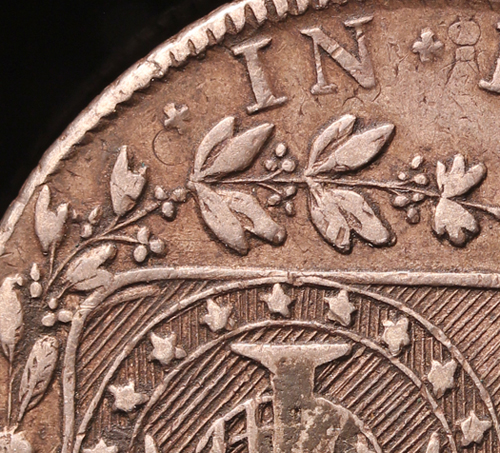
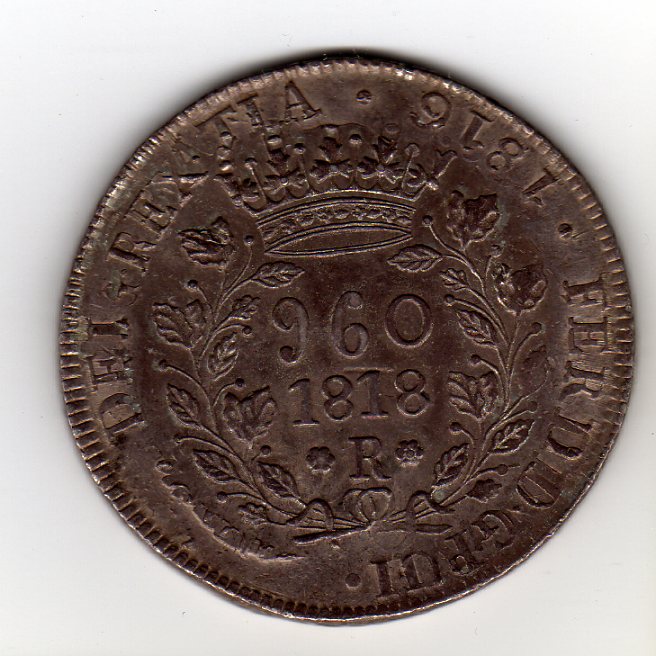
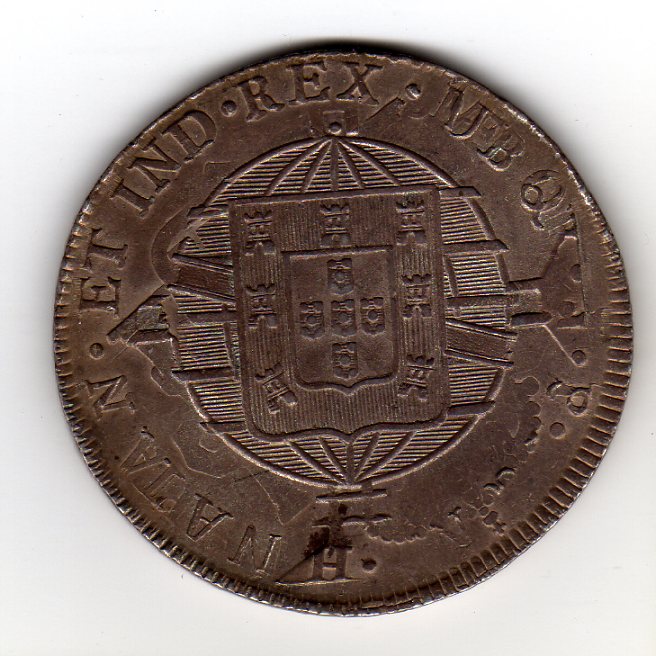
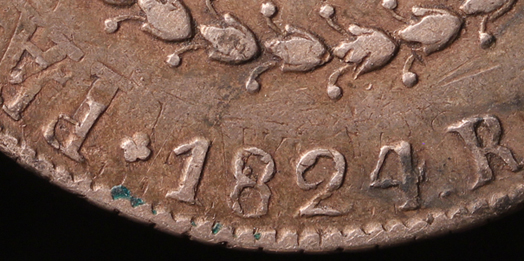
I would concur with the date being 1818.
As to the host coin - what we can see clearly identifies the coin as a Colonial issue not a Spanish mainland coin because the host uses the pillars of Hercules motif. So that eliminates all the Spanish mints.
Because the date is 1818 you can also eliminate Chile (So) from consideration since no colonial 8Rs were made that year at Santiago. It had already started making Republican 8Rs.
Using the same method you can also eliminate the Columbian mint (P) and the Guanajuato, Mexico mint (Go) because no 8Rs were issued in 1818 at those mints.
In fact because the 8 is so clear on the undertype it will allow you to narrow your search for the name of the mint where the host coin was produced.
The 8 has an opening at the upper left which is terminated in a point that curves inward to the right. The 8 also has sides of differing thicknesses. The right side of the bottom loop is significantly thicker than the left side at the same point.
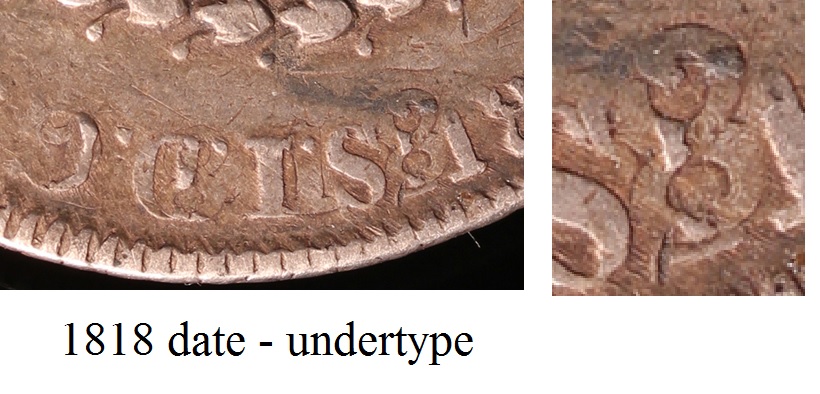
So start by reviewing what the number 8 punch looked like at each of the remaining colonial mints. Those left include Mexico City (Mo), Chihuahua (C or Ca), Durango (D), Guadalajara (Ga), Zacatecas (Zs), Potosi (Pts), Lima (LME) and Guatemala (NG).
By checking multiple samples of each mint in the Heritage Auction Archive some are readily eliminated. I could not locate enough 1818 8Rs from Chihuahua to be positive - however, it seems that the Chihuahua issues all had crude mint marks.
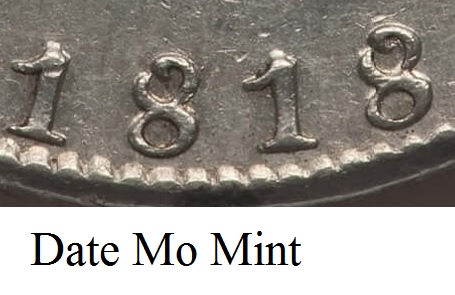
The Mexico City Mint: The date below clearly is the correct type. Spacing is good and the 8s match.
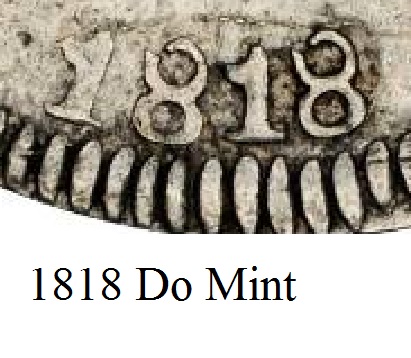
Durango mint: The date below is not a match. The date on the Durango coins is close set and the 8 has no inward curved point. The opposite side of the opening is squared off not pointed and the 1 uses a different font with a very thick serif.
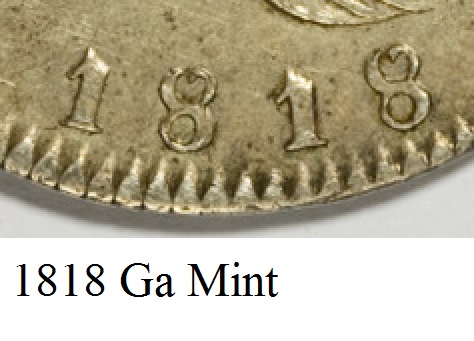
Guadalajara Mint: The date below is not a match. The 8 is a pincer 8 with the opening near top center and it lacks the correct inward curved terminus. The opposite side of the opening is pointed but terminates higher almost over the top of the loop. The top loop of the 8 is larger than the lower loop creating an out of balance numeral. In addition the 1 is a different shape.
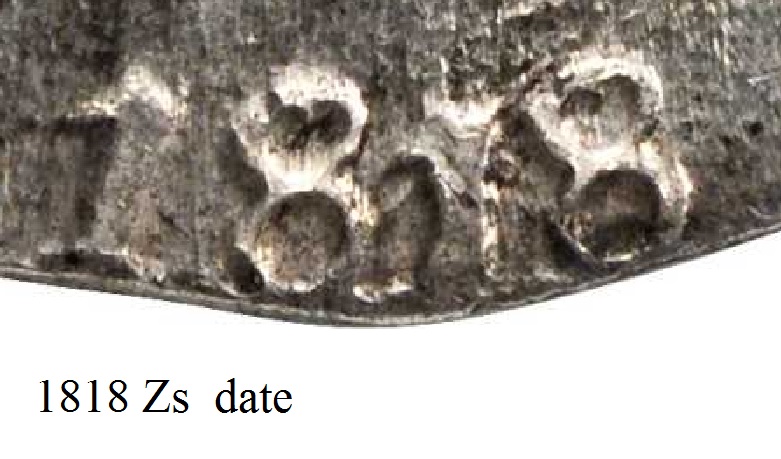
Zacatecas mint: The date here is typical of the crude style used - the date is also spaced very closely, so there is no match.
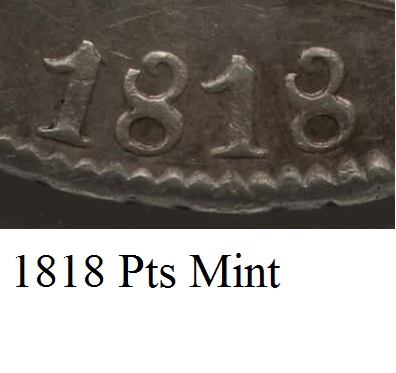
Potosi, Bolivia mint: This date is a close enough match to seriously consider. The open loop terminates in an inward curve that ends in a point - however, the other side of the opening is squared off NOT pointed so there is no match.
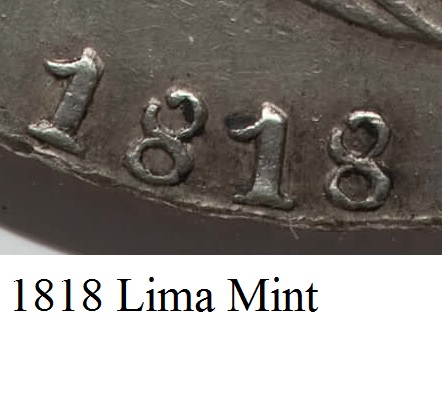
Lima, Peru mint: Here the 8s do not match - the lower terminal of the opening in the 8s is squared off not pointed.
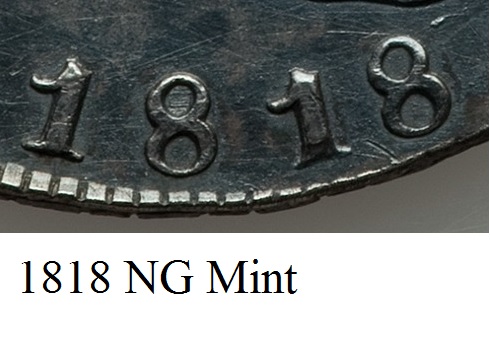
The Guatemala mint: Here there is again no match because the 8s are solid in the upper loop.
Based on the foregoing - I believe the host to be a Mexico City 1818 which would have the assayer initials JJ.












 Posted 08/20/2017 9:55 pm