|
This page may contain links that result in small commissions to keep this free site up and running.

Welcome Guest! Registering and/or logging in will remove the anchor (bottom) ads. It's Free!
To participate in the forum you must log in or register. | Author |
 Replies: 11 / Views: 1,377 Replies: 11 / Views: 1,377 |
|
|
CCF Advertiser
 United States
1318 Posts |
People often think Romans were pagans but honestly if you go to youtube and listen to Marcus Aurelius's book Meditations you feel like you are listening to a Catholic Theologian quite often. So what did we lose when we lost the Romans way of thinking about Gods? In my opinion a lot as just like Eskimos have a lot of words for describing snow, Romans talked about so many things in terms of their spirit, rivers bridges etc. But they certainly did not believe in these River Gods etc in my opinion. Case in point the coin below of Pergamum. If you take over a people who are very primitive they probably expect you to have a God. So the coin has Senate and Roma and they probably figure these are the new Gods that came with the new people. But the aristocracy of the town you are taking over are much more worldly and learned probably. No problem the coin also conveniently tells them Rome is the Power but the Senate in Rome makes the laws and holds a special place. Talk about a neat dual purpose for Gods. Again, I doubt any Roman ever prayed to a God named Senate. And if you listen to Marcus Aurelius he pretty much sounds like a monotheist who just happens to use the word Gods and God sort of interchangeably. Just a theory about this coin below of course. 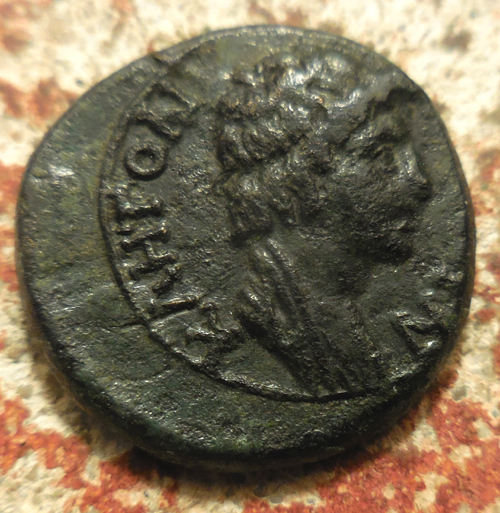 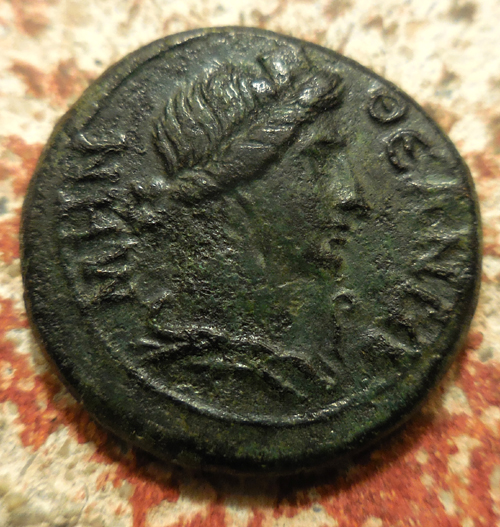 Edited by louisvillekyshop
09/10/2017 04:28 am
|
|
|
|
Moderator
United States
34549 Posts |
@LCS, sorry but for those of us who are more casual collectors of Roman coins, could you please explain what this coin has to do with the text of your post? Are you saying that this god (Pergamon?) is portrayed in much the same way as the emperor (Marcus Aurelius?) on the other side? I think that I am missing your point--sorry about that.
"If you climb a good tree, you get a push."
-----Ghanaian proverb
"The danger we all now face is distinguishing between what is authentic and what is performed."
-----King Adz
|
|
Pillar of the Community
United Kingdom
2624 Posts |
The city goddess for Pergamon was the Great Mother.
I think where ever the Romans went they accepted the local culture and adopted the deities into their own.
Hence many of the dieties are rrlated to places and were retained to make the Roman presence more pallettable... I guess back in Rome these would have been half heartedly accepted and were more a form of appeasement.
Correct me if this impression is incorrect but thats what I always thoughg.
|
|
CCF Advertiser
 United States
1318 Posts |
Here is the ID for the coin: So I only traditionally see the Gods Senate and Roma.
MYSIA, Pergamum. Pseudo-autonomous issue. temp. Trajan or
Hadrian(?), AD 98-138. Draped bust of Senate right
/ Draped bust of Roma right; crescent before. SNG France -; BMC 212-13
And I am not saying the God is portrayed as Marcus Aurelius. The Gods and Goddesses take on the role of Branding and are used to depict a thought. So no one is preying to Senate. It is the brand for the Senate in Rome. But if a primitive people needed a transition as they got more sophisticated sure they can start as they get used to Rome thinking this is a God or Goddess from Rome. Like the God Bonus Eventus or Ceres even. The Government was telling you something. Here comes the free grain we gave you that. And unlike our sportstars who we use for branding these Gods never wore out.
I am saying the Gods were used as a part of the language. Most were not for preying to at all. The only reason I mentioned Aurelius is if you listen to his book like as you drive to work over a series of days until it is over you get the feeling the man is actually Catholic most of the time. So I am saying these people were really not Pagan at all. Did not believe in a whole host of Gods and Goddesses. They often speak as one God is all there is that matters. And remember when Rome ran off to Turkey or Constantinople as they could not defend the Rome anymore the Senators families just called themselves Cardinals. Listen to Aurelius and if you are versed in Catholic thinking you kind of get the point the Roman Catholic Church is not just about being in the city of Rome. It really never went under. Now the people did switch many of the lesser Gods jobs to saints etc but you are really not preying to a patron Saint of travel. You are asking for him to intercede with God at best. It was a hard transition to one God and notice the Saints fell away as Protestants came about.
Edited by louisvillekyshop
09/10/2017 07:41 am
|
|
CCF Advertiser
United States
1318 Posts |
David;
I am not saying there were not religious cultures. I am talking about Rome and how they used the Gods in language more then preyed to them. Go to Syria and see Tyche. Not that was a Goddess people were totally enthralled with and could not live without. Check out the Eastern Orthodox church, the Virgin Mary took on all the look of Tyche. The people always needed her there. They always preyed to her. It took Islam to finally put an end to Christianity in most of the the region with the much much stricter rules on what you can keep from old religions. Like to see the church make it there but lately they are on thin ground sadly.
|
|
Pillar of the Community
United States
6130 Posts |
I think the modern Western culture shares a lot more in common with the Romans than we like to think. I think it is very important to differentiate between gods/goddesses and personifications. Did Americans worship Liberty until 1947? Do the French worship Marianne?
The Romans worshipped deities like Jupiter and Vesta beyond a doubt. There were a LOT of "mystery cults" that intensely focused on either minor gods, or foreign ones. For the most part, I don't think many if any prayed to Liberalitas or Annona, but it's impossible to make general assumptions. Do Christians believe the dogwood tree is so small today because it was the tree of the True Cross? Mostly no, but some do.
|
|
Pillar of the Community
Belgium
1194 Posts |
as Finn said , the heritage of the Western culture from the Ancients is enormous, even in our dayly live : day of 24 houres , one houre=60 minutes etc , even the representtation of Britannia on British coins goes back to a Roman denarius just as the statue of Liberty is inspired by the Ancients . We have also to differentiate between gods and personifications . Every town and river and mountain had his personification , but was not treatd as a godd/goddess.So important organisms had a personification : the Senate with your draped bust , even gods had personificationssymbols : Zeus/Jupiter an eagle , Athene an owl...
The policy of Romans was tp assimilate as much as possible the local gods and institutions in their system . For the gods ,it was easy , Jupiter=Zeus=Baal=Amon ...For the politics , there was a difference between the East and the West : in the West , the Romans implanted immediately their system , because there was no system , only different tribes . In the East ,things were different , there was a vere developped political sense they respected , so we find there the pseudo-autonomous cities and kingdoms .
For the religious idea , I think we have a wrong idea , due to our catholic education and society .In our idea , we have one God and the Antiquity lots of gods/goddesses , but we forgot that the Christian God is in fact three persons and in the Catholicism , the other gods are replaced by the Saints , the Virgin Mary existed also in another form .So there is ,for me , on difference between Catholicism and paganism . In ancient Egypt , in the 15th century BC , Echnaton had his only God : Aton , the same idea existed in Ancien Greece . With the Hellenism of Alexander the Great , there has been a kind of mundialisation in the Eastern world , just as now .Once this mundialisation was accepted , the Roman Empire was created and brought this mentality to Rome and the West . The emperor Claudius imposed Gallians as senator in Rome .
Just as there was a political unification , there was also an idealogical unification ,in Rome , there lived no more only Roman or Latin people , but people from over all the world : Asia , Greece , Egypt , Spain , Gallia .All this people had their own gods and customs , so ,inevitably, you had a melange .
In the second century , there is a succession , let s say , by heritage . So the new emperor was no 'barbarian designed by the army , but a man with origin and education , what was the case of Aurelius , the emperor-philosoher, who , I think , represents the mentality of his time and who had the possibility to express his opinion for the whole world ( litterally) .Aurelius is the successor of Hadrian , who had the same mentality. albert
|
|
Pillar of the Community
United States
7067 Posts |
Some interesting food for thought in this thread. Thanks for getting it started, Joe. I know relatively little of Roman history (although I learn more all the time by reading threads here at this corner of CCF), but I am always interested in the cross-currents in religious and artistic motifs. If the Romans adapted to local traditions, certainly many societies have historically adapted to the Romans. Case in point: the first American god, George Washington, in all his Greco-Roman glory, as depicted by Horatio Greenough in 1840: 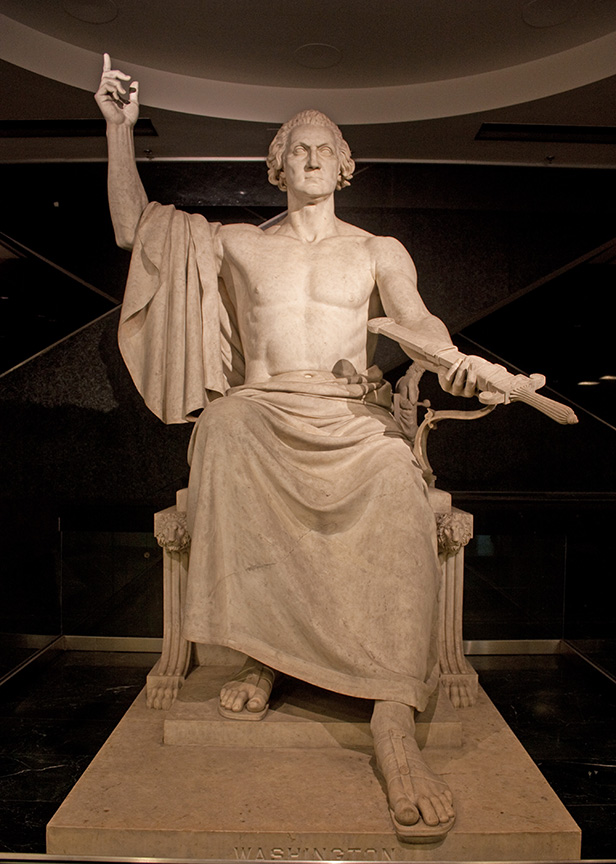 The historical examples of the transformations of gods as belief systems are spread geographically or through time are interesting. A good example is the male Indian god/bodhisattva Avalokitesvara. By the time Buddhism spread eastward, being assimilated into various cultures and worldviews along the way, he had been transformed to the female Kuan Yin in China. And, of course, the image of the Buddha himself (who, I believe, in an earlier incarnation was produced of a virgin birth - as told in the Jatakas hundreds of years before Jesus), transformed over time and locations as well, developing almond shaped eyes as the religion/philosophy spread eastward. (Perhaps akin to the rendition of Jesus as a tall, sandy-blond European fellow?) I also find the architectural adaptation and transformation of the secular Roman basilica into the Christian basilica, a process begun in the fourth century, quite interesting. Edited by Kamnaskires
09/10/2017 11:52 am
|
|
Pillar of the Community
United States
616 Posts |
One thing I might add: The Romans were incredibly superstitious by our standards, and viewed the gods as behind anything negative.
So if the Tiber flooded or Hannibal beat their armies, they had lost favor of the gods and needed to make them happy again through rituals, particularly animal sacrifices.
They believed that the gods made their will known through omens, which is why augury played so much of a role in the maintenance of their daily lives.
For example, generals would refuse to go to battle unless the auspices were favorable, and losses and reversals were often blamed on a leader's ignoring the omens instead of bad generalship.
|
|
Pillar of the Community
Canada
5290 Posts |
It is fascinating to compare the statue of Washington with those of Roman and Greek gods. @Bob L has a good point. I never thought of it quite that way.
|
|
CCF Advertiser
United States
1318 Posts |
jskirwin;
When you say the Romans were superstitious and viewed gods as behind negative things so they sacrificed animals to appease gods.
Well hate to suggest it but the Roman leaders, I don't think they thought the animal sacrifices would help. Many cultures did and probably very seriously did from the top down, but Rome might have just been again manipulating the masses with such sacrifices.
For example, Jews were very very well integrated in Germany. No one could imagine of all places Jews would meet such a fate 30 years before. But the government took a ton of science from the Americans of our sociologist master race stuff and ran with it with Eugenics to deal with the war loss. The German people turned out to be extremely superstitious and telling them the Jews were carrying all the diseases allowed the people to justify getting rid of all the Jews.
If Rome was running Germany after World War One and looked at their superstitious people and gave them animal sacrifices to some gods that were angry with Germany I think you could argue that would have been preferably to today's way of appeasing superstitious people with human scapegoats.
And that is not just ancient history. Putin sacrificed the gays legally for a while recently, the head of the Philipines sacrifices the drug users. At least after 911 and the modern wars we only sacrificed French Fries for a while but we still were playing on the need of a superstitious public to have a scapegoat.
So hate to say it but I question if the Romans believed half of what they were doing when they sacrificed animals for bad events and just had that as an established tool to let the lower public have a release valve for frustration.
|
|
Pillar of the Community
United States
7067 Posts |
Quote:
...fascinating to compare the statue of Washington with those of Roman and Greek gods Yeah, and of course that's just one example of the borrowing of visual motifs and ideology. Compare our houses of veneration for our "gods," the Roman Pantheon at left and the Jefferson Memorial: 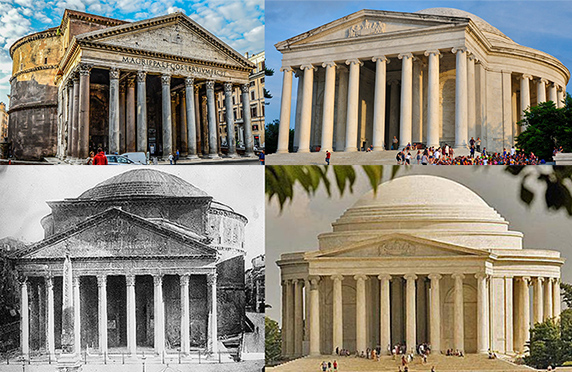 |
| |
Replies: 11 / Views: 1,377 |
|
To participate in the forum you must log in or register.
Disclaimer: While a tremendous amount of effort goes into ensuring the accuracy of the information contained in this site, Coin Community assumes no liability for errors. Copyright 2005 - 2026 Coin Community Family- all rights reserved worldwide. Use of any images or content on this website without prior written permission of Coin Community or the original lender is strictly prohibited.
Contact Us | Advertise Here | Privacy Policy / Terms of Use
|
| Coin Community Forum |
© 2005 - 2026 Coin Community Forums |
| It took 0.58 seconds to rattle this change. |
 |
|
| |
| |






 Posted 09/10/2017 07:03 am


