| Author |
 Replies: 14 / Views: 3,263 Replies: 14 / Views: 3,263 |
|
|
Pillar of the Community
United States
6431 Posts |
Here's a coin my wife bought for me when she visited Argentina in 2004 (yes, she's a sweetheart!). Any opinions on grade, originality, and/or value? Thanks! 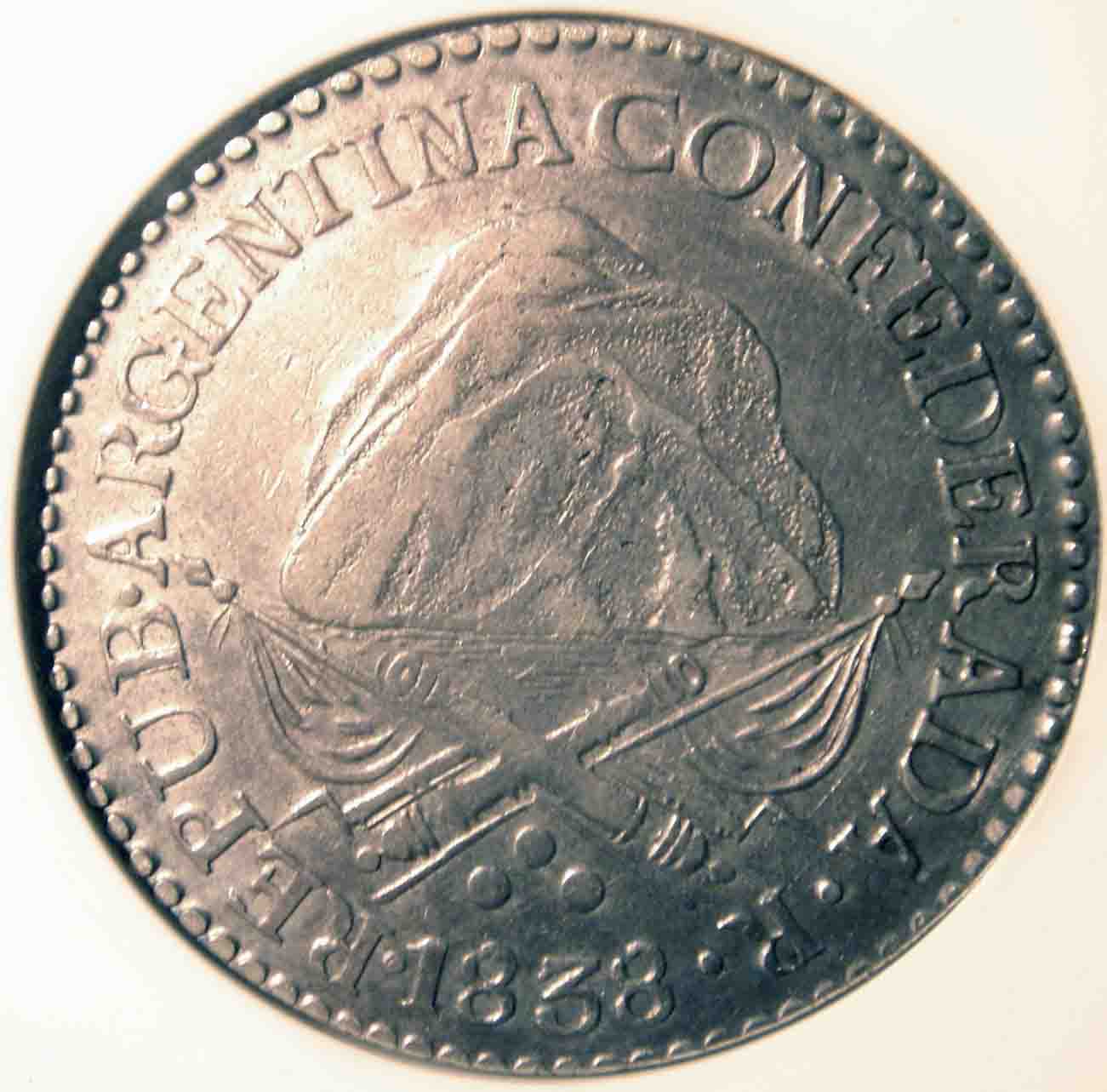 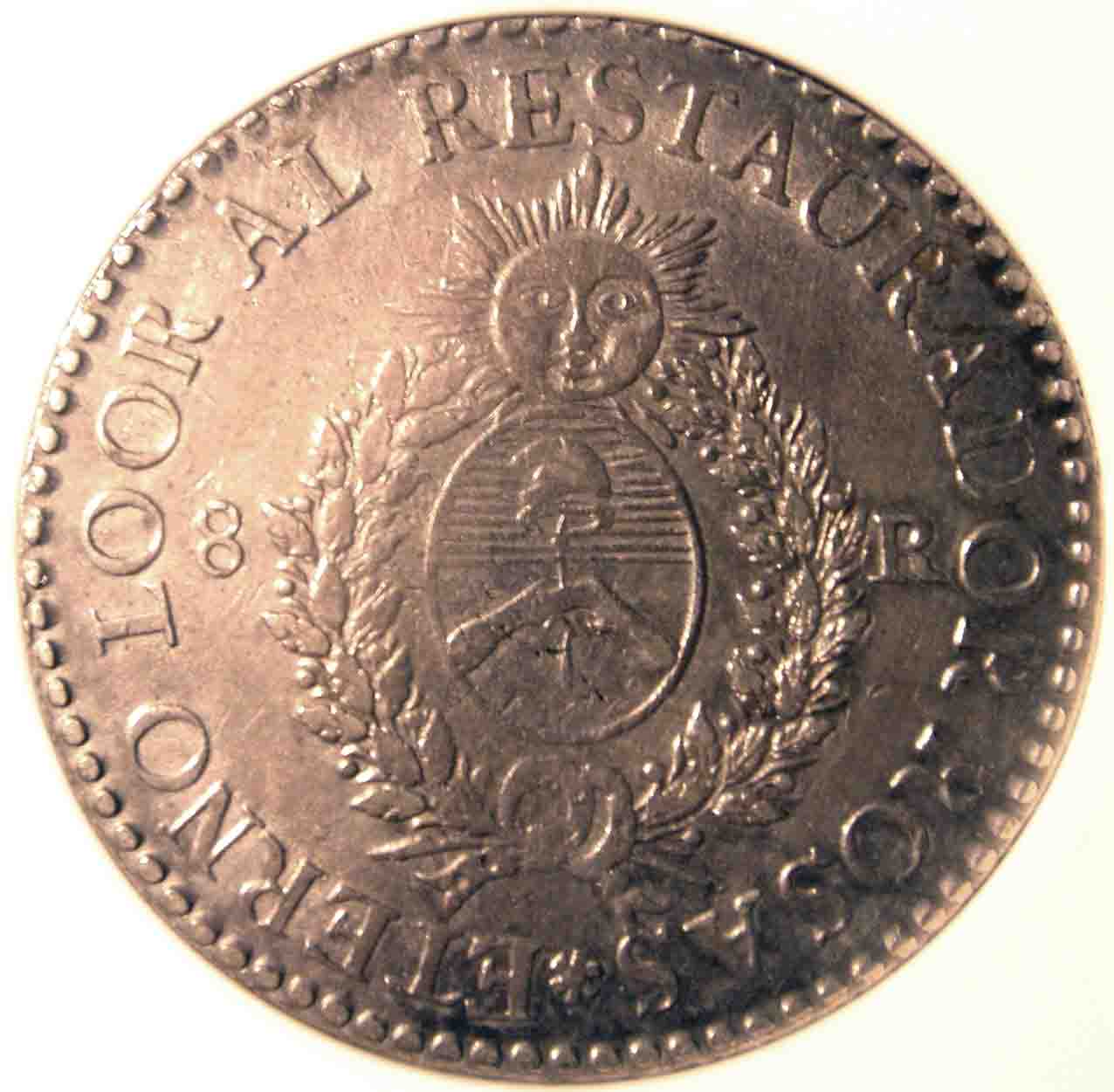 |
|
|
|
Pillar of the Community
United States
3499 Posts |
I am certainly not an expert on this type of coin, but it appears to be from the province of La Rioja. I would grade it around VF-EF, though it is quite hard to determine value based on the fact that it appears to have been cleaned. My 4th edition of Krause says that it is $175US in VF and $350US in EF (when not cleaned). As for authenticity...Sap or one of the other Pillars of the community may have an answer for you.
|
|
Moderator
 United States
23731 Posts |
Interesting looking coin, but I have my doubts about it being real. It looks cast and there is what looks like uneven wear on the reverse. Swamperbob is the person to ask about these type of coins.
|
|
Pillar of the Community
United States
5362 Posts |
Jaobler - The issue of grading is not as critical as authenticity. In the specialty of Counterfeit Detection, the design of a coin is often not as important as how a coin was made. The manufacturing process often leaves behind clues that can tell you a lot if you just look. I am not an expert in this series but I do have some comments to offer on how the coin was produced and that combined with how it should have been made - may result in a conclusive decision on authenticity. These comments are made only on what I can see in the enlargement. It appears that the coin may have been in a holder of some sort (see the shadow lines on the obverse) which cause some problems when viewing the edge. Here is a small portion of the 1838 near the date. Image Insert: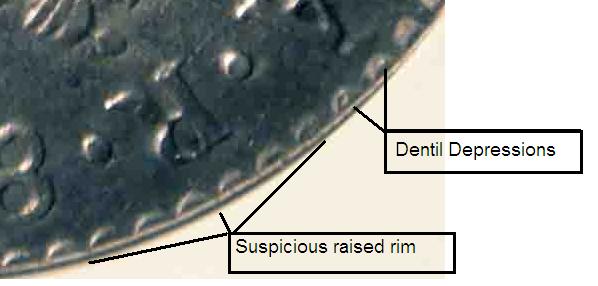 I have marked the two areas that really concern me. The first concern I have are the two depressions I see in adjacent oval beads that form a boarder around the coin. This sort of depression is often seen on transfer copies struck from dies that were made using a casting process. These dimples should be closely examined with a high power binocular microscope to determine if they are post strike damage. Simply stated these depressions HAVE to be post strike damage. There is essentially no other mechanism that would produce them. For a die to make these depressions requires a RAISED spot on the die. How would it get there? If they are a part of the die itself (a feature with uninterrupted flow lines present) - I would support a diagnosis of counterfeit and I would suspect casting was involved in the process someplace. The second concern is far more serious. There appears to be a raised rim on the coin that intersects the oval beads and in fact appears to replace part of several beads. The oval dot feature is an edge design that I routinely associate with two die presses. I am very familiar with the Haitian coins that use a similar design feature. The problem is that in an open press - there is no collar die. The dies are made larger than the planchets. The strike occurs anywhere on the die face - but there is NO POSSIBLE way to produce a wire rim in an open sided press. The die used to make this coin appears to STOP half way through these oval beads. That would happen if an eccentrically struck original coin was used to make the die. That edge segment needs to be examined closely. To me, unfortunately, this would be enough to categorize the coin as a Suspect at the minimum. If the coin was on ebay I would be bidding on it expecting it to be a counterfeit (a Modern Numismatic Forgery). I agree with echizento that the coin "looks" like a casting, but I am not familiar enough with the die making process used in 1838 in Argentina to be sure. It could be a rusted hub. There are odd looking bumps visible in the mountain. There are numerous causes for these lumps that could be real. But given the two concerns above it does not look great. Has the weight of the coin been determined accurately? Specific Gravity? Has any expert in the area of Argentinian coins authenticated this coin?
|
|
Pillar of the Community
 United States
6431 Posts |
Hi Bob, It does appear that there is a raised rim that extends about from the 1 in the date up to about the final A in CONFEDERADA. I can't closely examine the edge since the coin was authenticated and slabbed by ANACS. Based on your comments in another thread about ANACS' sloppy authentication process, maybe their judgment isn't reliable.  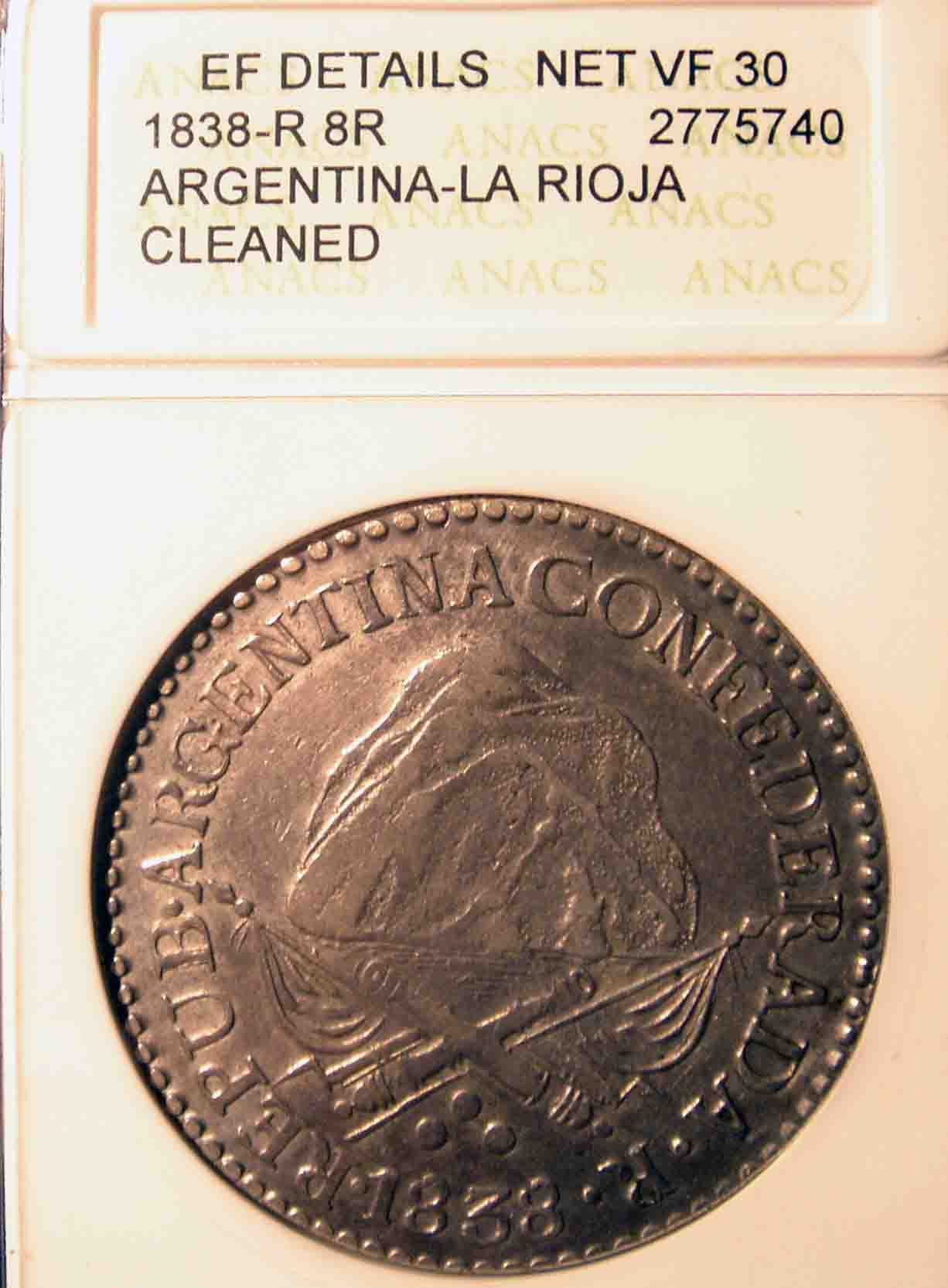 I know the USA implemented the closed collar minting process in 1836 for half dollars. Does anyone know when or if that process was implemented in Argentina? Is it possible these coins were actually minted using a collar? Maybe I should contact ANACS about a re-evaluation of this coin? I had sent it in raw for grading after I received it. Unfortunately I did not record any details about the edge, weight, or density. |
|
Pillar of the Community
United States
5362 Posts |
Jaobler - I wondered if it was encapsulated from the pictures.
Anyway, as I have said before - ANACS has a problem with older foreign coins because they do not look at the edges of the coins when authenticating. I confirmed this with their head grader about a year ago (for the second time). I spoke earlier on a couple occasions with Mike Fahey when he was there and got the same answer. They do not have time to look at the edges. They NEVER do specific gravity tests. I also know for a fact that they make mistakes and encapsulate counterfeits because I have submitted counterfeits to see what happens.
But that being said, you do have an authenticated coin! You have ANACS's guarantee it is real - even if it is a fake.
It could be worse.
But I agree the next step should be a determination of how the Argentina mint made 8Rs in 1838. It seems early for a three die press but you never know. The coin you have was made on a collared press.
|
|
Bedrock of the Community
United States
14454 Posts |
very informative post and one I am very glad I sat and made sure I read the whole thing. I wasn't aware of a problem with older coins from ANACS so this is a must read for anyone looking to buy authenticated older coins by them
|
|
Pillar of the Community
United States
5362 Posts |
Jaobler - One other comment here that may not have been expressed clearly enough in my earlier posts. The fact that a raised rim intersects the oval beads is PROOF that only a portion of the beads appeared on the die face used to strike the coin. The question that remains is why the mint would put a "defective" die into service. I call the die defective because the circle of oval beads was incomplete. This feature is actually an anti-theft device designed to make clipping or shaving the edge very noticeable. This would be less important on an open sided press (because of eccentricity) but in a collared press it becomes a quality control issue. Partially missing beads would likely call every similar coin into question for being altered. That circle is an important element of the design and making a die missing part of the circle seems hard to accept if they used a collared press. Perhaps they had poor quality control, but the partial nature of these beads leads me in the inescapable direction of a transfer die made from an eccentrically struck original coin made on a two die press. There is of course the possibility of a die error here. This kind of error can happen in the finishing step for a collared die. When a die is finished for use in a collared press there is a machining step that matches the face diameter of the die to the collar size. Remember that the die head actually expands during hubbing and pressing process (the pressure exerted on the die face by the hub alters its diameter). To insure that the collar will fit around the entire die pair (to create a three sided coining chamber in which the planchet is struck) one of the final steps is to machine the perimeter of the dies to remove just enough metal to allow the die to fit into the collar snugly. Too tight and the machinery jams, too loose and the extruded rims become fins that also jam up the works. In this case, the final machining step could have removed 1/2mm or so too much on one section of the perimeter - basically cutting away half of the ovals. I made a rough sketch of the coining chamber in a three die press. The collar sits around the hammer die essentially level with the top face. The finger feeders (ejectors) place a planchet on the die. The collar die rises and then the hammer die is driven downward. The force of the strike drives metal into all recesses on all sides of the coining chamber producing both obverse and reverse designs as well as the edge design and wire rims (if any) all in a split second. The hammer retracts - the collar returns to its lower position and the feeder fingers (ejectors) remove the struck coin and insert a new planchet. Image Insert: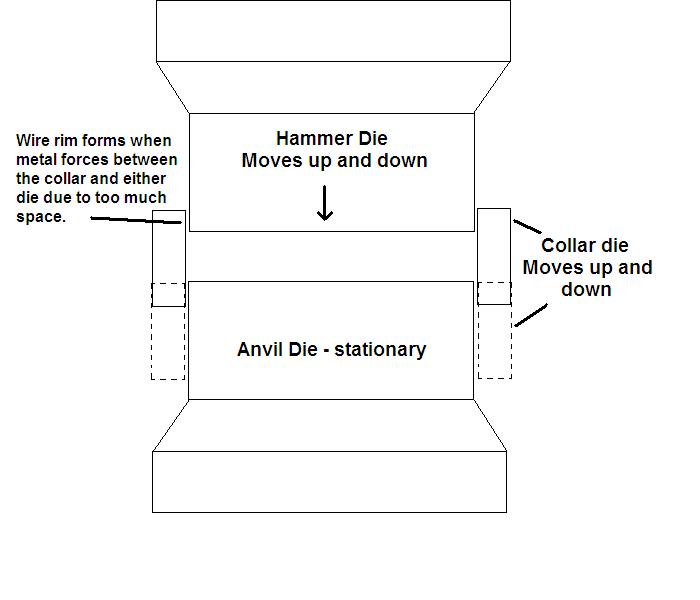 So to get only part of the impression of the oval beads on the coin means that the beads were only partial on the die. The raised rim is created by the gap between the die edge and the collar. If the Argentina mint actually did use a three part press - then every coin made from this particular die pair will have the same missing oval beads. Someone should recognize the die variety. The pictures of originals I have located for the 1838 R 8R all have intact oval bead circles. If the Argentina mint used an open sided press - the coin is counterfeit. I see only the two alternatives. I hope that explains the problem I see here clearly.
|
|
Pillar of the Community
United States
6431 Posts |
Hi Bob, Thanks for all the great info. I found a couple examples of this coin that sold on Heritage. They also seem to have truncated edge beading and at least some evidence of partial wire rims. Here is an example graded MS-62 by NGC: 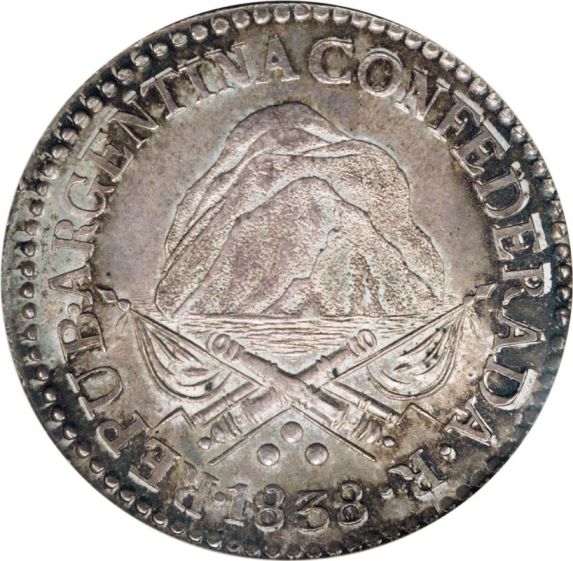 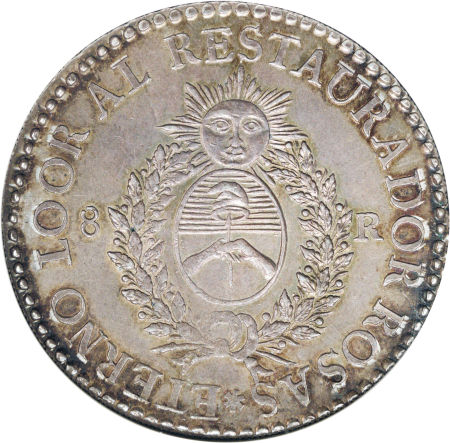 This one is graded AU-50 by PCGS. 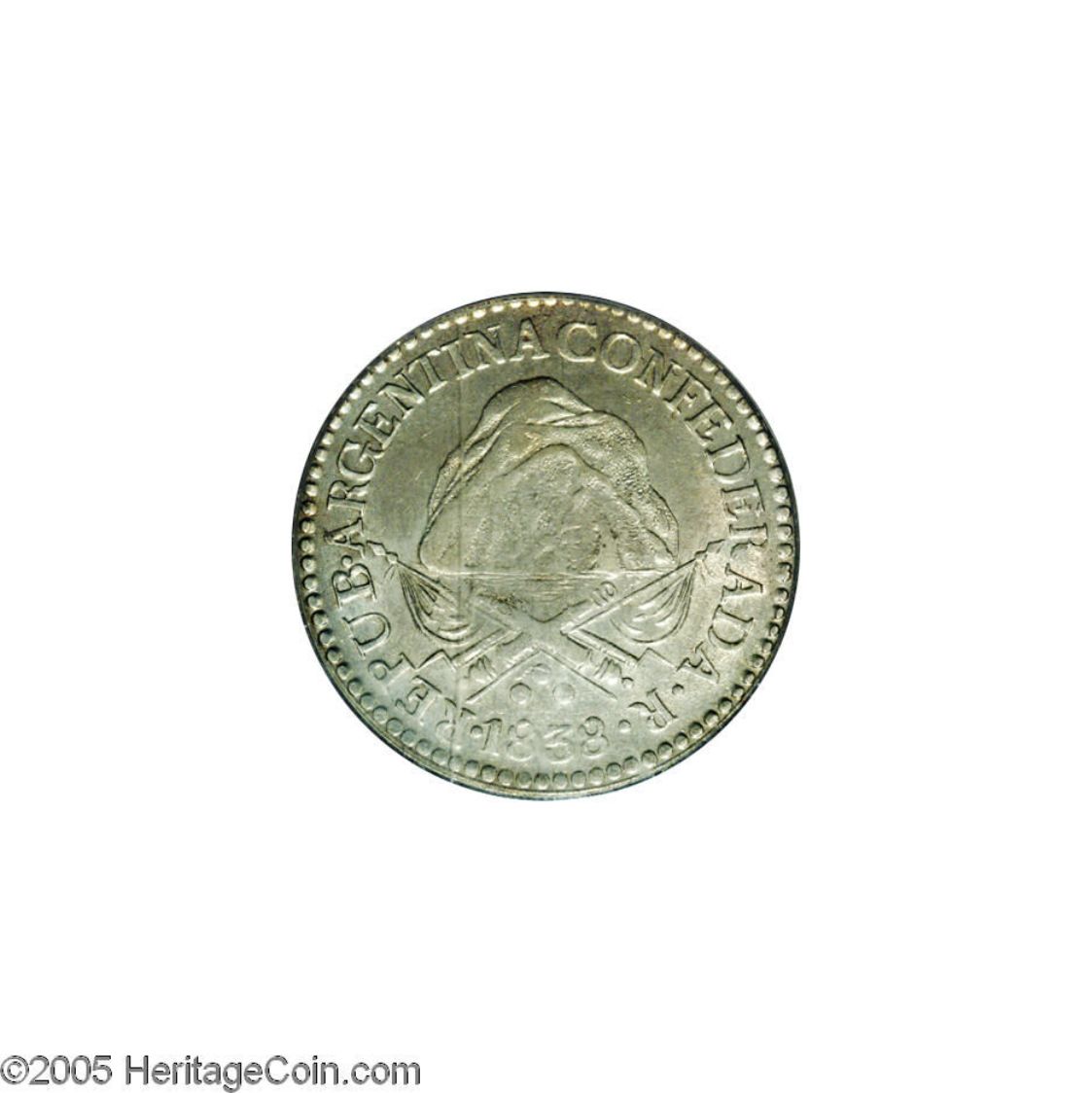 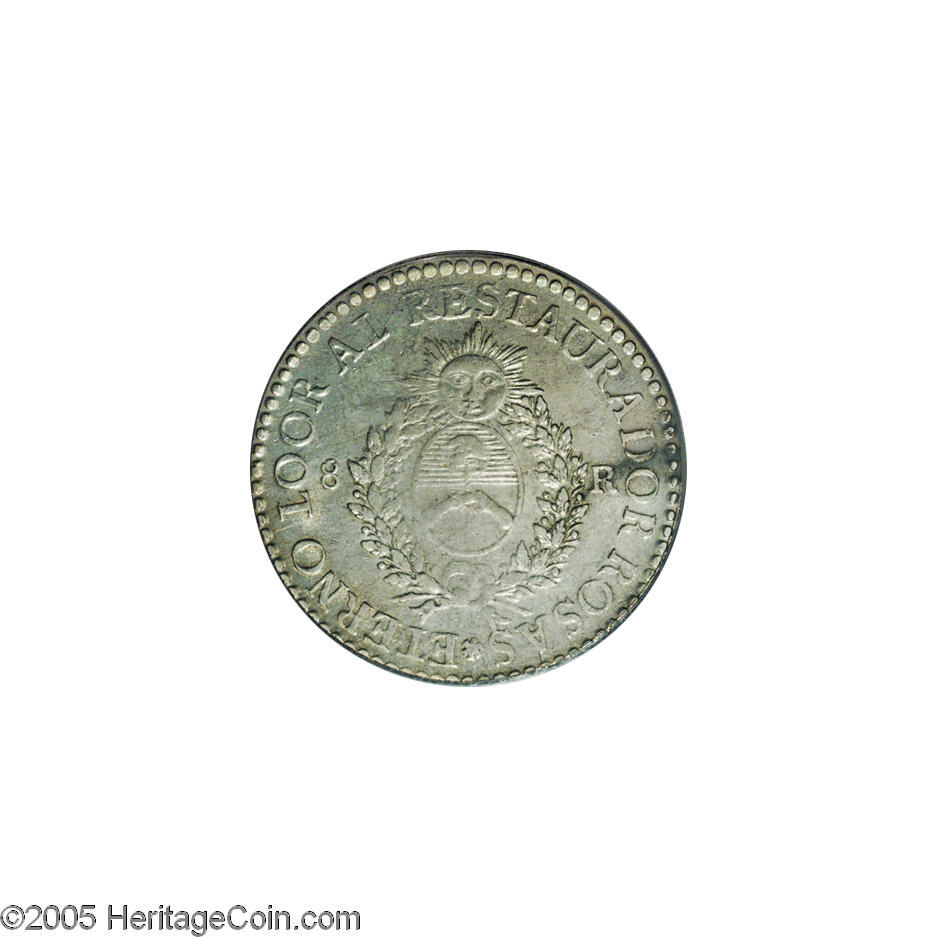 Are there any new conclusions to be drawn from these photos? |
|
Pillar of the Community
United States
5362 Posts |
Jaobler Nice pictures - they do provide some information. They indicate to me that the originals were definitely struck on a press without a collar. They show no trace of what I was referring to as a raised rim. The edge of the struck coin simply cuts across the oval beads and the beads themselves "die off" due to the die recesses not completely filling.
I just want to confirm one fact. On your coin is the edge raised? Is there raised metal rising above the level of the field on the coin and actually crossing the beads? Or does the coin simply end part way through the ovals?
One picture does show a circular raised line just outside the oval beads. That raised line looks like a die setting guide. The die setters often cut a shallow circle into the die face to act as a guide for placement of dentils and beads - that is not the raised rim I was referring to earlier. On most dies, these setting guide marks are polished out in the final die polishing step. But on earlier dies these lines sometimes show.
I just want to make sure we both understand what I was referring to originally.
I tried to sketch a picture to show what I mean but I was not really successful.
|
|
Valued Member
United States
405 Posts |
|
|
Pillar of the Community
United States
5362 Posts |
I came up with a sketch of what I mean. This is a cut section through the edge. Which is closest to your coin? Image Insert: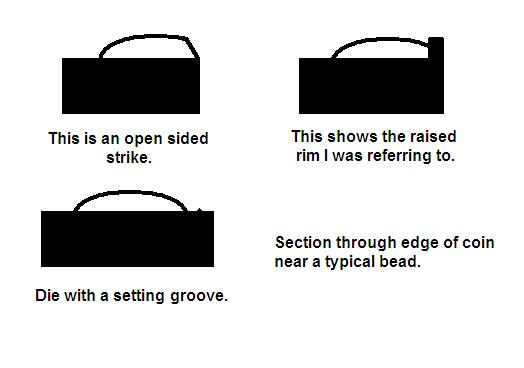 |
|
Pillar of the Community
United States
6431 Posts |
Hi Bob, et al, I've examined the coin edge as best I can inside the slab, using a stereo microscope. I've concluded that there is no "wire rim"; what shows in my photos is basically a mirage caused by lighting and shadow from the holder. The appearance at the edge of the truncated beads most closely matches your "open sided strike" sketch. In those sections where the beads are incomplete the beads do seem to "die off" at the edge, just as you say. Thanks again for the excellent information and the informative diagrams! The section near the date is fairly deeply recessed below the inner edge of the ANACS holder so you can't get a good look at it. Under the scope this area closely resembles the area above "LOOR" in the third close-up shot below: 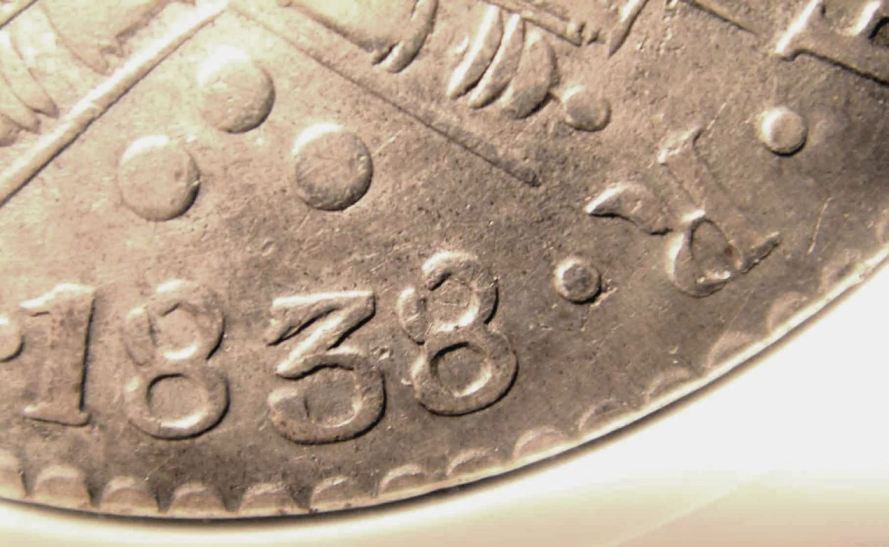 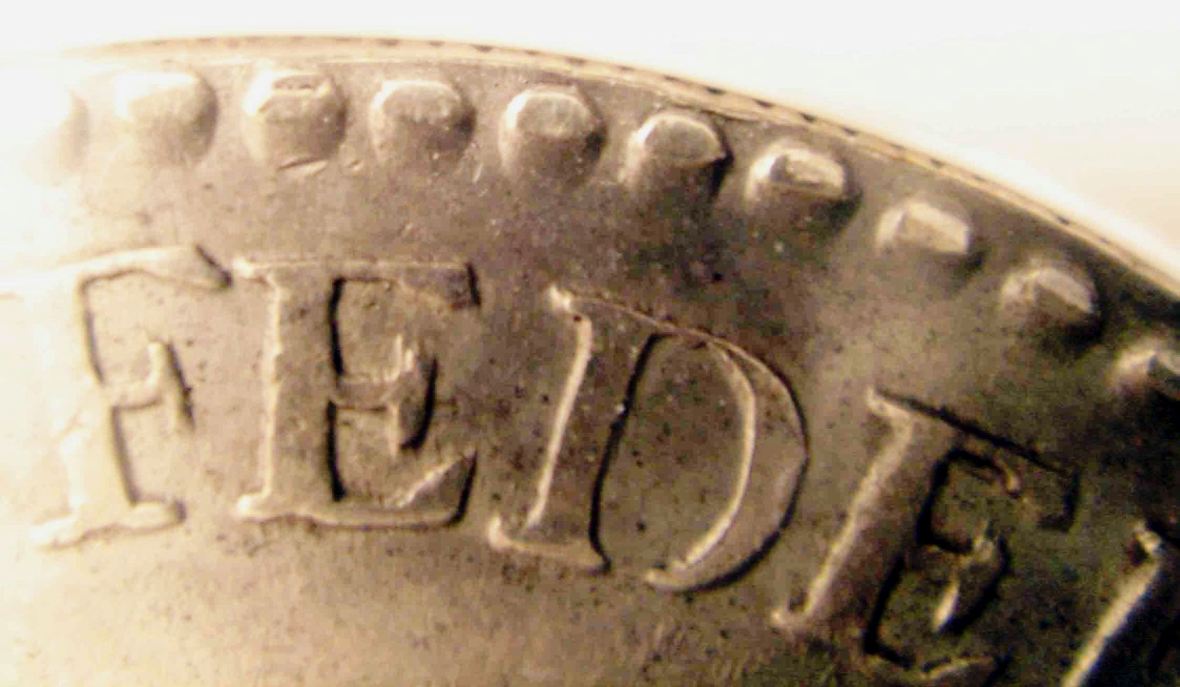 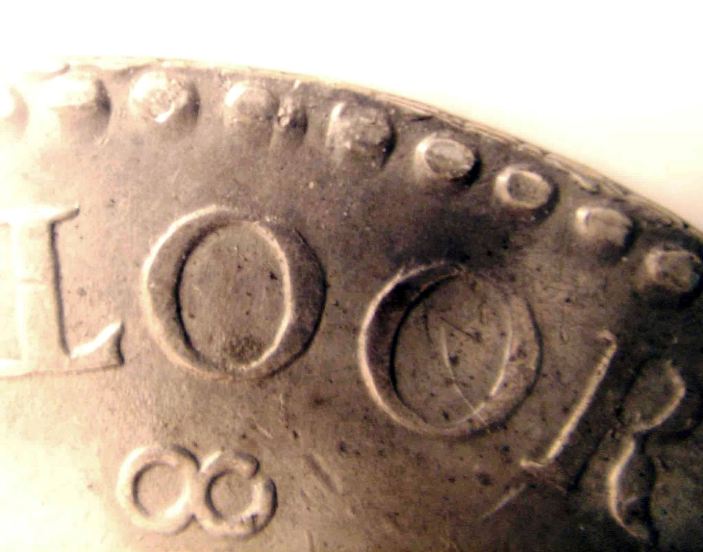 I'm feeling better about authenticity on this coin. Now, if I could only do something about the cleaning! |
|
Pillar of the Community
United States
5362 Posts |
Sounds real to me.
That is one of the serious problems with photos taken through holders.
|
|
Pillar of the Community
United States
5318 Posts |
What an interesting, informative post! And, a good case study on how holders can inhibit proper attribution--particularly for coins where the edge is a key determinate of authenticity. This should be one of our pillar picks.  p.s--I see that someone is asking about authenticity of a Colombia 8R.Edited by KurtS
05/10/2008 4:23 pm
|
| |
Replies: 14 / Views: 3,263 |
|







 Posted 05/05/2008 09:32 am





