I'll attempt to make a strong argument.
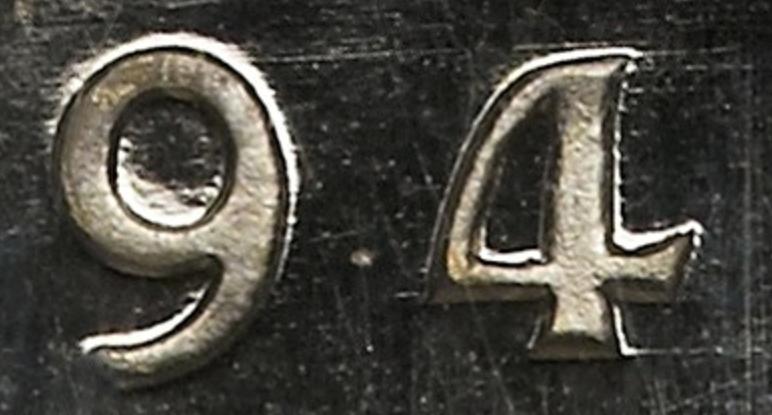
The die marker, notched 4, and apparent doubling under the right crossbar are visible at 10x once you know to look for them. The fact that I first saw these with a microscope at 40x to me is irrelevant. Lumping it in with somebody who thinks they won the lottery because they found some obscure dot with a microscope isn't fair. A pretty large number of "varieties" exist because somebody snooped around with a magnifying glass. Looking around at 40x is no different; it's just a different tool. While the level of magnification might be a threshold for somebody, or the degree of this or that, it's purely arbitrary. Whether it's too small or too minor is subjective. You can tack on "minor" or "micro", but the key issue to me is repeatability.
We document every minuscule nub, die chip and die state for the 1859 large cent. It's relevant because each of these features occur multiple times across many coins. Were they all discovered with the naked eye, at 5x, at 10x? Or are they "obvious" now because someone first saw them with a 40x loupe? I could go on with other examples but you get my point.
The important thing here is also repeatability. There are dozens of examples of this notched 4 on Heritage. There are, as far as I can tell, three different reverse dies used on the 1948. I can pick out whether the notched 4 exists on a coin or not just by looking at the inside of the 9. I have looked at roughly 100 examples, ignoring specimen strikes, and 45 are notched 4, 33 are not, and 21 are not positively identifiable due to image quality. Of those 21, 12 have the vertical die marker, but the image is not good enough to decide. All of the notched 4 have the vertical die marker inside the 9. None of the other two dies have it. Readily identifiable examples range from AU53 to MS65.
As far as "value", I don't see there being any change. Roughly half the coins I've looked at have it. If anything, the dies that don't have it are more rare.
Whether those other two (or more, who knows) dies have a similar or some other thing going on, I can't say since I only have one example in hand. Look and see?
Ultimately it doesn't really matter to me whether this gets documented somewhere, or accepted as a variety or not. Looking at the level of magnification of the pictures for, let's say, the 1951 5/5s in the 2012 Charlton, I'd think a similar sized image would clearly show this repunching for the 1948. But it's up to the experts to decide. Regardless, from now on I'll never _not_ see it or check for it.
These dies do not have the notched 4:
Die #2 has obvious line from 10:00-4:00
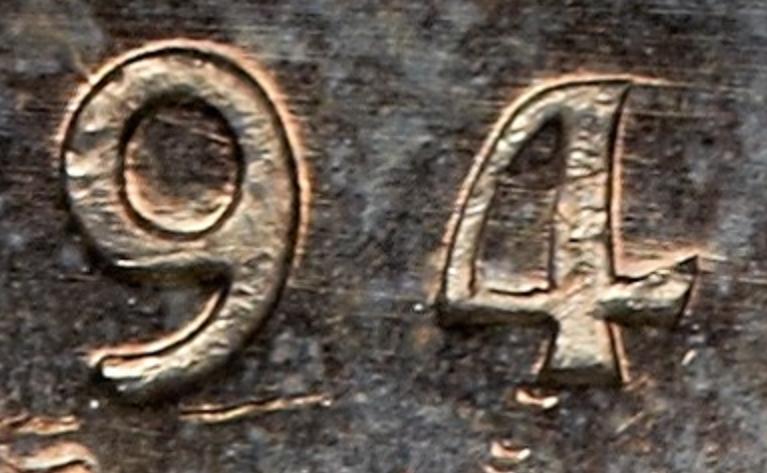
Die #3 has no obvious lines, minor striations NW to SE
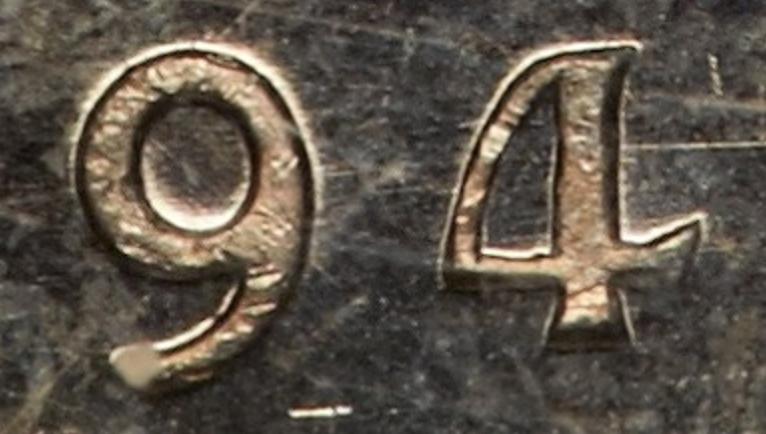
Specimen die for reference







 First Page


 Posted 09/22/2017 3:02 pm