| Author |
 Replies: 25 / Views: 4,273 Replies: 25 / Views: 4,273 |
|
Pillar of the Community
United States
4233 Posts |
As far as I know, these two "varieties" have not been documented. Here are a 4/4 (or possibly, 4/4/4), and a "doubled"/repunched HP, on a 1948 dollar. It raises a question, at least for me, about what constitutes a variety and at what magnification. The repunching (if that's what it is...) of the 4 is barely identifiable at about 10x as a notch in the top of the 4, but is evident once you know what to look for. The die marker inside the 9 (see below) is also a reliable identifier. Do we care? Am I finding a new variety or just identifying a specific reverse die? Certainly other variants of the double/repunched HP are almost as esoteric (see Charlton images for 1938, 1945, 1951), and a lot of the doubled digits throughout Canadian coinage are almost as invisible. I would say the characteristics of this one are the notched 4, and a slightly "fatter" right side of the horizontal part of the 4. The other 1 9 8 digits on my coin do not show anything unusual. 40x, photo through eyepiece, sorry about the obnoxious pointer. 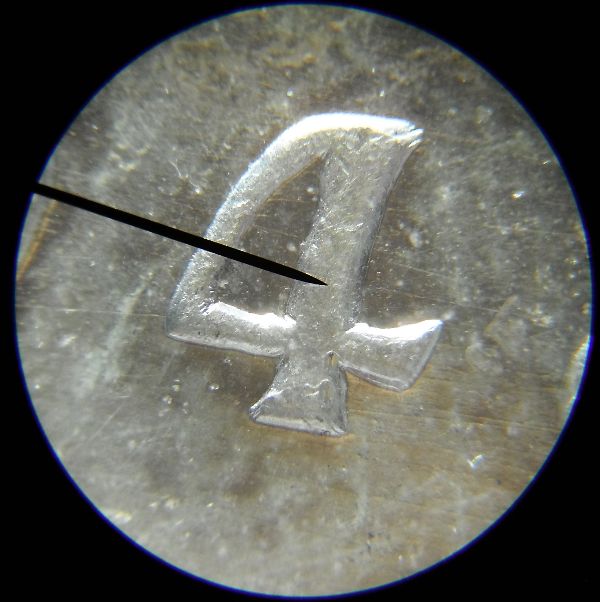 Highlighted 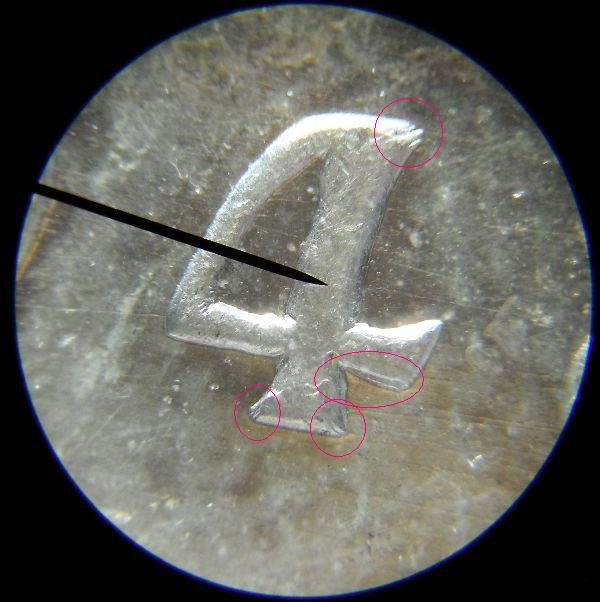 40x repunched HP 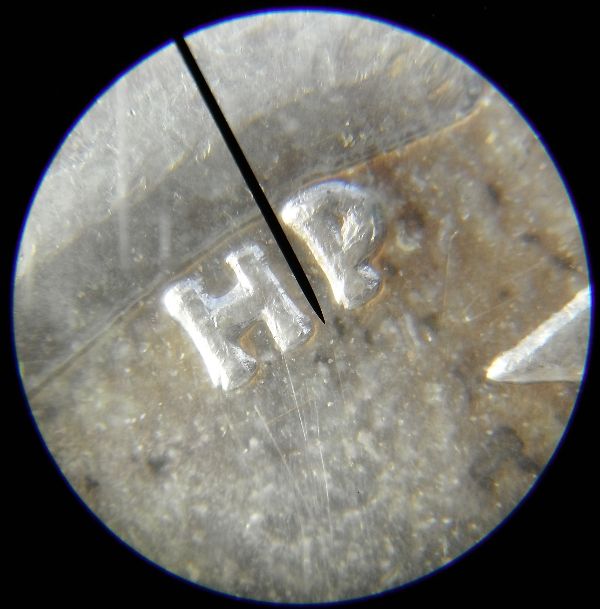 4 at about 160x 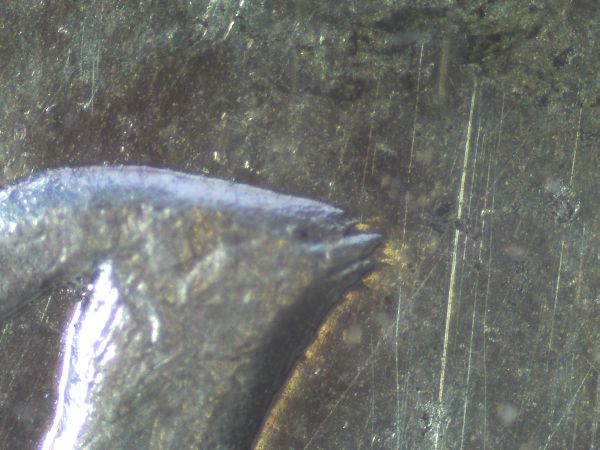 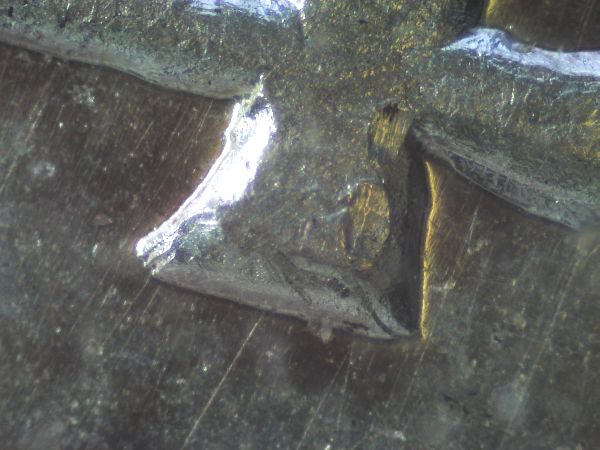 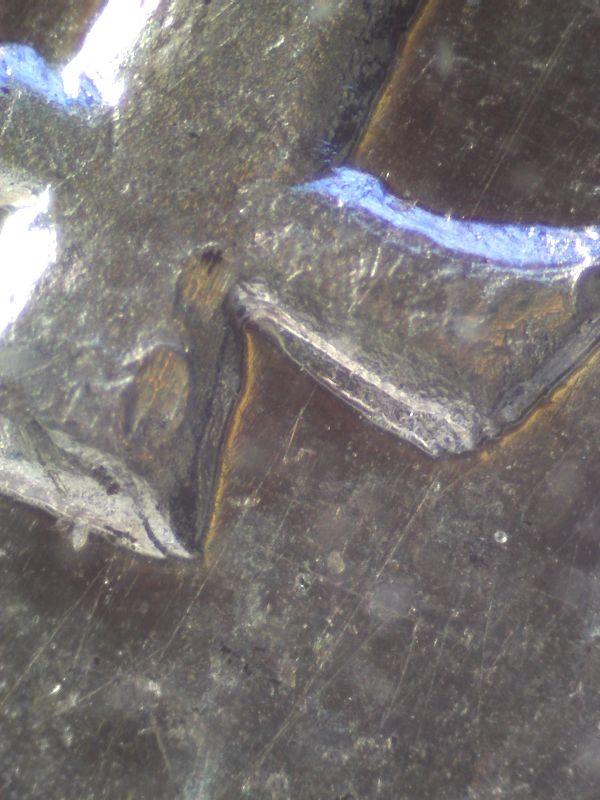 ~160x HP 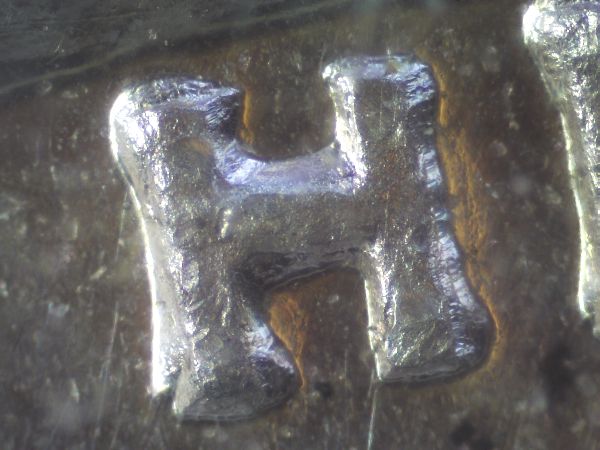 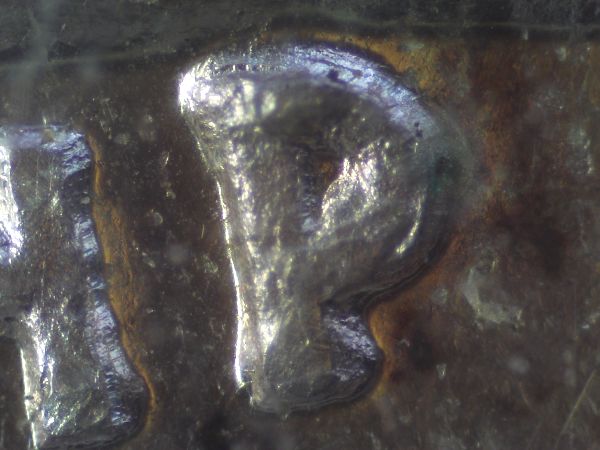 Heritage images show many with this reverse die. 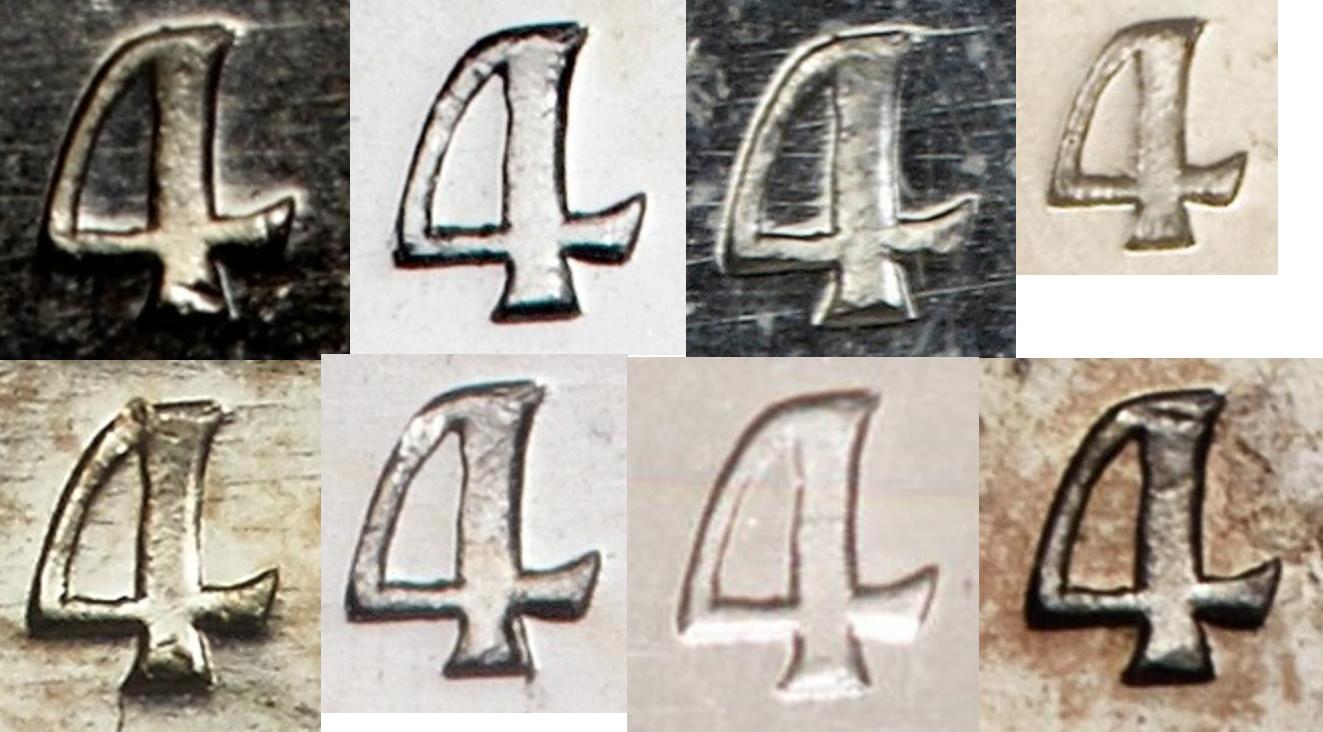 Many do not show this. 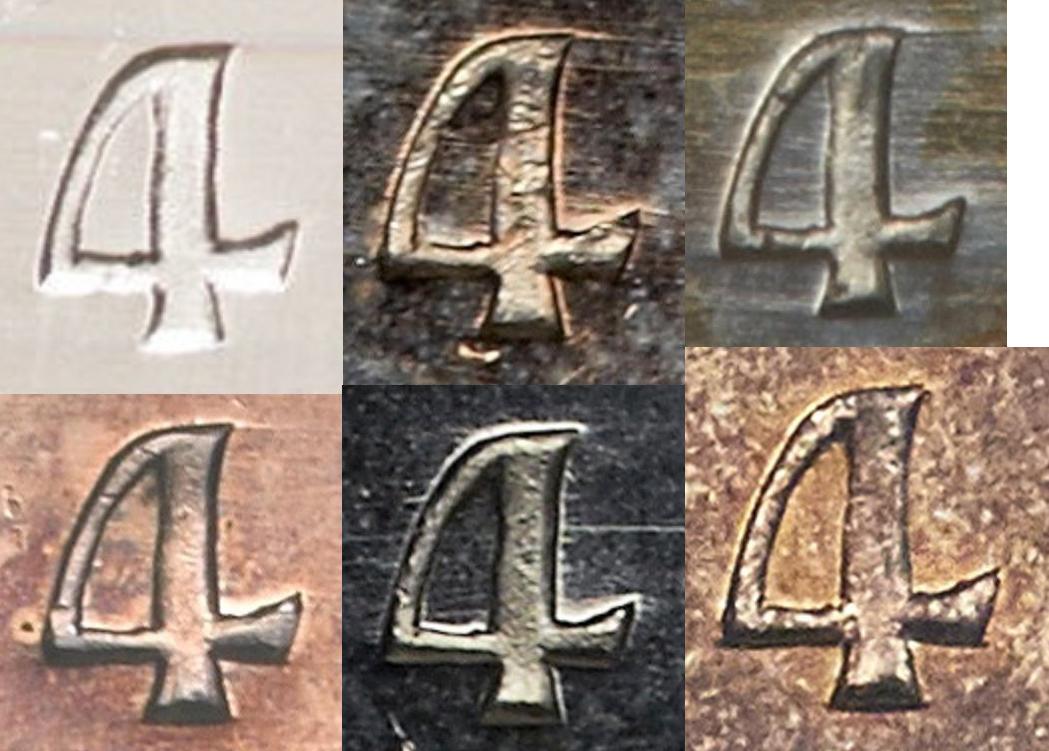 The coins that have it all have the same polishing line inside the 9. 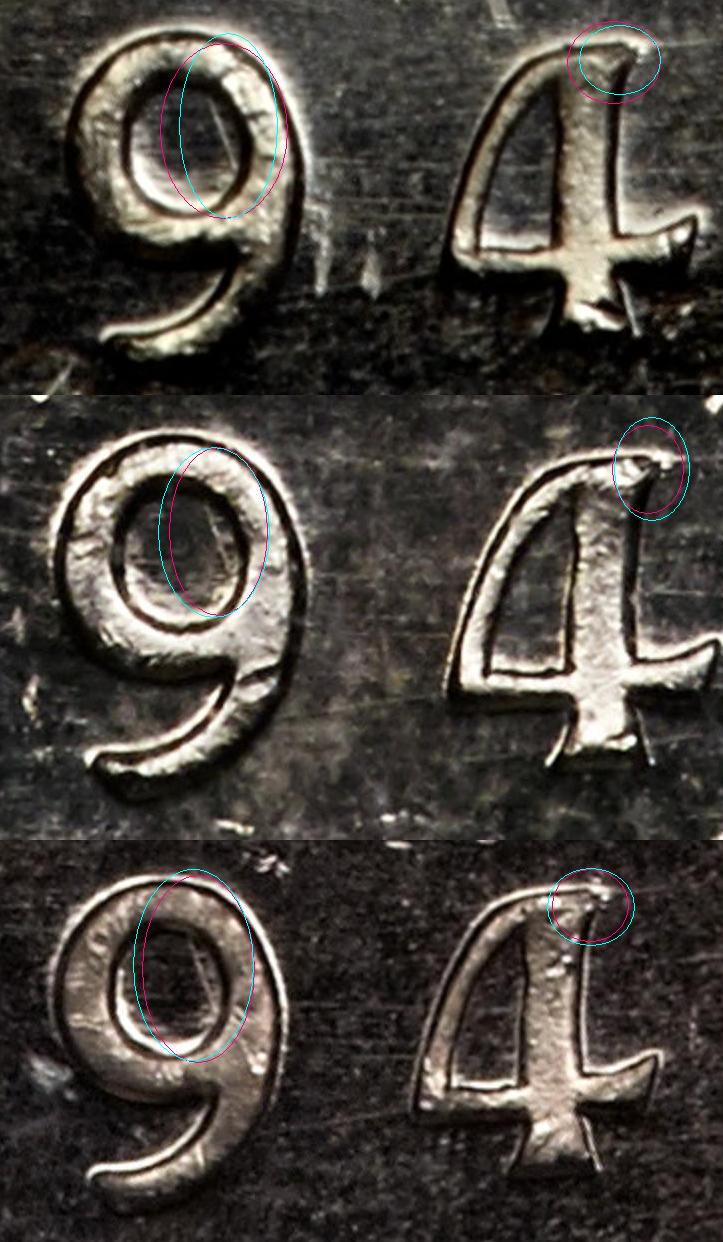 |
|
|
|
Moderator
 Canada
10477 Posts |
Very cool... I'll be touch with you shortly, I'd like to write about this one in my CN Journal column... (or course, you will be acknowledged for your work).
"Discovery follows discovery, each both raising and answering questions, each ending a long search, and each providing the new instruments for a new search." -- J. Robert OppenheimerContent of this post is licensed under a Creative Commons Attribution-NonCommercial 3.0 Unported License. See: http://creativecommons.org/licenses...0/deed.en_USMy eBay store
|
|
Pillar of the Community
 United States
4233 Posts |
|
|
Rest in Peace
10197 Posts |
Since that is such a minor one, could this not be a product of Master Die Doubling? Have you checked many others of this date to see at this level of mag? Wear would be a big factor agin' ya tho. I don't know my self, in this particular case, but I have seen such minor differences on US coins that AREN'T considered a documented doubled die, just an anomily or typical manufacture when using the multiple hubbing process. Just what percentage of overlapping constitutes a true hubbing error up in the land of Maple leaves? Never occurred to me until now.  |
|
New Member
35 Posts |
|
|
Pillar of the Community
 Canada
9903 Posts |
The HP is likely not repunched, doubled HP are usually DDO and occasionally M.D. The master reverse die was not fully dated, the last digits were hand punched in the die. Only six reverse dies were used to produce all the 47ML and 48 dollars. "Dipping" is not considered cleaning...
-from PCGS website
|
|
Pillar of the Community
United States
4233 Posts |
Crazyb0, those are all great questions. That's what I love about coin collecting. Checking "many others of this date" would involve many tens of thousands of dollars, but that's why we have the internet!  Yes, it is a minor difference, like a Morgan VAM is a minor difference. The question whether it is a just a typical anomaly with manufacturing is crucial to me. Below you see a highly magnified image of the die marker inside the 9, for this "split serif" variety. You can also see that the interior of the "9" is tripled from the press/anneal cycle. Yet overall this digit shows nothing unusual at a more "macro" scale. Why is the 4 different? 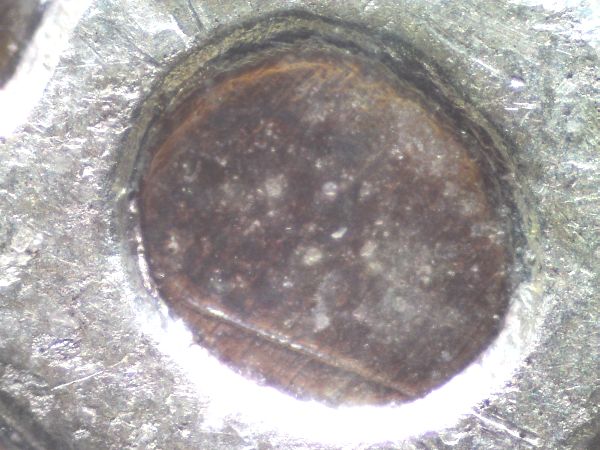 |
|
Rest in Peace
10197 Posts |
Now that I understand about the last two digits hand-punched in from a common multi-year Master Die, the rotation making the split "serif", it is feasible for that to have happened just on the 4 and no where else. Very similar to RPMs on US coins. The Mint tech generally hit the hammer/punch at least twice to insure clarity of design. That's hardly a 1 degree turn, I shake more than that!  |
|
Pillar of the Community
United States
4233 Posts |
Crazyb), I wholeheartedly agree, it's a triple shake at the punch. But in the US it would get a special VAM and a big value bump. DBM, I politely disagree. There's an HP repunch, whether double, triple or quad, for every George VI from 1937-1952, except 48 (until now) and 49. I'm not aware of any that are also DDOs. Some in Charlton are considered " Die Deterioration" (not MD). I suspect with the right lighting and magnification every HP exhibits doubling. (Prove me wrong! Send me your George VI dollars!) |
|
Rest in Peace
10197 Posts |
Final thought, since this isn't a hub doubled event, would this not technically be a RPD(repunched date)? Doesn't fit the typical OVD (overdate() classification. |
|
Pillar of the Community
Canada
5654 Posts |
There is no manufacturing process that does not spew out whatever it is making without some minor anomalies. Each machine will have a certain "tolerance" for acceptability, especially for common everyday items, whether they be nails, screws, matchsticks, newspapers, coins or anything else. I think that the advances in photography and binocs have led people down the primrose path to "discovering new varieties" when they see any kind of $$$ value added because of an anomaly that can be seen only with a 10X to 40X magnification. I am a firm believer and collector of "varieties", but I consider a variety to be a coin produced with good well-tuned machines, on good planchets, and with proper usable dies. Any changes made to the overall design, the legends, or modifications made to improve die or machinery life were done with the mintmaster's approval or one of his representatives. These I consider true varieties and most anything else is an error. My definition is no different than Zoell's, which he used to put in front of most editions of his pamphlets. I'm not trying to be critical, but the word "variety" has taken on a whole new meaning with advancements in optics and the availability of the internet to spread the word about any new discovery. And when the word "variety" or "scarce variety" is put onto ebay or coin sites, then wishful $$$ signs become attached. I'm not trying to discredit this neat, interesting 1948 thread with some excellent photography .. I enjoyed it. It's just that I had to voice my displeasure on the overuse of the word "variety". Sorry, I'm not trying to be mean, just being realistic. |
|
Valued Member
Canada
491 Posts |
Okiecoiner I agree with the binocs becoming better and better the variety area will become more clouded. I believe ICCS and CCCS if it can be seen with 10x or 5x loupe your holder will reflected the variety you seek. As long as the variety is in the front of the Charlton book. If your looking for re punched letters or numbers in the date if not seen with a 10x or 5x loupe the re punching will not be recognized.
So the question is. How low do collectors want to go with magnification to call a variety a variety? Just look on E-Bay now and you can see seller have gone to extreme points to try to make up a variety. Other slap on outrages prices to get collectors to believe variety's are worth more. All in the name of profit.
|
|
Rest in Peace
United States
17900 Posts |
In the exonumic world we frequently use: Variety (seen without aid), Minor Variety (size and/or placement of elements require measuring), and Micro Variety (the need to make miniscule comparisons as seen here).
Edited by moxking
09/21/2017 08:53 am
|
|
Pillar of the Community
Canada
5293 Posts |
Quote:
It raises a question, at least for me, about what constitutes a variety and at what magnification. This is a very good question. But 2 other questions, perhaps more important, are whether collectors are interested enough to make a distinction in their collecting pursuits, and if so how $value is attached to the different varieties. Collectors are not required to follow any set of rules for their collecting, but if enough think the variety, whatever it might be, is worth collecting, then the marketplace will make the distinction and assign a relative value to the different varieties. While varieties are interesting, I made up my mind some time ago not to pursue anything but the most conspicuous varieties, since I already collect too much. |
|
Pillar of the Community
Canada
4912 Posts |
Quote:
DBM, I politely disagree. There's an HP repunch, whether double, triple or quad, for every George VI from 1937-1952, except 48 (until now) and 49. I'm not aware of any that are also DDOs. i'd have to side with DBM here  if the HP is doubled, and not as a result of Machine Doubling, it is a doubled die..or a tripled die if the HP is tripled etc. it is just a common spot to see the splitting and distortion as most doubled die obverse dollars don't have a very impressive spread. a personal favorite of mine as well as of the market it seems is the 1947 P7 $1 with a quadruple HP..that is a quadrupled die obverse..it is a genuine multiply hubbed obverse die which is easy as day light to see on the " IMP" where the dots between the letters distort to ovals and where the letter bases become and tops become extremely thick. another example for you would be this piece: http://goccf.com/t/283420&SearchTerms=1937,doublebut congrats on your discovery, although I agree it's a pretty minor variety, it is still one and brings a lot of fun and interest seeing as it's on a 48 dollar and hasn't been noticed til now. I doubt a dollar value will be attached to this variety when 1948 SWL dollars attract no interest or premiums..but still a cool find  Feel free to call me Will.
|
|
Rest in Peace
10197 Posts |
Okie, that is EXACTLY my point! In the errors forum here I continually contend with folks using high power macro lenses with levels of 50x and greater that basically "demand" their "new find" is the next coin variety lotto winner. Any slight imperfection due to metallic machining and the wonders of photographic lighting will "prove" to the viewer a new "variety". ANYTHING, even the "Shroud of Turin" can be seen at levels above 100x! It seems to me even worse in the last two years that endoscopy has become less expensive(USB Microscopes).
Varieties do have their place, but I limit my study and discovery to determining the difference between two factors. Is this a PRODUCT of man-made introduction into the die making process or is it a PRODUCTION of normal machining? Examples as OP's coin is the "grey area" between these. While it is evidently a product of man-introduced error, it is too slight of difference and falls into category of "tolerances".
For example, a hammer is used to punch a hardened metal tool into a less hard metal die. The hammer will naturally "bounce" upon striking causing additional secondary strikes as the energy bleeds off. Same as a die strike causing mechanical vibrations as we know as MD. My field is US RPMs on cents, at 40x max I can determine 80-90% of catalogued varieties, I use my scope for those few that are similar to others and to take pix for comparitve analysis. I find absolutely no need for any higher mag than 50x, you begin seeing too many irregularities and the mind tricks you.
|
| |
Replies: 25 / Views: 4,273 |







 Posted 09/21/2017 01:10 am





