Posted this one yesterday, might as well copy and paste here too. Posted this one almost a year ago, before the Photobucket fiasco.
Macedon, Alexander III "The Great"
336-323 BC
AE Chalkous (1/48 drachm)
Youthful head of Apollo right
Free horse galloping right, ALEXANDROU above, monogram below
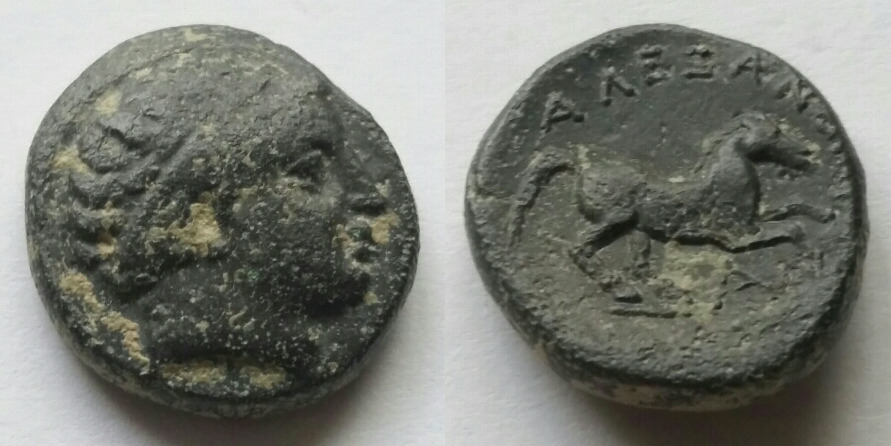
While Alexander's silver coins (mostly drachms and tetradrachms) are among the most studied coins in existence, his bronzes are less well understood, as they were made locally for mundane purchases, not soldiers' payroll. They are also host to a much more diverse series of imagery.
Although not firmly attested, the "free horse" is likely a homage to the story of how Alexander tamed his famous war steed, Bucephalus:
Quote:
[6.1] Philonicus the Thessalian brought the horse Bucephalus to Philip, offering to sell him for thirteen talents. But when they went into the field to try him, they found him so very vicious and unmanageable, that he reared up when they endeavored to mount him, and would not so much as endure the voice of any of Philip's attendants.
[6.2] Upon which, as they were leading him away as wholly useless and untractable, Alexander, who stood by, said, "What an excellent horse do they lose for want of address and boldness to manage him!"
[6.3] Philip at first took no notice of what he said; but when he heard him repeat the same thing several times, and saw he was much vexed to see the horse sent away, "Do you reproach," said he to him, "those who are older than yourself, as if you knew more, and were better able to manage him than they?"
[6.4] "I could manage this horse," replied he, "better than others do."
"And if you do not," said Philip, "what will you forfeit for your rashness?"
"I will pay," answered Alexander, "the whole price of the horse."
[6.5] At this the whole company fell a-laughing; and as soon as the wager was settled amongst them, he immediately ran to the horse, and taking hold of the bridle, turned him directly towards the sun, having, it seems, observed that he was disturbed at and afraid of the motion of his own shadow;
[6.6] then letting him go forward a little, still keeping the reins in his hands, and stroking him gently when he found him begin to grow eager and fiery, he let fall his upper garment softly, and with one nimble leap securely mounted him,
[6.7] and when he was seated, by little and little drew in the bridle, and curbed him without either striking or spurring him.
[6.8] Presently, when he found him free from all rebelliousness, and only impatient for the course, he let him go at full speed, inciting him now with a commanding voice, and urging him also with his heel. Philip and his friends looked on at first in silence and anxiety for the result, till seeing him turn at the end of his career, and come back rejoicing and triumphing for what he had performed, they all burst out into acclamations of applause; and his father shedding tears, it is said, for joy, kissed him as he came down from his horse, and in his transport said, "O my son, look thee out a kingdom equal to and worthy of thyself, for Macedonia is too little for thee."

(Schommer, late 1800s)
That narrative by Plutarch is probably mostly fictional, but the horse himself is very well attested, and was Alexander's favorite charger for his campaigns. The name Bucephalus literally means "Bull-head" and is said to refer to a branding mark carried by the horse, although some accounts remark on his enormous head, which leads me to believe that he is the subject of this coin, rather than a generic horse.
Bucephalus died in battle against the armies of the Indian king Porus in May 326 BC, in what today is Pakistan. Alexander founded the city of Bucephala at the site, and pressed on with his campaign before being forced to turn back by his troops. Alexander regrouped in Babylon and was planning to resume his campaign when he died suddenly of illness in 323 BC.
As for the coin itself, most bronzes are believed to be lifetime issues, contrasting with the silver issues (especially tetradrachms) that continued in the same style for more than 150 years. Until Alexander's death, it was considered taboo for a monarch to place his image on a coin. The image of Apollo here further attests a lifetime issue.as for the timing of its minting, not much can be said with certainty. It could have been made while Bucephalus was alive, or it could have been a commemorative after his death. If this is indeed a depiction of Bucephalus, that makes it the oldest surviving depiction of that horse, who would feature a prominent role in Seleucid numismatics as well as classical art.







 Posted 10/14/2017 3:54 pm





