The town of Kleef (in Germany) belonged to the county of Kleef, located in the German empire in the Middle Ages. The progenitor of Kleef's counts was Rutger. His descendants have been mentioned as counts of Kleef since the 11th century. In 1368 Kleef was united with the county of Mark, and in 1417 it was elevated to duchy. The history of the Kleefse counts and dukes is closely linked to the history of the counts and dukes of Gelre, partly by family relations.
In 1423 Berg united with Gulik. Gulik, that had been a duchess since 1356, was closely linked with Gelderland in the Middle Ages. Two Dukes of Gulik have also been the Duke of Gelderland (Willem van Gulik 1371-1402 and Reinald van Gulik 1402-1423). In 1511, Gulik and Berg came to Maria, the wife of Johan van Kleef, by marriage. Berg (not to be confused with the Dutch area of #8203;#8203;'s-Heerenberg) was a county on the right bank of the Rhine. In 1380 this area was raised from county to duchy. When Johan van Kleef became Duke of Kleef in 1521, he united the duchies of Berg and Gulik with the Duchy of Kleef. His successor, Willem V van Kleef (1539-1592), had been both Duke of Kleef and Duke of Gelderland from 1539-1543. In Kleef he was Willem V and in Gelderland Willem II. In 1543, however, he had to leave Gelre to Charles V. Huissen, the Lijmers, Wehl and Emmerich remained in Kleefs, as well as Ravenstein, on the Meuse.
In 1609 the Duke of Kleef dies(Johann Wilhelm van Kleef 1592-1609), there is no male successor. The men who made the most of his successor were Johann Sigismund, author of Brandenburg and Wolfgang Wilhelm Paltz, Count of Neuburg. On June 10, 1609, a treaty is signed in Dortmund, which governs the joint management of the Kleef areas. They call themselves "the possidiernde fürsten" (principles possidentes). However, this agreement is short-lived because an ever-breeding religious struggle between the two princes comes to an eruption in 1614. It was decided to divide the legacy into two. Brandenburg gets Kleef, Mark, Ravensberg and Ravenstein. Neuburg gets Gulik and Berg. Despite the mutual struggle and division, they continue to control the territories until 1624. In that year, the divorce will be final and will be officially signed in Düsseldorf. The Count of Neuburg now also receives Ravenstein.
Until 1701, the area of #8203;#8203;Kleef was in the hands of the Duke of Brandenburg, after which the area was annexed, together with Brandenburg in the kingdom of Prussia. In 1795, Kleef west of the Rhine was governed by French. In 1815 the Prussian government was restored. In 1947 Kleef became part of Nordrhein-Westfalen.
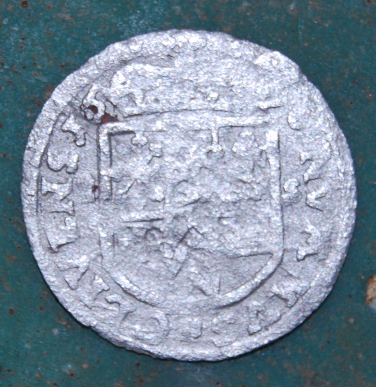
Obv: Coat of arms between 1 & S
Legend: NUMMUS CLIVENSIS 1670
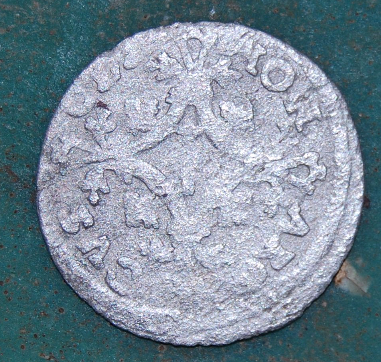
Rev: Long double cross, with open diamond. In it four round pebbles in the shape of a cross.
Legend: MON ARG CVS CLI
Diameter: 20mm
Mass: 1,11 gram
 *** Moved by Staff to a more appropriate forum. ***









 Posted 10/27/2017 1:53 pm


