From the 12th century to the 16th century, wage bills were counted on a calculating table in western Europe. The word rekenpenning also often uses the word "Jeton" from French, but "jeton" actually means more than just Rekenpenning. It may, like the English term "token", also refer to guild money, play money, access tokens or, for example, replacement of small change.
The calculator, which was added, subtracted, multiplied, etc. on horizontal lines of different values #8203;#8203;with pennies, stones or otherwise, already existed in the Roman times, but wasn't used in the Middle Ages. The flourishing trade in Italy and France resulted in a renewed introduction, which was introduced around 1600 by introducing new calculation methods and pen and paper.
Jetons have been provided since it's introduction with decorations. In the second half of the 16th century, that decoration was especially political in the Netherlands. Ultimately, that political character was so important that it was one of the reasons that they were still used long after people no longer used the method for calculating.
Because of the political nature, these 16th & 17th century Jetons are often holed.
From the middle of the 17th century, the jeton began to manifest itself more as a play token or fiche. The producers (Nuremberg was a large production center) often recalled to historical jetons, but usually in reduced form.
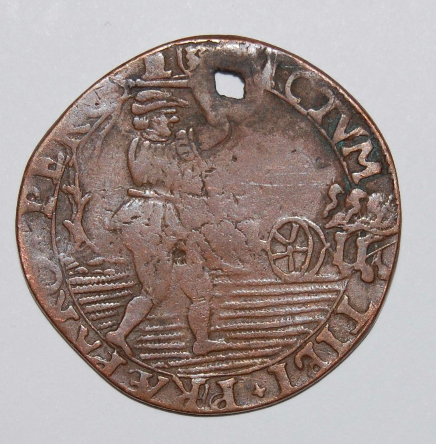
Minted in the city of Dordrecht.
Obv: Farmer driving his plow. The Plowman provides for the subsistence of the soldier who protects him.
Legend:(Small shield with the arms of North Holland.) VICTVM.TIBI.PRAE.PARO.PERG E.
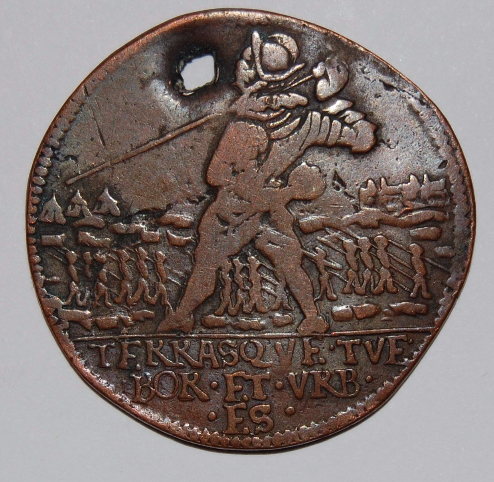
Rev: A pikeman in a camp, walking left.
This figure is none other than the pikeman of
"Clothing of officers and soldiers of a regiment of infantry of the Netherlands "drawn by Henri Goitzius and engraved by Jacques de Gheyn.
Legend: TERRASQVE. TVEBOR. ET. VRBES. i6o3
Diameter: 31mm
Mass: 5,56 gramm
Ref: Van Loon, t. Il, p. 3, n" I.; Catalogue du precieuc cabinet de jetons d'or et d'argent forme par feu M. L ...
by L. de Coster, Fr.-J . Olivier (Firm) (1885)








 Posted 01/01/2019 5:35 pm


