| Author |
 Replies: 5,980 / Views: 455,946 Replies: 5,980 / Views: 455,946 |
|
|
|
Bedrock of the Community
United States
37102 Posts |
|
|
Bedrock of the Community
 United States
10284 Posts |
1973 Bring Home the Christmas Tree proof sterling medal What I like about this medal is the Norman Rockwell style picture of Dad or Grandpa and his boy dragging home the Christmas tree. Very reminiscent of my early Christmas's as a kid and I love those whitetails on the run on the dated side. I don't know how many of these were minted but this earlier annual Holiday medal is one of a run from the 70's and 80's from all I could find out. This one in particular, is always a favorite and not always so easy to find.  Looks like it should be kept close in the safe with my 4 Coin 20 Dollar Canada Whitetail set? There they go again!  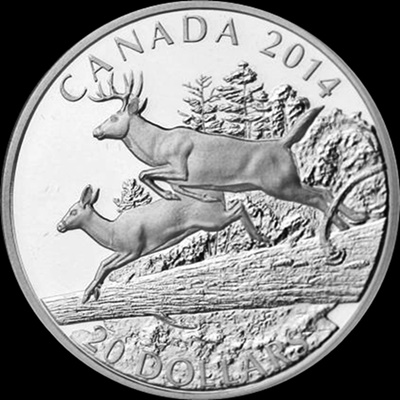
|
|
Pillar of the Community
United States
987 Posts |
Beautiful Christmas medal. You are right about it being Rockwell style.
|
|
Moderator
 United States
195559 Posts |
Quote:
1973 Bring Home the Christmas Tree proof sterling medal Lovely!  |
|
Pillar of the Community
United States
1346 Posts |
Superb engraving on the Christmas coin!
|
|
Pillar of the Community
United States
5029 Posts |
Nice Christmas medal. I actually just saw this scenario in real life driving home this morning down some back roads. Of course they were crossing the road and vs a log or stream. Beautiful animals and beautiful items TNG. |
|
Pillar of the Community
United States
1476 Posts |
|
|
Pillar of the Community
United States
987 Posts |
Quote:
Superb engraving on the Christmas coin! I already commented how much I liked the Christmas medal.But your comment made me go look again. It is very nice. I do not think I have the experience to tell bad engraving, however. I am going to find some time to do some research on this. |
|
Bedrock of the Community
United States
10284 Posts |
Thanks thisistheshow, I can't say this is exceptional engraving, but it is a pleasing theme and I think it is well done anyway. I have found a couple others. Some were place directly in a greeting card, made of bronze from the same dies. One year may have nostalgic themes such as mine. A horse drawn sleigh on a bridge, a decorated Christmas tree, children ridng a toboggan down a hillside. Other years may have the more religious themes, Three kings, Baby Jesus, Nativity etc. These too, were minted and placed in cards or were in a display with wooden base in sterling silver proof. It was the deer that made me do it. While some consider Franklin Mint medals junk silver, I do not in many issues. Some have very nice engraving and interesting themes while I will admit, others were simply made with little artistic effort to simply expand the size of a set or string along the sales to club members. Some are very scarce and even somewhat rare while others are so common, they are simply another way to collect silver bullion.  This is called "Country Christmas" on the inside of the card. I have seen it called "Cutting of the Tree" and "Bringing home the Tree" in error as that is from 1984 and entirely different. I suppose it doesn't matter. Now I just found a nice one seen above there in a rough card in bronze and bought it. It's on the way, because of course, I needed both variations didn't I? Better detail in these images.  Edited by TNG
10/02/2018 12:24 am
|
|
Pillar of the Community
United States
1346 Posts |
To my tired eyes it looks grand. Perhaps I should have said design.
|
|
Pillar of the Community
United States
5029 Posts |
Very nice TNG. |
|
Valued Member
United States
343 Posts |
1821 George IV coronation medal by T.Webb, 55mm, BHM #1092. 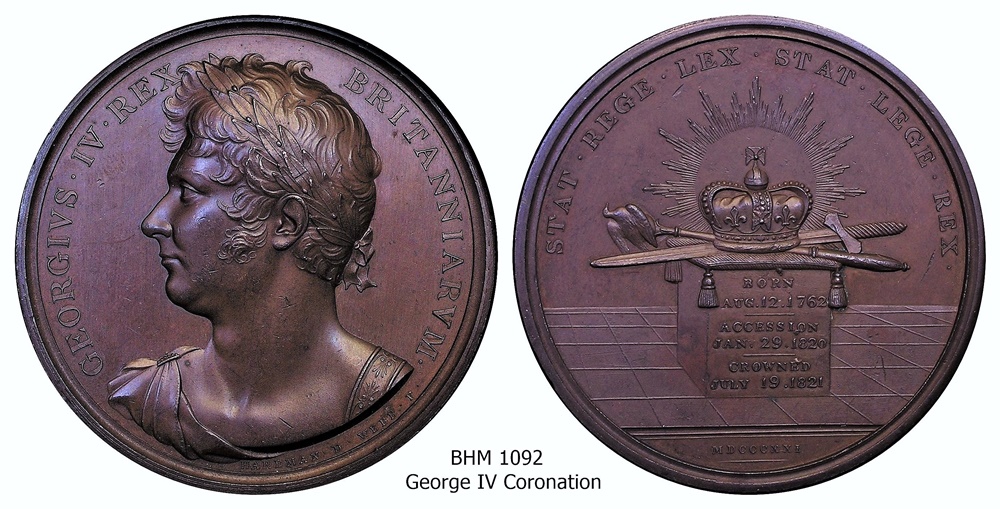 |
|
Bedrock of the Community
United States
10284 Posts |
Yarm You have some beauties! Thanks so much for posting them here. Anyway, thorough searching pays off as this one was found listed as a replica or reproduction and not titled very well in the listing tonight. I got it at a great price so now I have one slabbed and a second one here loose. This is probably the key to the 12 c.smith set. I have only seen 3 of these for sale in the past year or so, and I was overbid on 1 and bought the other two. 1948 C.SMITH T.ROOSEVELT/SAN JUAN HILL 1898-1948 There's a thread I posted about these c.smith so-called Half Dollars here. http://goccf.com/t/328924This is a long copy and paste but it is the best account I found on the Theodore Roosevelt Association webpage. July 1, 1898 proved to be one of the most significant in Roosevelt's life. Assembled as part of the Army's Fifth Corps to assault fortifications protecting Santiago, the Rough Riders were ordered to advance towards the San Juan River.
As the troops neared the river, shrapnel from a Spanish shell hit Roosevelt in the wrist, and wounded several other Rough Riders and Army regulars. Wood then ordered the Rough Riders to follow the First Brigade and ford the San Juan River. In the stifling heat with temperatures above 100 degrees Fahrenheit, the Rough Riders moved out but the advance stalled and troops found whatever cover they could from enemy fire.
Ordered to advance up Kettle Hill to support Army regulars, who were attacking nearby San Juan Hill from a different direction, Roosevelt, riding his horse Texas, exhorted his men to ride forward as he pressed on.
The Rough Riders found themselves pushing the troops in front of them, and Roosevelt ended up leading the entire advance, which observers at the time thought had no chance of succeeding because there wasn't sufficient troop strength and the Americans were facing well-entrenched Spaniards.
Still on Texas, Roosevelt advanced about 40 yards from the summit of Kettle Hill where there was a wire fence. Dismounting and releasing Texas, Roosevelt climbed through the fence and quickly reached the summit, along with his orderly, Henry Bradshar, and other Rough Riders and Ninth Infantry troops. Once there, the Americans found themselves under heavy Spanish fire and took cover in Spanish trenches and behind the sugar kettle for which the hill was named. Still, they managed to penetrate and keep up a steady fire on the Spanish line, eventually causing it to collapse.
Roosevelt then ordered a charge and took after the Spaniards on adjacent San Juan Hill. But he didn't realize that only five men followed, three of whom fell wounded within a hundred yards. The other two held their ground while an angry Roosevelt returned to the main line through the continuing fire and confronted his men for not following. In the heat of the moment, the troops hadn't heard Roosevelt's order nor seen him charging up the hill almost single-handedly. Now the charge became general and the troops cleared the Spanish trenches and kept a tenuous hold on both San Juan and Kettle Hills.
The Rough Riders lost 89 of 490 men killed or wounded in what came to be known as Roosevelt's Crowded Hour. Most experts agree that his personal valor and leadership were the single strongest elements leading to that day's victory.
The Rough Riders dug in on San Juan Hill, foraging for food and waiting for a counterattack, which never came even though the Spanish kept up a steady fire. Roosevelt and his men held their position in the uneasy siege of Santiago until July 10, when they were ordered to guard the El Caney Road. The Spaniards surrendered on July 17. After the armistice, the Rough Riders returned to the U.S. and on August 14 disembarked at Montauk Point, New York, where they were quarantined until being mustered out of service on September 15, 1898. In the four and one-half months the Rough Riders were together, more than one-third were killed, wounded, or stricken by disease, giving them the highest casualty rate of any American unit that took part in the Spanish-American War.

Edited by TNG
10/02/2018 12:13 am
|
|
Pillar of the Community
United States
5029 Posts |
yarm and TNG fantastic items! |
|
Moderator
United States
195559 Posts |
Quote:
1821 George IV coronation medal by T.Webb, 55mm, BHM #1092. Looks absolutely fabulous! Quote:
1948 C.SMITH T.ROOSEVELT/SAN JUAN HILL 1898-1948 Very nice! |
| |
Replies: 5,980 / Views: 455,946 |








 First Page
 Previous Page


 Posted 09/29/2018 9:52 pm


