|
This page may contain links that result in small commissions to keep this free site up and running.

Welcome Guest! Registering and/or logging in will remove the anchor (bottom) ads and the security checks. It's Free!
To participate in the forum you must log in or register. | Author |
 Replies: 5,980 / Views: 455,987 Replies: 5,980 / Views: 455,987 |
|
|
|
New Member
United States
24 Posts |
That's a beautiful specimen Dave H! Did you acquire it recently? I think I've seen it before.
|
|
Moderator
 United States
195559 Posts |
Quote:
Acquired two tokens recently. The first is the Union Coffee company NY-343. Unusual in that it is unholed. The second one is Macullar Parker, BOS-50. Very nice, beancounter!  Looking good, Dave H!  |
|
Pillar of the Community
United States
1436 Posts |
beancounter,
no, I bought it raw in the summer of 2016 at a local coin show and finally got it graded over the summer
|
|
Bedrock of the Community
United States
12057 Posts |
This is a 28mm bronze medal, with loop, struck in Germany in remembrance of the May Day (1 May) celebrations of 1892. The obverse features a portrait of Ferdinand Lassalle, a very controversial figure who, on the one hand, advocated for workers' rights, universal suffrage, and whose organization would later go on to become the mainstream German political party known as the SPD; yet, on the other hand, had extremist nationalist views and often advocated violence to preserve the Prussian/German Empire at all costs against "enemies" real and imagined -- the seeds which would later grow into the terrible nightmare of Nazism. The motto on the obverse is PROLETARIER ALLER LÄNDER VEREINIGT EUCH - "Workers of the World, Unite" - the motto of the International and of European and German socialism. May Day is an important day to European workers, much as Labor Day is in the United States. The two holidays share an historic background born against the struggle of workers in the late 19th c. for safer, healtheir working conditions, minimum standards, and the right to organize as a union. Even though some things workers enjoy nowadays are taken almost for granted (an 8 hour workday, 5-day or 6-day workweek, a minimum age of employment, regulations to improve safety and fairness in hiring) these workers' rights were won, quite literally, by blood, sweat, and tears. You're a worker at the International Harvester factory in Chicago, Illinois. The year: 1886. You work grueling hours for subsistence pay. A very common on-the-job injury will result in your firing and your family becoming destitute; and if you are suspected of being "anti-company", firing's the least you can expect. Private security companies, local police forces, and the politicians all perform a puppet dance on the strings of the wealthy factory owners and businessmen, bribed and paid to suppress worker rights and sway public opinion. Knowing all of this, since February, you have bravely been on strike in support of an 8-hour workday, along with many other fellow workers, a large number of them German immigrants. The bosses at the factory don't much like your attitude, to put it mildly. While you're on strike, Pinkerton "detectives" - a paid mercenary army of "policemen" - are called in to harass you and your fellow striking workers. You endure physical and verbal abuse, your family is threatened, and yet you take the high road and keep your own actions civil and peaceable. The company bosses next call in the actual Chicago police, who are even more brutal, to disperse your strike, but you endure. Some of the pro-strike workers' unions activists hand you a flyer advertising a pro-labor Rally to be held on May 1, a Saturday. Strike leaders, workers, and sympathetic authors and politicians invite you to the Rally, to be held at the Haymarket Square on Randolph St and the adjacent Desplaines & Halsted Sts. You, and many others like you -- perhaps 1500 to 2000 -- show up early in the evening, a light rain falling, to hear the British Rev. Sam Fielden, along with former Confederate veteran & Radical Republican Albert Parsons, and the socialist editor of the German-language Arbeiter-Zeitung (Workers' Times) newspaper, Albert Spees. The plan is to discuss the efforts towards an international 8-hour workday. A large number of uniformed policemen are there to "keep the peace." The rest -- that's history and worth a read on your own. Celebrations commemorating that fateful day - May 1 - are held throughout the world now, but often without remembering the events that inspired them. The socialists soon realized that radical anarchists were turning a philosophical battle into a very real war, especially in Europe, an ideological battle that ultimately contributed to the outbreak of WWI. At the same time, through the efforts of unions, churches, and activists, many of the privileges and rights workers have today were won and defended, with major benefits for both businesses and employees. 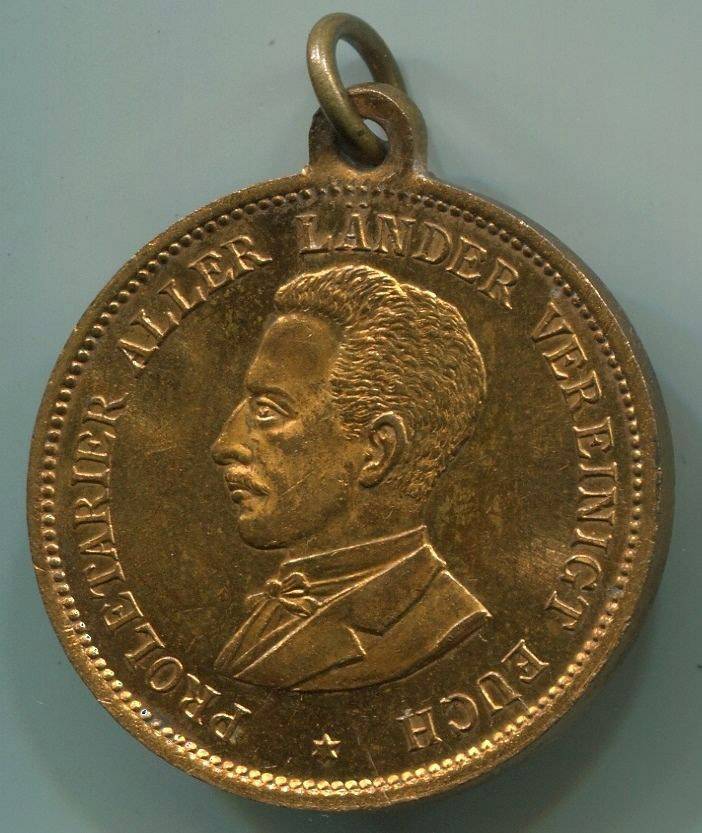 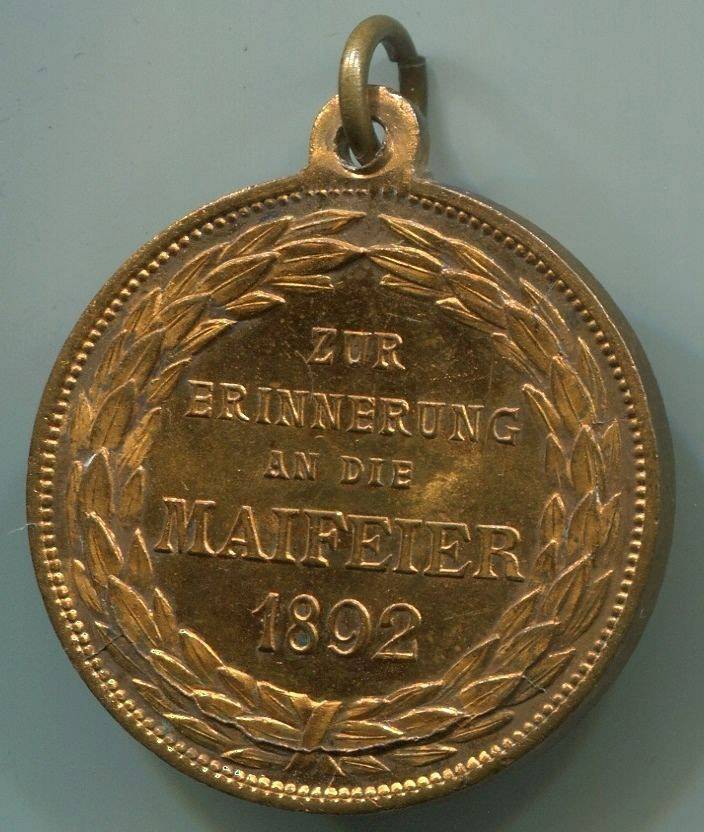 Member ANA - EAC - TNA - SSDC - CCT #890 "Most of the things worth doing in the world had been declared impossible before they were done." -- Louis D. Brandeis Edited by paralyse
11/14/2018 12:55 pm
|
|
Pillar of the Community
United States
5029 Posts |
Very nice add paralyse |
|
CCF Master Historian of Commemorative Coins
United States
12554 Posts |
@paralyse: I enjoyed the history lesson and the images of the May Day medal! Great write-up. Thanks much for sharing!
Collecting history one coin or medal at a time! (c) commems. All rights reserved.
|
|
Moderator
United States
195559 Posts |
An excellent contribution, paralyse. Thank you. |
|
Bedrock of the Community
United States
37102 Posts |
|
|
Pillar of the Community
United States
581 Posts |
Apothecary Weights & Tokens I knew nothing about these and it took several days of heavy research just to gain some basic fundamental knowledge. Good thing I enjoy doing researching and learning about history. Thank you to all that have posted photos in this thread. I have greatly enjoyed each one and have learned a lot. In descending order: ONE DRACHM / 3j / H. TROEMNER / PHILADA. - APOTHECARY WEIGHT TOKEN TWO SCRUPLES 3ij J.L.B. APOTHECARY WEIGHT TOKEN ONE DRACHM / 3i / H. T. PHILA. - APOTHECARY WEIGHT TOKEN HALF DRACHM / 3 SS / "M" / PHILA. & N.Y. - APOTHECARY WEIGHT TOKEN 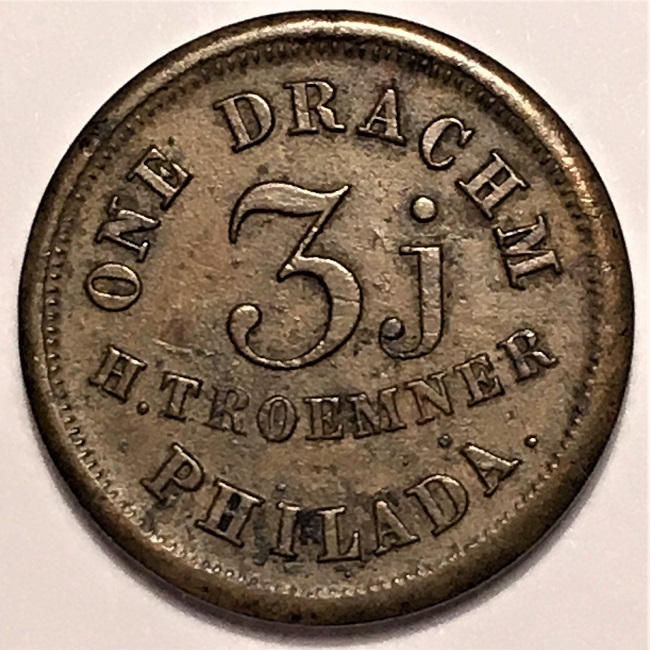 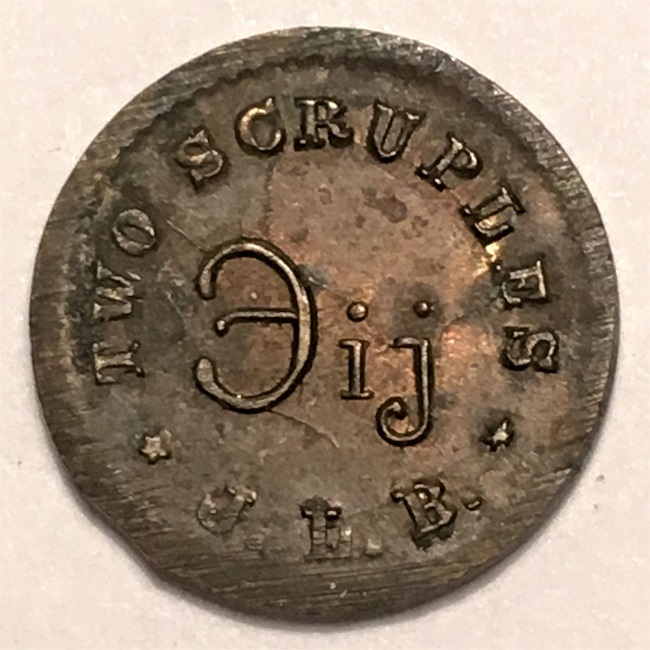 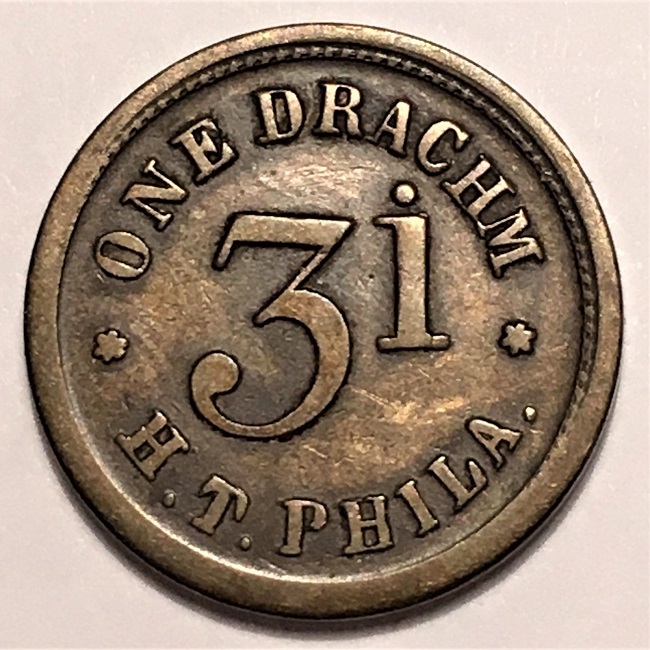 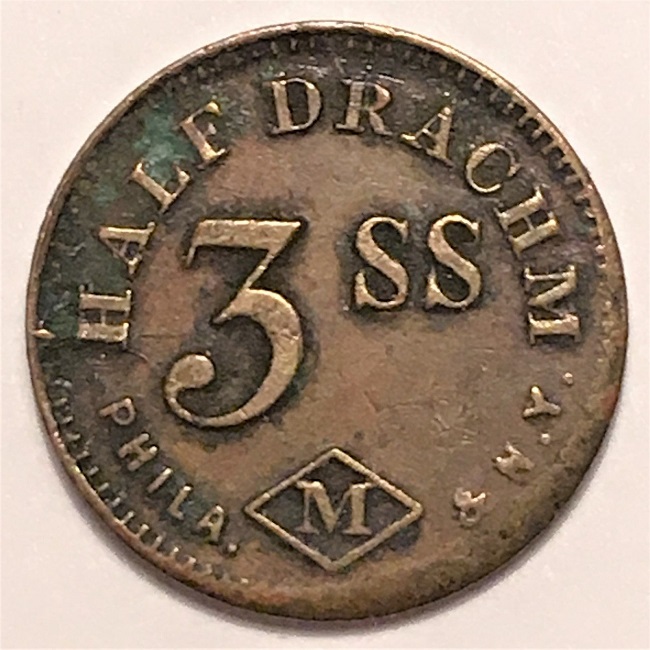 |
|
Bedrock of the Community
United States
12057 Posts |
Some nice examples of apothecary weights. The apothecary weights and measures system of drams/drachms, semis (ss), scruples and minims/grains is still in use for certain things.
1/2 pint = 8 fluid ounces = 64 fluid drams. The proverbial "spoonful of sugar" is approximately 1 1/2 drams (dry weight.)
In the 19th c. & early 20th c. a pharmacist was often literally a chemist (the term which survived into British English) -- the nearest modern equivalent is a "compounding pharmacy" in the US. A working knowledge of Latin was also required to read formulas.
Medicines had to be mixed from base components and compounds, carefully weighed out, and then formed into pills or tablets using molds or, later, a machine; or dissolved into liquid solutions with alcohol, water, etc. With many of the popular and dangerous early drug compounds a very small mistake in measurement could be deadly, so accurate scales and weights such as these were a must when preparing them.
Member ANA - EAC - TNA - SSDC - CCT #890 "Most of the things worth doing in the world had been declared impossible before they were done." -- Louis D. Brandeis |
|
Moderator
United States
195559 Posts |
Quote:
Apothecary Weights & Tokens Very nice! |
|
Pillar of the Community
United States
581 Posts |
paralyse- Thank. Excellent info. The more the better.
Without delving to deep into the subject I have a couple of questions or observations that I found curious. Maybe you or another forum member has input.
1. Why are the various abbreviations for the city of Philadelphia so inaccurate/bazaar?
2. All the apothecary weights pictured, accept one, are part of the same measurement system i.e. they correspond with each other as fractional weights in the same system of measurement and the "3" in the center signifies drachm. The weight that is different is the Two Scruples.
TWO SCRUPLES 3ij J.L.B. APOTHECARY WEIGHT TOKEN: This round or Russian E mirrored is the symbol of the scruple. (The dram or drachm has the 3-like symbol.)
ii or ij is 2 in Roman characters. The ij form one often encounters in medieval and early modern books and manuscripts.
A scruple weighs 20 grains or 1.296 grams, as the online Enc. Brittannica shows. So 2 scruples weigh 2.592 grams. 3 scruples is a dram, 3.888 grams, which is not far from the usual weight of a Greek drachm.
So this weight says "Two Scruples" in two ways, words and symbols. It should weigh 2.592 grams.
Pharmacists used a balance beam scale to measure the appropriate amount of medicine to a customer. One would put the appropriate weights on one side and then pour the powdered drug on the other until the balance was centered. Small drachm (a unit of weight equivalent to 60 grains or one eighth of an ounce) weights, grain weights and smaller were employed to balance the small amounts of chemicals ordered by a doctor's recipe or prescription for each dose. Since the weights were base metal, mostly copper, the drachm weights were often gold plated to make them easier to read. The manufacturer's name is almost always listed on the weight.
Reference Fauver's 19th and 20th Century Apothecary and Bullion Weights Signed by the Maker published in the October 2003 Journal of the Token and Medal Society.
Edited by yellow88
11/14/2018 3:14 pm
|
|
Bedrock of the Community
United States
12057 Posts |
No worries!
The city of Philadelphia has often been abbreviated Phil., Phila., Philad'a., Philad., and numerous other ways -- nowadays, Philly! The Philad'a. version was common in the 18th and 19th c. In much the same way, Pennsylvania was Penn, Penna., etc.
There were two systems of apothecary measurement for volume/fluid: Imperial (British) & US. The oddball Imperial system used a gallon of wine as a base measurement, and had 20% more volume than the US gallon. (!)
In addition, the equivalency (to grams or ounces) varied based on whether you were measuring liquids (volume) or solids (mass). This is still the case in the US, where 16 (solid) ounces weighs one pound, but 16 (fluid) ounces usually does not!
A "dry" or "solid" scruple is about 1.3 grams (1/3 dram) and a "wet" or "fluid" scruple is about 1.2 milliliters. A 2 scruple weight should equal about 2.6 grams as you note, however, damage due to wear, metal loss, or even intentional alteration may change the actual weight as measured. The heavy file marks on your example and damage to the rim suggest that the weight is almost certainly no longer going to be accurate.
The numbering as "j, ij, iij.." was done for a reason. Imagine a formula calling for 3 drams of iodine, a common element in many pharma compounds -- when written out by hand in a formulary, you encounter what looks like "d.iiiiodine".
Is that supposed to be 3 drams (iii) of iodine, or 2 drams (ii) with a stray mark in between? The solution was to represent the final Roman numeral I as a j. There is no confusion as to how much is intended by "d.iij iodine" where it is clearly intending to mean 3 drams.
Electrical engineers use j/i for a slightly similar reason: you don't want to confuse the imaginary number I (the square root of -1) with the abbreviation for current in amperes (i), so an analysis of an AC circuit will use j for the phasor angle.
Member ANA - EAC - TNA - SSDC - CCT #890 "Most of the things worth doing in the world had been declared impossible before they were done." -- Louis D. Brandeis |
|
Bedrock of the Community
 United States
10284 Posts |
Thanks for keeping the thread alive and well with the excellent additions and info. Great stuff! |
|
Pillar of the Community
United States
1346 Posts |
"Thank you" to all the collectors who post to this thread. You allow me to see some truly great coinage that I would not see otherwise.
|
| |
Replies: 5,980 / Views: 455,987 |
To participate in the forum you must log in or register.
Disclaimer: While a tremendous amount of effort goes into ensuring the accuracy of the information contained in this site, Coin Community assumes no liability for errors. Copyright 2005 - 2026 Coin Community Family- all rights reserved worldwide. Use of any images or content on this website without prior written permission of Coin Community or the original lender is strictly prohibited.
Contact Us | Advertise Here | Privacy Policy / Terms of Use
|
| Coin Community Forum |
© 2005 - 2026 Coin Community Forums |
| It took 0.98 seconds to rattle this change. |
 |
|
| |
| |







 First Page
 Previous Page


 Posted 11/12/2018 10:09 am


