










 Posted 12/19/2017 10:42 am


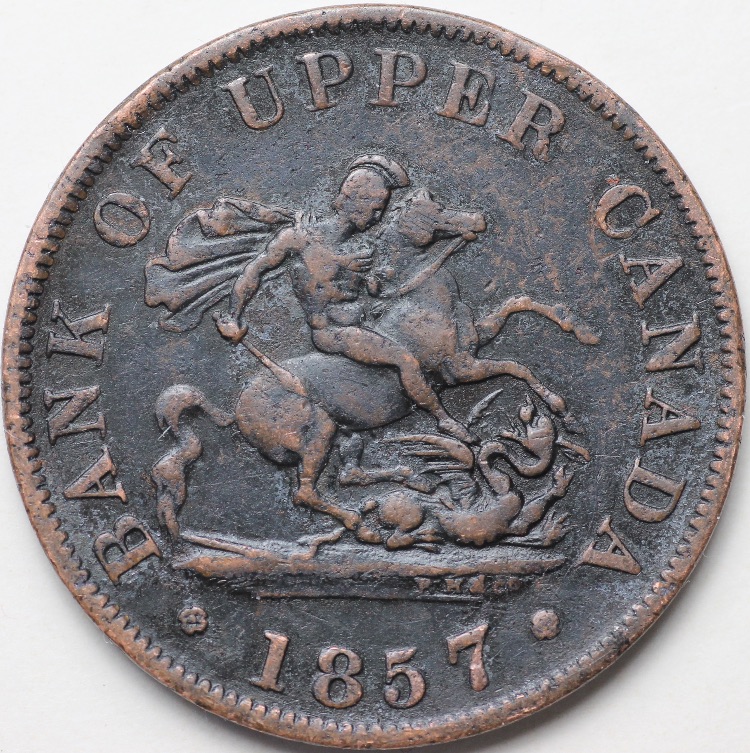
Concerning the 1857 ONE HALF PENNY tokens, Dr. Courteau initially separates these into two primary groupings dependent upon whether or not the obverse Rosettes contain inner Dots. Group I, varieties 159-190 inclusive are found NOT having an inner Dot within each Rosette. Group II, varieties 190-207 inclusive are found having an inner Dot within each Rosette. Your token is of the Group II category.
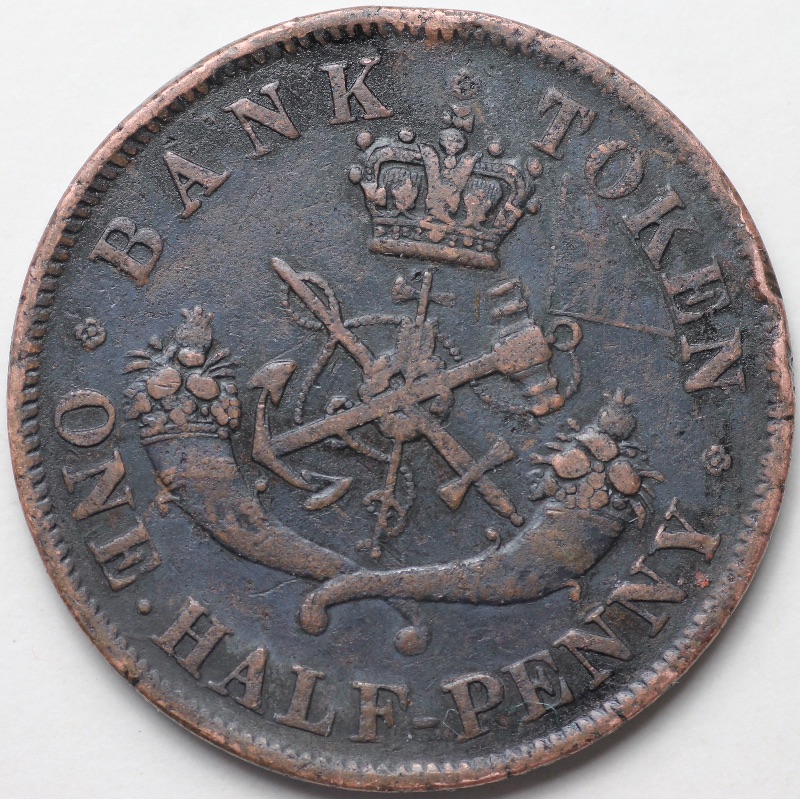
Dr. Courteu's primary focus on the Reverse concerns the Terminal Dots of the Anchor Rope. The Terminal Dots are located to the immediate right of the lower section of the Battle-axe Handle. These are found either having one Dot, one Dot and a small line, a downward pointing Dash, 2 small Dots, 2 dots (the last being smaller), 2 medium sized Dots, 2 large Dots, 2 and a half Dots, 3 downward pointing Dots, or 3 horizontal Dots. Yours is of the 2 medium sized Dot varieties.
Thus far, your token is of the Group II category (varieties 190-207). Of these, only varieties 192-198 are found having the terminal of the Anchor Rope ending in 2 Dots of medium size.
Other areas of concern noted by Dr. Courteau are the completeness of the Man's left Foot, the left Rein of the Bridle, the placement of the numeral 7, the completeness of the Union Jack, the line/lines below the Man's right Arm, the Serif of the N of BANK (obverse), whether or not the inner Ornamental Balls of the Cornucopia are connected to the Cornucopiae, and a host of other significant details.
Using my shortcut (previously posted) concerning the placement of the numeral 7, only varieties 170, 171, 176, 178, and 194 shew the top of the numeral 7 extending above the right Rosette. Of these, only variety 194 is of the Group II category.
Dr. Courteu's narrative of variety 194:
"194. Obv. Perfect l. foot to man. Fig. 7 away from 5, with its top higher than rosette. Sometimes with die-cracks to N of BANK and to left of R.
Rev. Same as No 192. R-2.
2 Dots of medium size."
Referring to variety 192 we find:
"Rev. Perfect outline to U.J., only the upper of St-Andrews cross frame shows below E. Three large dots and a small one for rope between feather and anchor. The four balls are connected to Cornucopiae."
A cut and paste of my expanded narrative:
p.s. Forgive the layout of this cut a paste as the program of this site does not like my Word Perfect (Corel) program. Much is lost in the conversion process.
"194 R-2 Two Medium Dots.
Varieties within this group having two medium Dots are 192, 193, 194, 195, 196, 197, and 198.
Obverse Characteristics:
The numeral 7 is away from the numeral 5, with the top higher than the right Rosette.
The 7 is on-line with the centre of the 5th Denticle to the immediate right of the numeral 5.
Note - The die-setter may have been a mite tipsy, for he sunk the 7 opposite the wrong Denticle. The 7 is severely canted to the left.
An imaginary line across the Face of the vertical of the Serif of the numeral 7 is on-line nearer the initial R and distant from the initial H in the abbreviation below the ground.
An imaginary line across the top of the 7 extends into the field midway betwixt the right Rosette and the right ground.
The Man's left Foot is complete, but weakly struck. Doctor Courteau referenced the foot as Perfect.
One line is below the Man's right Arm. Note - The line does not fully extend to the Man's Body.
The left Bridle Rein is heavy and arches. The right terminal of the left Rein touches the right Rein, arching away from the right Rein and merging with the right Rein 2/3 the distance to the Neck of the Horse.
Two horizontal lines are below the left Wing of the Dragon. Note - This diagnostic is not readily discernable on lower grade specimens.
From perfect and broken dies.
A Die-Crack is to the N in BANK.
This short curving Die-Crack is from the centre of the Denticle betwixt the A and N in BANK, arching to the left end of the Serif of the left Upright of the same N.
A Die-Crack is to the R in UPPER and CA in CANADA.
This bent Die-Crack is from the left-side of the Denticle above the right section of the E in UPPER, extending to the top of the left corner of the Serif of the R in the same word. The Die-Crack extends through the top of the same R and through the top of the CA in CANADA.
A Die-Crack is to the top of NADA in CANADA.
This Die-Crack is from the left-side of the Denticle above the right-side of the 1st A in CANADA, extending to the left end of the Serif of the left Upright of the N in the same word, and continuing across the top of the ADA in the same word. Note - This Die-Crack was not mentioned by Doctor Courteau.
A Die-Crack is through the bottoms of the date. Self-explanatory.
Note - This Die-Crack was not mentioned by Doctor Courteau.
A Die-Crack is to the Mantle.
This Die-Crack is from the field on-line with the midpoint betwixt the F in OF and the you in UPPER, extending through the upper corner of the 2nd Mantle Fold, and exiting the lower curve of the 5th Mantle Fold, and exiting to the upper curve of the Tail of the Horse. Note - This Die-Crack was not mentioned by Doctor Courteau.
Reverse Characteristics: The same as varieties 192 and 193, but having Die-Cracks.
The outline of the Union Jack is Perfect.
Only the upper section of the St. Andrew's Cross frame shews below the E in TOKEN.
The Anchor Rope Dots betwixt the Feather and Anchor consists of three large Dots and a slightly smaller Dot.
Note - Doctor Courteau identifies the terminal Dot as 'small.' The Dot is smaller than the other three, but is much larger than a traditional 'small' Dot.
The Battle-Axe has a hole.
The ornamental balls well are connected to the Cornucopias.
The centre of the bottom of the E in TOKEN is not fully struck.
The Dot to the left of the lower ornamental Ball of the right Cornucopia is present.
The Anchor Ring is complete.
The Anchor brace running across the top of the left-side Anchor Arm is heavy, and terminates slightly before the lower inner tip of the Fluke.
From perfect and broken dies. Note - Doctor Courteau made no mention of having broken dies.
A Die-Crack is to HALF.
This Die-Crack is from the right-side of the Denticle below the Dot betwixt ONE HALF, extending to the left-side of the Stand of the left Upright of the same H, extending through the bottoms of the ALF in the same word, and exiting to the top of the Denticle below the hyphen.
On earlier die states, only the Die-Crack to the H shews.
A Die-Crack is to O in ONE, left Rosette and BANK.
This Die-Crack is from the mid section of the left curve of the O in ONE, extending through the upper Lobe of the left Rosette, extending through the Stands of BANK.
Thus:
194 Perfect - no Die-Cracks
194A A Die-Crack is to HALF.
194B Die-Crack as above, plus a Die-Crack is to the N in BANK (obverse).
Die-Cracks as above, plus a Die-Crack is to the R in UPPER and CA in CANADA.
Die-Cracks as above, plus a Die-Crack is through the top of NADA in CANADA.
Die-Cracks as above, plus a Die-Crack is to the bottoms of the date.
Die-Cracks as above, plus a Die-Crack is to the Mantle.
Die-Cracks as above, plus a Die-Crack is to O, left Rosette and BANK (reverse).
Note - Many Die-Cracks were not mentioned by Doctor Courteau.
This is the Die-Crack progression.
Enjoy
and Merry Christmas and a Happy New Year.
God Bless
doug
Dr. Courteu's primary focus on the Reverse concerns the Terminal Dots of the Anchor Rope. The Terminal Dots are located to the immediate right of the lower section of the Battle-axe Handle. These are found either having one Dot, one Dot and a small line, a downward pointing Dash, 2 small Dots, 2 dots (the last being smaller), 2 medium sized Dots, 2 large Dots, 2 and a half Dots, 3 downward pointing Dots, or 3 horizontal Dots. Yours is of the 2 medium sized Dot varieties.
Thus far, your token is of the Group II category (varieties 190-207). Of these, only varieties 192-198 are found having the terminal of the Anchor Rope ending in 2 Dots of medium size.
Other areas of concern noted by Dr. Courteau are the completeness of the Man's left Foot, the left Rein of the Bridle, the placement of the numeral 7, the completeness of the Union Jack, the line/lines below the Man's right Arm, the Serif of the N of BANK (obverse), whether or not the inner Ornamental Balls of the Cornucopia are connected to the Cornucopiae, and a host of other significant details.
Using my shortcut (previously posted) concerning the placement of the numeral 7, only varieties 170, 171, 176, 178, and 194 shew the top of the numeral 7 extending above the right Rosette. Of these, only variety 194 is of the Group II category.
Dr. Courteu's narrative of variety 194:
"194. Obv. Perfect l. foot to man. Fig. 7 away from 5, with its top higher than rosette. Sometimes with die-cracks to N of BANK and to left of R.
Rev. Same as No 192. R-2.
2 Dots of medium size."
Referring to variety 192 we find:
"Rev. Perfect outline to U.J., only the upper of St-Andrews cross frame shows below E. Three large dots and a small one for rope between feather and anchor. The four balls are connected to Cornucopiae."
A cut and paste of my expanded narrative:
p.s. Forgive the layout of this cut a paste as the program of this site does not like my Word Perfect (Corel) program. Much is lost in the conversion process.
"194 R-2 Two Medium Dots.
Varieties within this group having two medium Dots are 192, 193, 194, 195, 196, 197, and 198.
Obverse Characteristics:
The numeral 7 is away from the numeral 5, with the top higher than the right Rosette.
The 7 is on-line with the centre of the 5th Denticle to the immediate right of the numeral 5.
Note - The die-setter may have been a mite tipsy, for he sunk the 7 opposite the wrong Denticle. The 7 is severely canted to the left.
An imaginary line across the Face of the vertical of the Serif of the numeral 7 is on-line nearer the initial R and distant from the initial H in the abbreviation below the ground.
An imaginary line across the top of the 7 extends into the field midway betwixt the right Rosette and the right ground.
The Man's left Foot is complete, but weakly struck. Doctor Courteau referenced the foot as Perfect.
One line is below the Man's right Arm. Note - The line does not fully extend to the Man's Body.
The left Bridle Rein is heavy and arches. The right terminal of the left Rein touches the right Rein, arching away from the right Rein and merging with the right Rein 2/3 the distance to the Neck of the Horse.
Two horizontal lines are below the left Wing of the Dragon. Note - This diagnostic is not readily discernable on lower grade specimens.
From perfect and broken dies.
A Die-Crack is to the N in BANK.
This short curving Die-Crack is from the centre of the Denticle betwixt the A and N in BANK, arching to the left end of the Serif of the left Upright of the same N.
A Die-Crack is to the R in UPPER and CA in CANADA.
This bent Die-Crack is from the left-side of the Denticle above the right section of the E in UPPER, extending to the top of the left corner of the Serif of the R in the same word. The Die-Crack extends through the top of the same R and through the top of the CA in CANADA.
A Die-Crack is to the top of NADA in CANADA.
This Die-Crack is from the left-side of the Denticle above the right-side of the 1st A in CANADA, extending to the left end of the Serif of the left Upright of the N in the same word, and continuing across the top of the ADA in the same word. Note - This Die-Crack was not mentioned by Doctor Courteau.
A Die-Crack is through the bottoms of the date. Self-explanatory.
Note - This Die-Crack was not mentioned by Doctor Courteau.
A Die-Crack is to the Mantle.
This Die-Crack is from the field on-line with the midpoint betwixt the F in OF and the you in UPPER, extending through the upper corner of the 2nd Mantle Fold, and exiting the lower curve of the 5th Mantle Fold, and exiting to the upper curve of the Tail of the Horse. Note - This Die-Crack was not mentioned by Doctor Courteau.
Reverse Characteristics: The same as varieties 192 and 193, but having Die-Cracks.
The outline of the Union Jack is Perfect.
Only the upper section of the St. Andrew's Cross frame shews below the E in TOKEN.
The Anchor Rope Dots betwixt the Feather and Anchor consists of three large Dots and a slightly smaller Dot.
Note - Doctor Courteau identifies the terminal Dot as 'small.' The Dot is smaller than the other three, but is much larger than a traditional 'small' Dot.
The Battle-Axe has a hole.
The ornamental balls well are connected to the Cornucopias.
The centre of the bottom of the E in TOKEN is not fully struck.
The Dot to the left of the lower ornamental Ball of the right Cornucopia is present.
The Anchor Ring is complete.
The Anchor brace running across the top of the left-side Anchor Arm is heavy, and terminates slightly before the lower inner tip of the Fluke.
From perfect and broken dies. Note - Doctor Courteau made no mention of having broken dies.
A Die-Crack is to HALF.
This Die-Crack is from the right-side of the Denticle below the Dot betwixt ONE HALF, extending to the left-side of the Stand of the left Upright of the same H, extending through the bottoms of the ALF in the same word, and exiting to the top of the Denticle below the hyphen.
On earlier die states, only the Die-Crack to the H shews.
A Die-Crack is to O in ONE, left Rosette and BANK.
This Die-Crack is from the mid section of the left curve of the O in ONE, extending through the upper Lobe of the left Rosette, extending through the Stands of BANK.
Thus:
194 Perfect - no Die-Cracks
194A A Die-Crack is to HALF.
194B Die-Crack as above, plus a Die-Crack is to the N in BANK (obverse).
Die-Cracks as above, plus a Die-Crack is to the R in UPPER and CA in CANADA.
Die-Cracks as above, plus a Die-Crack is through the top of NADA in CANADA.
Die-Cracks as above, plus a Die-Crack is to the bottoms of the date.
Die-Cracks as above, plus a Die-Crack is to the Mantle.
Die-Cracks as above, plus a Die-Crack is to O, left Rosette and BANK (reverse).
Note - Many Die-Cracks were not mentioned by Doctor Courteau.
This is the Die-Crack progression.
Enjoy
and Merry Christmas and a Happy New Year.
God Bless
doug
Edited by colonialtokens
12/19/2017 10:46 am
12/19/2017 10:46 am


 Totally AWESOME thank you Doug


