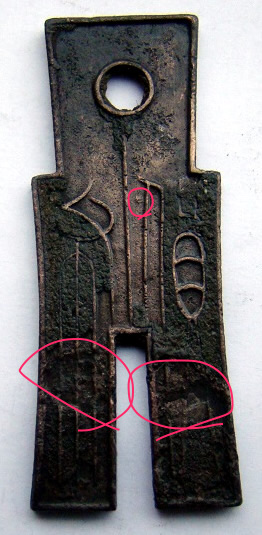
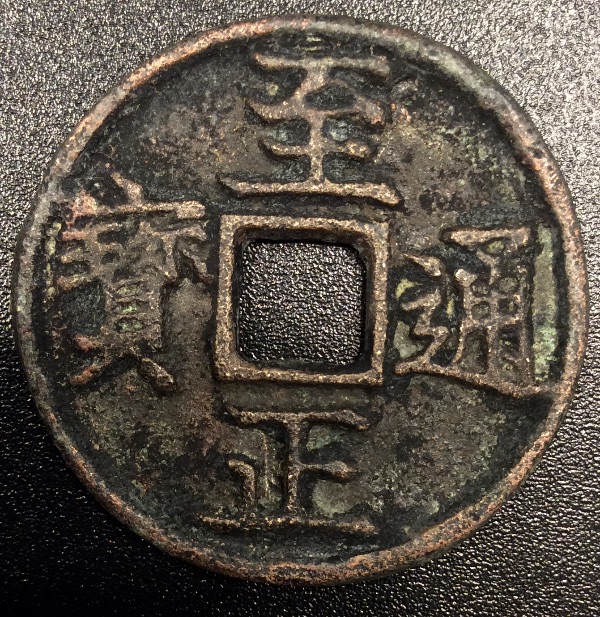
Indeed, all Chinese coins (save a couple of really rare ones; the Chu-gold blocks come to mind) up until the 20th century were cast coins. While I myself specialise in pre-Han coinage, I do come across these quite often (they are by far the most common spade-type). I myself also own one, which was the first Chinese coin I ever got (sorry for the slightly out-of-focus image. The book is an original 19th century Japanese coin catalogue):
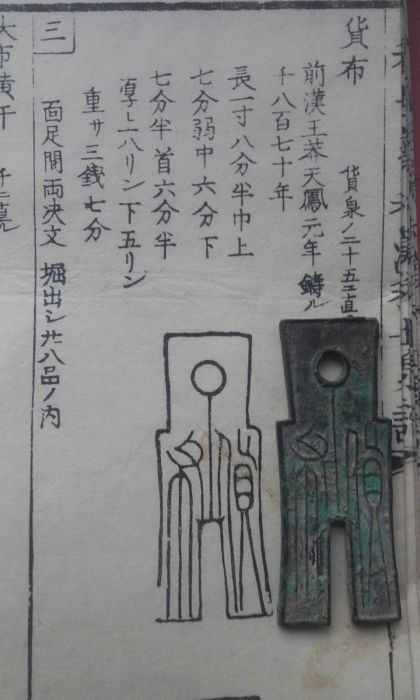
Justinokay's ID was quite close; A so-called 'huobo' (litt: 'Spade money') spade, which was valued at 25 huo quans (=125 Zhu), instigated in the last coinage reform of the usurper Wang Mang. Around 7 AD, this regent seized the imperial Han-throne and had himself crowned emperor of the newly created Xin-dynasty (Xin literally translates to 'New'). Wang Mang is an enigmatic figure in Chinese history, and ditto for his policies. He instated a state-owned monopoly on several markets and limited the amount of land a single person could own; the rest would return to the state. He is therefore often regarded as a sort of 'proto-communist'. He also reformed the coinage system multiple times, most of which were so extremely unpopular, that anyone caught possessing older Wu Zhu coins not deemed legal, would be executed. The reform in AD 14 would be the final reform and it, amongst other things, introduced the Huobo spade we see here. The Wang Mang-interregnum lasted until 23 AD, when peasant rebellions would overthrow the hugely unpopular Wang Mang and cut his body into pieces.
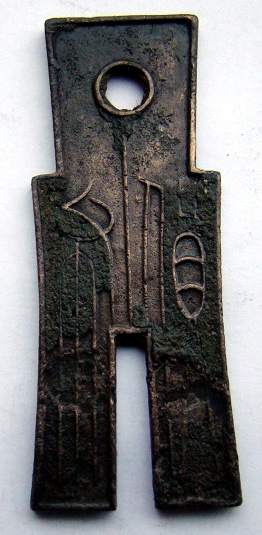
As for the authenticity: I am not 100% sure. You can never be with these pieces. But I definitely am not seeing any immediate red flags. The book Petrus references to is the first ever Chinese coin catalogue published in the Western Language (I had the privilege of handling an original copy a while back). And I hate to say it, but it is rather outdated and it is almost never used. 90% of the fakes from this type are extremely easy to detect, with the other 10% being extremely difficult. They are characterised by thin and accurate strokes and rims. This ticks both those boxes. The colour is correct for a cleaned piece. I am willing to say it is very, very probable to be genuine. A lot of people immediately assume all spades are fake, but they definitely aren't!
Vince, just two questions: could you please provide us with the measurements, weight and size, if possible? And: where did you purchase this coin? Based on the damage on the left foot, I think I know where you got it from; a lot at the NPV? If that is the case, I have a picture of it before it got cleaned. I actually bid on that lot! That coin is most likely authentic, and I get what you mean with 'high corrosion'. The patina/corrosion is a huge factor in authenticating these spades, so I wouldn't have cleaned it and I would always advise against. But it certainly isn't ruined!
Also: if possible, could you provide us with a picture of the rim? It is rather specific for this type of coin, so who knows we might be able to deduce something from that.
Thomas (TypeCoin971793) specialises in numismatic artefacts from the Xin-interregnum, and will undoubtedly be able to provide a lot more information on it's authenticity. I've send him a message, hope he will tune in and give his opinion.
Kind regards,
Mika












 Posted 12/24/2017 11:54 am


 I think that was a bad idea @vince. Hopefully @typecoin or one of our other experts on these will weigh in. in the meanhwile, here are a couple potentially useful threads: