| Author |
 Replies: 9 / Views: 1,666 Replies: 9 / Views: 1,666 |
|
|
Pillar of the Community
778 Posts |
A coin listed on ebay as "SEGOVIA OF 2 REALES PHILLIP III 1621(1608)", ebay # 312024556946, was just sold at about $270 US dollars. It is listed in my copy of MONEDAS ESPANANOLAS. 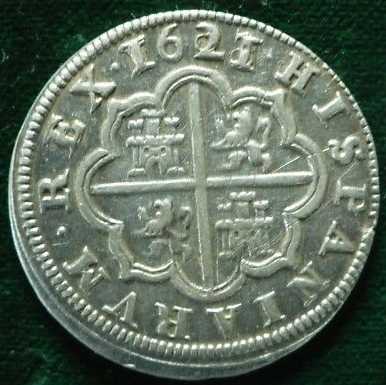 Why did the Spanish mint re-use old coins? Thanks, Bill |
|
|
|
Pillar of the Community
United States
1962 Posts |
|
|
Pillar of the Community
Australia
3841 Posts |
Very interesting. I'm a fan of overstruck coins. I'm not well versed in early European coins and can't comment much except it looked like it was a much larger coin which was reduced in size. Maybe a Spanish patagon?
My partial coin collection http://www.omnicoin.com/collection/gxseriesMy numismatics articles and collection: http://www.gxseries.com/numis/numis_index.htmRegularly updated at least once a month. |
|
Pillar of the Community
Belgium
1185 Posts |
@gxseries
are you talking about a patagon from the Spanish Netherlands (Albrecht&Isabella, Philips IV)?
they are not expensive, especially when worn
this possibiliy invokes a nightmare of numismatic forgery I would call numismatic plastic surgery converting a cheap original silver piece from the right period into a more rare piece (other type, other year) or pieces of a higher grade
(perhaps the contemporary restrikes of a new date on coins were a form of numismatic plastic surgery)
the numismatic fraud of today would take two steps
* buy cheap original silver piece made from the same silver source (+> XRF, SG would match)
** restrike with perfected dies
I can't say anything about this Segovia 8R except that the coin is very regular in shape, is that not weird? One would expect some edge irregularities
|
|
Pillar of the Community
Belgium
1185 Posts |
@BillSnyder the seller describes the coin as : " Condition: Preservation XF +, sharp striking, nice original patina, uncleaned, no stains, two light scratches. See photos. " 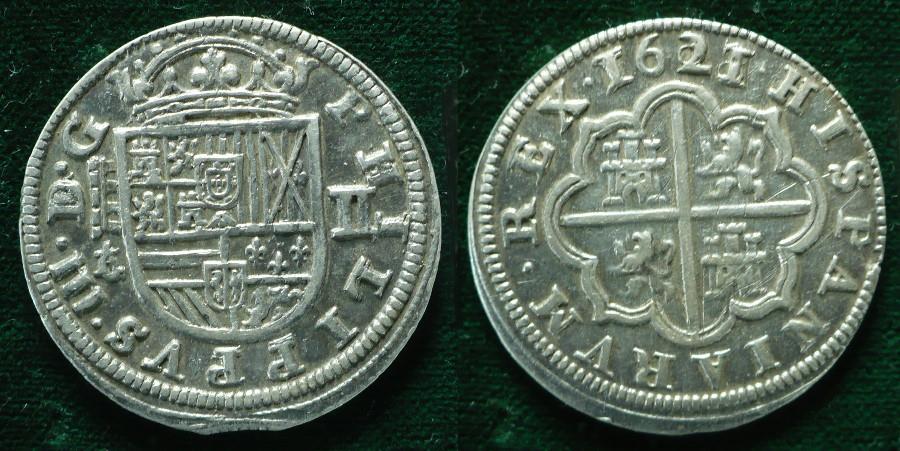 indeed very strange coin; better to be suspicious with the idea too nice to be true |
|
Pillar of the Community
United States
1962 Posts |
1c5d7n5m - Segovia was the one Spanish mint location that was producing modern Milled (round) coinage at this time... while all the rest were still hammering cobs. Segovia, in fact, was also still making some cobs in this period ("Old House" or "Casa Vieja", they refer to it as). As such, there's nothing odd about such a piece. In particular, the 1621/08 is a known type... and the ebay piece is from a legit old hoard. For the overstruck 161_ overstruck 2R I linked... It seems to be something, yes, larger... clipped down and struck with the milled coinage dies. Whether the dies are indeed milled (not cob) requires some verification, as 1610s Segovia cobs share more design elements with the Milled types as compared to the 1620s, where Segovia cobs vs. Milled are completely different). Some such blurring of the types, perhaps also reflected in a piece like this: https://www.sixbid.com/browse.html?...&lot=3387550may help justify how a piece like the overstrike I linked could have come about. That piece, BTW, has some provenance and certainly looks to be of that time overall... The Segovia mint has a foundation that is rather active, it seems... and I believe the head of it is from an Anglo background (Glenn Murray). I should poke around their list publications or perhaps even ask about it directly. http://www.segoviamint.org/english/association.htm |
|
Pillar of the Community
Belgium
1185 Posts |
realeswatcher - thanks for the detailed information I had a 2R from Segovia once, not Philip III but Philip IV- the piece was slightly curved and not 100% circular (more oval) unlike this piece I have the impression that the piece of the Auction is slightly curved https://www.sixbid.com/browse.html?...&lot=3387558moreover the elements of OBV and REV are sharper, it looks more OK but I am not an expert |
|
Pillar of the Community
 778 Posts |
I phrased my original question poorly. Instead of "Why did the Spanish mint re-use old coins?" I should have asked "Why did the Spanish mint re-use old coin dies"?
Sorry about that,
Bill
|
|
Pillar of the Community
United States
1156 Posts |
One of the members of my coin club is Roger Burdette and we recently had a discussion regarding the steel used in coin dies (he wrote the book "From Mine To Mint: American Coinage Operations 1833 to 1937"). Quality steel for dies, even as used in the early days of the US mint, was difficult to produce and die life was highly variable. Therefore, one reason for reuse of dies is to continue to make use of a die that came from a batch of steel that the right characteristics to enable its durability. Here's a post from swamperbob discussing die steel in colonial mints: Quote:
As far as I know, the best die steel in 1819 was still coming from mainland Spain. New World steel (even US) before the mid 1830s was simply not as good. The revolution in Mexico created additional die steel shortages as evidenced in the products of most of the branch mints. If you take note, the early Republican issues had their share of problems caused by poor quality die steel as well.
When steel for new dies was in short supply - over cut letters and repairs to dies are observed to increase in number. These are just logical conclusions drawn from the history of the times and examination of coins from the era.
If you check into the history of steel production it is easy to determine a break in time between the old methods of steel production and modern production - the date is 1856 and is due to the Bessemer process. Prior to this all steel was produced manually in small batches. |
|
Pillar of the Community
United States
1962 Posts |
Keep in mind their "modern" coining operation was what was called rocker press (also known as 'roller press'). Some web searching will elaborate... you end up with all kind of crazy clipped edges on these, sometimes combined with centering errors (especially on the 1660s copper maravedis issues, made by multiple Spain mints - sometimes even with dangling "webbing" pieces attached).
|
| |
Replies: 9 / Views: 1,666 |
|










 Posted 12/26/2017 5:59 pm


