| Author |
 Replies: 15 / Views: 3,722 Replies: 15 / Views: 3,722 |
|
|
New Member
United States
26 Posts |
I'm contemplating collecting maybe half a dozen one ounce gold coins, but I'm discouraged when I read about brown spots that develop randomly and spontaneously. But who wants to spend $1,500 on a coin, only to have it lose its beauty down the road? So, are there certain coins or certain mints that tend to have brown spot problems (like milk spots with silver coins?) If you purchased ten gold coins, how many on average would wind up with brown spots in the foreseeable future?) Or am I making a bigger issue out of this than it really is?
|
|
|
|
Pillar of the Community
Canada
849 Posts |
I recently saw someone's Maple Leaf Canadian gold coins from the late 70s to 1990. Not one of them has spots. They had been stored in tubes in a safety deposit box and none had spots.
|
|
Valued Member
United States
338 Posts |
I have had only a few with spots. One of them, a $20 liberty I dipped in EZ-est and the spot went away. Some collectors and dealers don't care about the spots.
|
|
Pillar of the Community
Canada
1051 Posts |
I've never owned a 24K gold coin with the dreaded red (brown) spots, nor seen one in person. The only way it could happen would be cross contamination at the mint, or atmospheric/environmental contamination during manufacture.
In the case of non-pure coins (Eagles, Krugerrands, etc.) I can see the possibility for copper "hotspots", but unfortunately I don't own any because of the tax laws here :(
|
|
Valued Member
United States
142 Posts |
I dont know. I had seal gold coin like the RCM maple in assay card for instance have those red spots and queens beast form red spots while sitting in a capsule! |
|
Pillar of the Community
United States
4333 Posts |
I've seen Buffalos with the spot.
When I listen to LED ZEPPELIN...so do my neighbors...
Roll hunting since '77
Dirt fishing since '72
|
|
Pillar of the Community
United States
992 Posts |
I've never seen spotting on any coin from the US Mint, you could limit yourself to Walking Liberties and probably be very safe.
If you're 'collecting' for the end of civilization as we know it, best to have a variety of sizes, 1/10, 1/4, 1/2, and full Ounce coins, for 'spendability'.
|
|
Pillar of the Community
United States
2023 Posts |
I had a 2014 Baseball Hall of Fame that developed a spot while in the slab. The seller's pic did not have the spot; the coin I received did. Same certification number, same slab (unless they re-slabbed and got the orientation perfectly identical). Key word: "had" -- I returned it. I have a 2008 Buffalo that has some mild red toning. Barely noticeable unless you're looking for it -- it's rather diffuse. Those aside, spotting seems to be fairly rare, though it obviously does happen. Just inspect carefully, make sure you can return it if you want to, and store what you get properly. |
|
Rest in Peace
United States
17900 Posts |
The higher the percentage of gold content, the less likely of any problems.
Coin gold for the U.S, with some exceptions, is 90% Gold. If the metal wasn't completely blended copper spots might exist on the surface which would tone. Even then the vast majority were well blended.
A Maple Leaf at .999% Gold isn't likely to develop spots.
|
|
Pillar of the Community
United States
777 Posts |
If you acquire bullion gold coins you're pretty much paying for gold, and when you go to sell should only expect to receive payment for gold so it wouldn't matter if you had spots or not. I myself have Mexican 50 peso and 20 peso coins. No spotting. I also have modern day U.S. Gold eagles and buffalos as well as various gold commemoratives in their original packaging, and in addition I have a few original U.S. gold coins from the 19th century and no problems. All my coins are either in hard plastic containers I purchased, or are slabbed. Everything is in a safe deposit box. No spotting anywhere.
|
|
Pillar of the Community
United States
3789 Posts |
I have seen spotting on even Chinese panda bears from 10 years ago, in fact one of my mine developed them.
Buffalo gold coins can get them, proof and bullion.
I have a Libertad that developed brown spots.
Bottomline- you will get toning and brown spots on ANY gold coin. Is it common as milk spots on silver coins, I would say NO based on my collection that goes back almost 20 years and from looking at older dated bullion coins. So I agree with others that brown spots are NOT that common.
I have a ton of proof gold eagles of all sizes that have yet to develop brown spots.
Here is another thing to consider. Suppose you get some brown spots on a gold coin. Even if you do, if that gold bullion coin is in high demand, low mintage and well liked, the vast majority of collectors will stay pay some sort of premium, it may NOT be the top end but they will still pay it because the coin is in high demand.
As an example, some gold pandas from the past have developed brown spots. Collectors will still pay a hefty premium on the coins because they are still low mintage and high demand.
Also, some coins you can send in for preservation and the gold coins are removed without impacting the value of the coin.
I would rather collect more gold bullion coins which will have LESS brown spots than TONS of issues with milk spots on silver coins.
|
|
Pillar of the Community
United States
4211 Posts |
I own very few gold coins but out of the ones I have there is just 1 with a tiny spot on it.
Not hardly worth mentioning.
|
|
Pillar of the Community
United States
3789 Posts |
another thought is stick to some quality mints, like the Perth Mint, I have a few older proof kangaroos and they appear today as they did almost 20 years ago! |
|
Valued Member
United States
426 Posts |
If you are buying for numismatic value then yes, you have to be careful when selecting gold coins, if it is just for intrinsic value then no big deal.
|
|
Pillar of the Community
United States
6432 Posts |
Hard to see how pure gold coins would tone. You can melt the pure metal with a blowtorch and it will form a new pristine surface as it cools, with zero discoloration. I'd think you would have to expose the coins to liquid mercury or chemicals like chlorine or cyanide to cause a chemical change.
I agree copper spots and surface toning are possible for gold-alloy coins like the 90% USA gold pieces.
|
|
Pillar of the Community
United States
2023 Posts |
Quote:
Hard to see how pure gold coins would tone. You can melt the pure metal with a blowtorch and it will form a new pristine surface as it cools, with zero discoloration. I'd think you would have to expose the coins to liquid mercury or chemicals like chlorine or cyanide to cause a chemical change. I agree copper spots and surface toning are possible for gold-alloy coins like the 90% USA gold pieces. I can't speak to the "how", nor yup's "quality mints, like the Perth Mint" comment, but I just got a 2018 Year of the Dog gold piece ( Perth Mint) this morning with some toning near the crown on the reverse -- second spike from the right (the toned area is to the left of the spike, total area a little more than the size of the spike itself). It's definitely on the coin (not the PCGS holder) and only noticeable with proper lighting and magnification. I'm kinda bummed, but it's not horrible (you can't see it unless you look for it) and it does still have intrinsic value. The obverse (the side I bought this for) is great despite the incredibly shallow relief and light scratches on the holder. 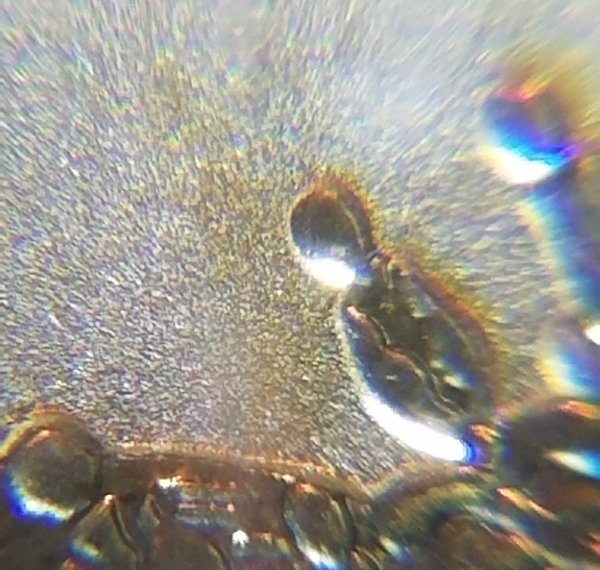 |
| |
Replies: 15 / Views: 3,722 |
|







 Posted 01/04/2018 11:11 am





