Posted 01/05/2018 07:38 am


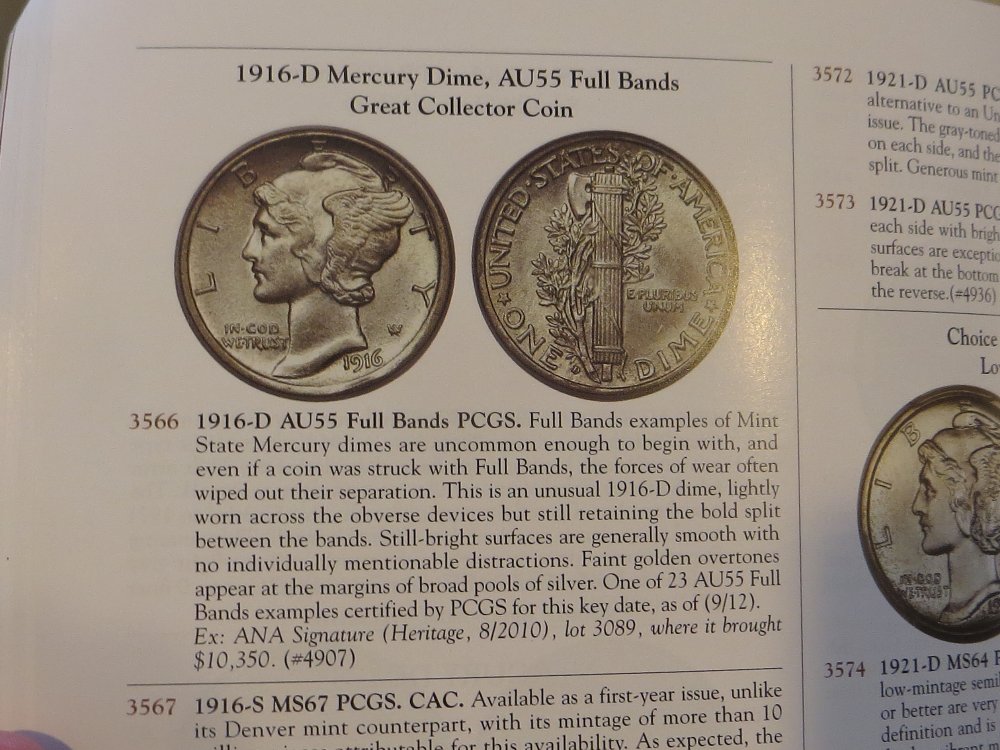
I think this is a good question. It really depends upon how you define "Full Bands". If by Full Bands you mean "full and rounded" ... then AU-58 may be as low as the grade could go. If you mean "split bands" ... then a coin as ow as a 55 or even a 53 could garner such a designation.
I've observed coins recently that PCGS has given the "FB" designation, that I would term "Split Bands". The line between the bands is uninterrupted, but the bands are flat, not "full", which I interpret to mean "rounded" from north to south, across their entire length.
Seems the interpretation of "FB" has degraded somewhat in recent years.
Its possible that for some issues, by "my" perception of what "full bands" actually means... perhaps none exist. At the very least, far, far fewer examples are extant.
If I play "fast and loose" with the FB designation in evaluating my own collection, then my 21-P is FB ... but it's not. The same could be said for many others.
I got my 1917-D from England, where the seller had estimated it to be VF ... but it's clearly an AU coin.
Chance
I've observed coins recently that PCGS has given the "FB" designation, that I would term "Split Bands". The line between the bands is uninterrupted, but the bands are flat, not "full", which I interpret to mean "rounded" from north to south, across their entire length.
Seems the interpretation of "FB" has degraded somewhat in recent years.
Its possible that for some issues, by "my" perception of what "full bands" actually means... perhaps none exist. At the very least, far, far fewer examples are extant.
If I play "fast and loose" with the FB designation in evaluating my own collection, then my 21-P is FB ... but it's not. The same could be said for many others.
I got my 1917-D from England, where the seller had estimated it to be VF ... but it's clearly an AU coin.
Chance
Edited by Chancellor Sutler
01/05/2018 07:41 am
01/05/2018 07:41 am