pirgah Welcome to the great fun of collecting the Portrait series. I have been collecting counterfeit 8 Reales since I was 10 years old. I started collecting coins in general a few years before but I was intrigued by counterfeit coiins. I am now 70 years old and also have cataracts in both eyes. So I bought a large 40 inch flat screen TV and hooked my laptop to that to make the photos easier to see. Fortunately my floaters have gone away. So now I see better than I did only a few years ago. I use a binocular microscope to study coins in hand. So in my experience cataracts can be overcome by looking at larger images. Just make sure the TV is a good high pixel one.
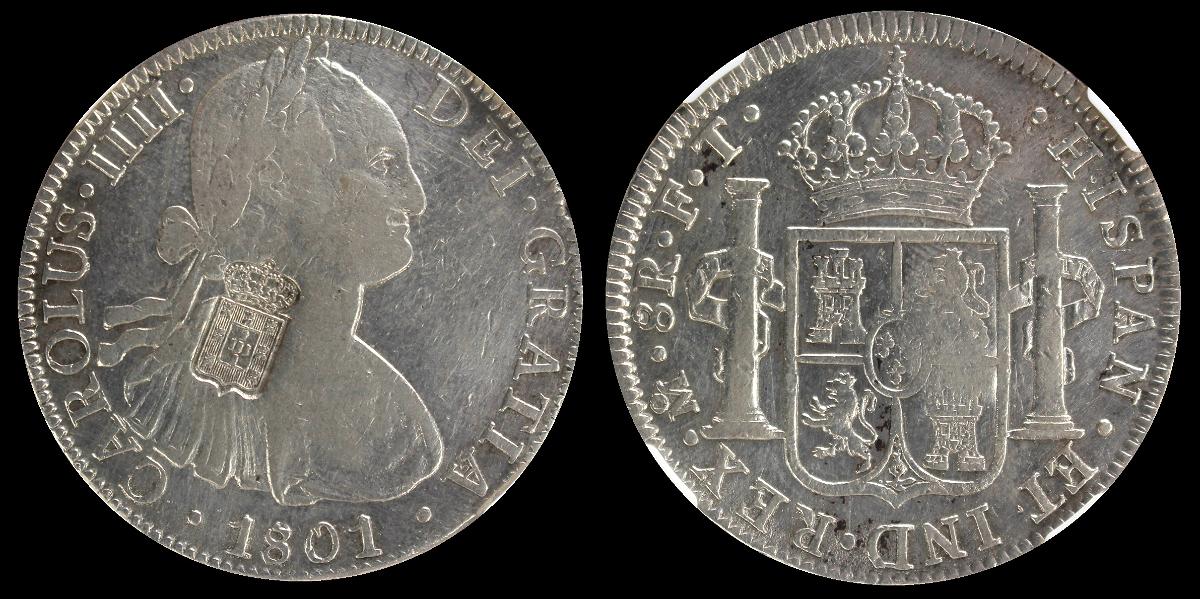
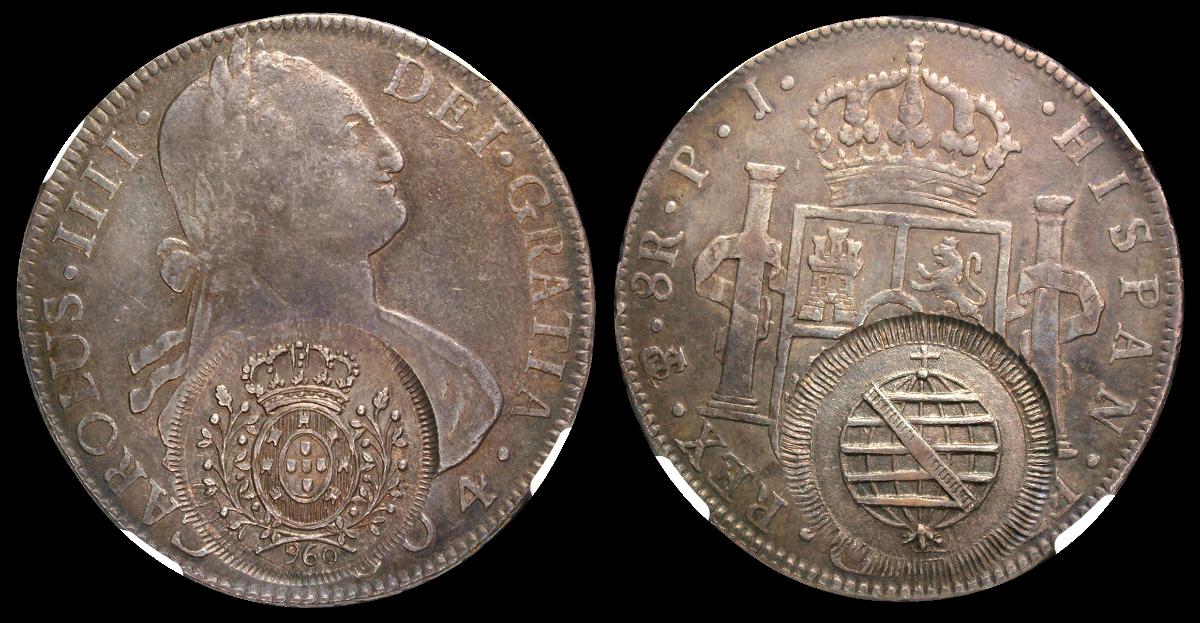
Both of these counter stamps are far more common as forgeries than as genuine coins. That is an absolute given so you need to be extra cautious when looking at pictures of these types. Safer to buy in hand.
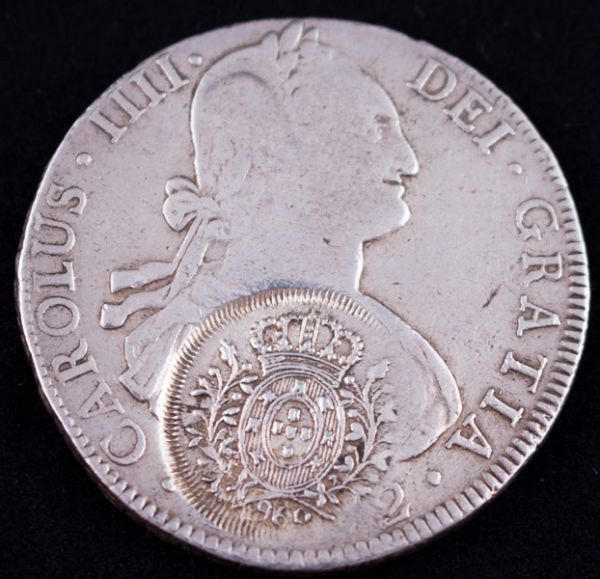
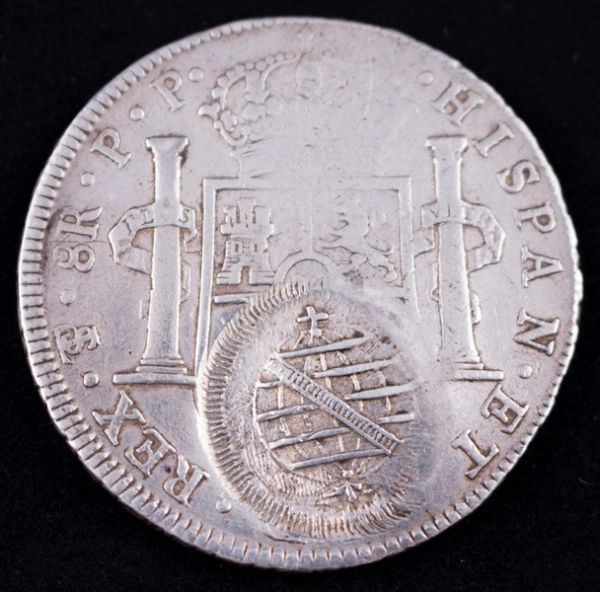
The Portuguese stamp is not one of the ones I would classify as a forgery based on the appearance of the design. There is no obvious percussive impression on the reverse which is a common flaw on forgeries that were made recently. They also learned quickly to reduce the pressure of the strike and they tend to artificially wear the reverse to get rid of the rim of the percussive impact.
I do see there are horizontal lines (diagonally up and to the right when viewed upright). An in hand inspection would be needed to see if the area is worn or artificially smoothed. The presence of the "lines" makes me suspicious.
The Portuguese stamp was applied in 1834 so the date of the host is not a problem.
A Specific Gravity test will disclose a debased counterfeit in any case so in hand that is the first thing I would do.
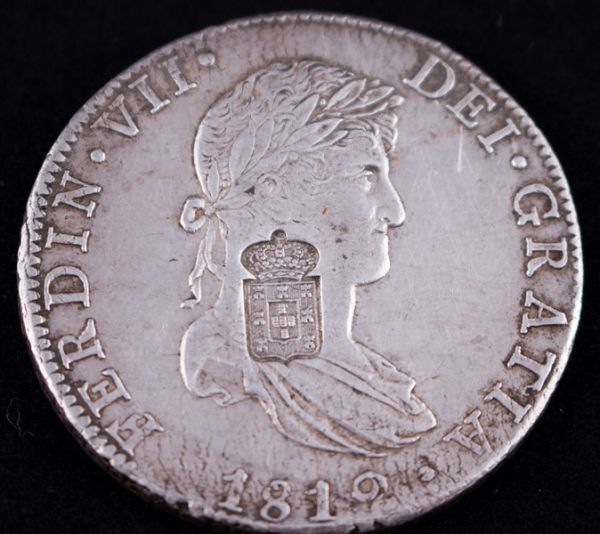
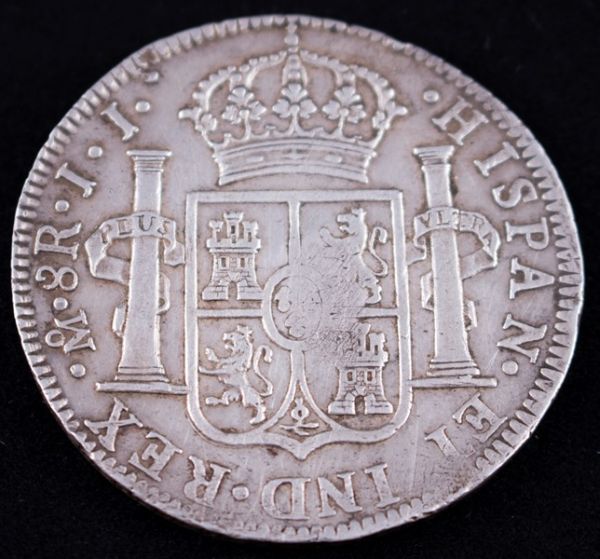
The 1819 Mexico City 8Rs were not made as Trade silver counterfeits until after 1885 when they were authorized as a face value coin in the Philippines. Until then silver counterfeits of Ferdinand 8 Reales made no financial sense for counterfeiters to make. There was no market where they would produce an adequate profit. (Counterfeiters only make coins they can get a profit from).
After 1893, the crash of world silver prices these coins all became bullion items so no silver counterfeits of Ferdinand coins were struck after that time. The 1885 to 1893 is a very brief period and I have never found a Ferdinand VII coin without a gold trace. So I am not certain any were actually made for the Philippines.
The host coin designs look very nice. I believe both are correct. So when could they have been made? A struck copy requires dies and a hand copied die always has errors. Cast dies made at that time used green sand or clay and oil to transfer impressions so graining is a problem. Finer grained matrix materials for dies were introduced about 1830. In that same decade a new industrial technique was developed to duplicate dies.
That process to replicate dies was developed first in France in the 1830s. Riddell was aware of this process in 1845 and attributed Durango counterfeits (dated 1832, 1834 and 1836) to this technology.
Electro-typing, spark erosion and Impact transfer were developed in the 1840-1850 period of time.
Based on those dates and the fact that the host coins are likely struck makes them unlikely to date before 1830 if they are in fact counterfeit hosts. Therefore I theorize that both host coins are genuine.
I agree with the comment that the Minas Gerais stamp looks seriously bad. There are very similar bad stamps coming out of Spain that are clearly recent forgeries. They appear mostly on cull grade coins with holes or serious damage. However, I have seen a few struck on VG grades of common dates. They use what is at hand and cheap. I am fairly sure the Minas Gerais stamp is a struck feature based on my review as opposed to a casting with that feature included on the mold. There is a texture difference. In addition I do not view the coin as a clear forgery - no proof yet.
Since neither of these host coins were targeted as Class 2 Silver Trade Counterfeits, I tend to look for earlier counterfeit traits. As I said above both hosts look pretty good to me. I would like to see the edges but with auctions on
ebay and elsewhere many do not post such photos. The edge might diagnose a modern forgery. Ask the seller for edge pictures if you get them you may be able to tell. If you do not get them suspect a problem.
It is an axiom that when a deal on
ebay appears to be too good to be true - ASSUME IT IS A FRAUD.
I am very leery of the Minas Gerais issue and of the two it is more likely to be a modern forgery. Not 100% certain but leaning that way based on what I see.
This is a detailed review of my mental process of authentication. I learned it is best to approach the issue scientifically. Use history and clues on the coins as distinct points in a process. Always consider all possibilities. Do not let your wish to get a bargain or your like for the appearance of a coin sway good judgement.
The process takes a couple minutes to go through and that is why the TPGs can not do what I do. No one on their staff as over 50 years experience looking at 8 Reales and they do not spend two minutes confirming authenticity.









 Posted 01/27/2018 1:41 pm