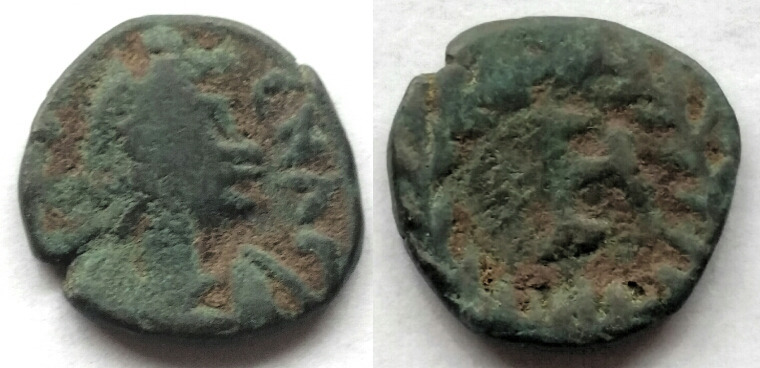
I knew that one of these coins were going to be in the nummus lot when I bought it, but the rest were a happy surprise! I love incorporating history into my collection, so here we go!
The Vandals were one of several Germanic tribes, originally from NE Europe, who were pushed west by the encroaching Huns during the third and fourth centuries. They came to settle in Roman Hispania, which they largely managed to wrestle from Roman control by the 430s. In 429, the Vandal king Genseric sensed the weakness of the waning Empire, and successfully invaded thr Roman provinces of North Africa, taking the ancient city of Carthage in 439. Relations with Rome understandibly soured, culminating in 455 when, egged om by the hollow threats and annulment of the betrothal between the Vandal prince Huneric and Roman princess Eudocia, Genseric laid seige and completely sacked Rome.
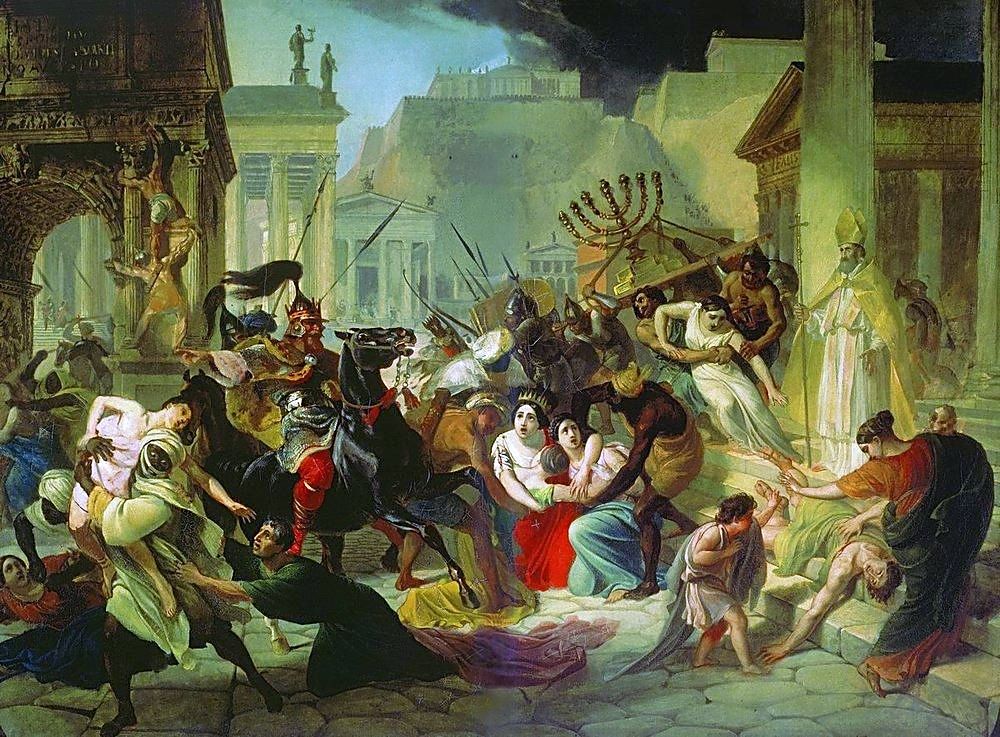
This certainly soured foreign relations, but it sent the message that the Vandals were not a force to be trifled with. This was further reinforced by the blundered attempt by the Byzantine Empire to conquer the kingdom in 468--The general Basiliscus, in command of over 1,000 ships and 50,000 troops, allowed the Vandals to break his formation and lost over 10,000 troops in the retreat. Much like the Romans had been in centuries past, the entire world now feared to take on the skilled and fearsome Vandal army.
The marriage between Eudocia and Huneric was finalized, and they had a son named Hilderic. Raised in the Catholic faith and the biological grandchild of Valentinian III, Hilderic enjoyed excellent relations with the Byzantine empire, and was a close friend of emperor Justinian upon his ascent to the throne in 523 at the age of about 60. Hilderic's faith was a cause of great concern among the Vandal nobility, who were all Arians and had traditionally persecuted Catholics.
(Aside: Arianism is an extinct branch of Christianity that holds Jesus to be divine, but a separate person from God, who did not exist prior to the Annunciation, and was therefore less worthy of praise. Catholics and Arians both deemed the other's faith to be heresy. Arianism became extinct in the middle ages, and the closest parallels today would be Unitarianism or Jehova's Witnesses.)
Hilderic's bronze coinage was mostly a throwback to the "Cross in Wreath" design used by his great-grandfather, Theodosius II. The coins originally bore a legend HILD REX, but they can be attributed based on the style of the drapery, and the thicker cross and wreath:

Hilderic was deposed and imprisoned by his cousin Gelimer in 530, an act seen as unacceptable by Justinian. Still wary of the idea of attacking the Vandals head on, Justinian decided to utilize tactic to invade the Vandal kingdom and secure the throne for his friend. Entrusting his general Belisaurius with his fleet, they prepared for attack in 533. Rather than risk a head-on campaign for a Phyrric victory, Belisaurius sent agents to the opposite side of the Vandal kingdom to incite rebellions. Taking the bait, Gelimer sent nearly his entire army to deal with the problem, whereupon Belisaurius landed his army in Africa. He met with Gelimer's forces outside of Carthage, and were nearly defeated when Gelimer's brother fell in battle, and the Vandal king left his army to flee in grief. Employing strict discipline among his men, they donned the mask of saviors and liberators, and were welcomed into Carthage.
Here is an anonymous Vandal nummus from Carthage, sometimes attributed to the time of Hilderic or Gelimer
Vandal-style bust right
Six-pointed star within double wreath

Upon entering Carthage, the Byzantines learned that Hilderic had just been slain on orders of Gelimer to prevent his possible return to the throne. Gelimer managed to rally with his army on their return from dealing with the rebellion, and met with Belisarius outside of Carthage. The Vandal army was defeated, and Gelimer fled to a stronghold where he held out for three months until his starving subjects forced his surrender. Gelimer was brought to Constantinople for the triumph of Belisarius, but was then allowed to retire to his estates where he lived to an advanced age.
Although not quite a complete set, the lot held an impressive variety of Carthage-mint nummi of Justinian.
1.
Diademed and draped bust right, garbled legend IV(S)IT...
Chi-Rho within double wreath
SB 283b
Scarce

2.
Diademed and draped bust right, legend ... STANI...
VOT XIII within double wreath, minted 539/540
SB 278
Scarce
I believe this is the very last VOT type coin, although it has been remarked that the Byzantines may have been aware of the type, but oblivious to its true meaning. VOT XIII and XIIII are known.

3.
Crowned bust facing, holding cross on globe, no legend
CN within wreath (supposedly standing for Carthage Nummus)
SB 283C
Rare

Following their 534 victory, the Byzantine Empire would hold the provinces of North Africa for over 150 years until the conquests of the Umayyad Caliphate.







 Posted 02/23/2018 04:57 am