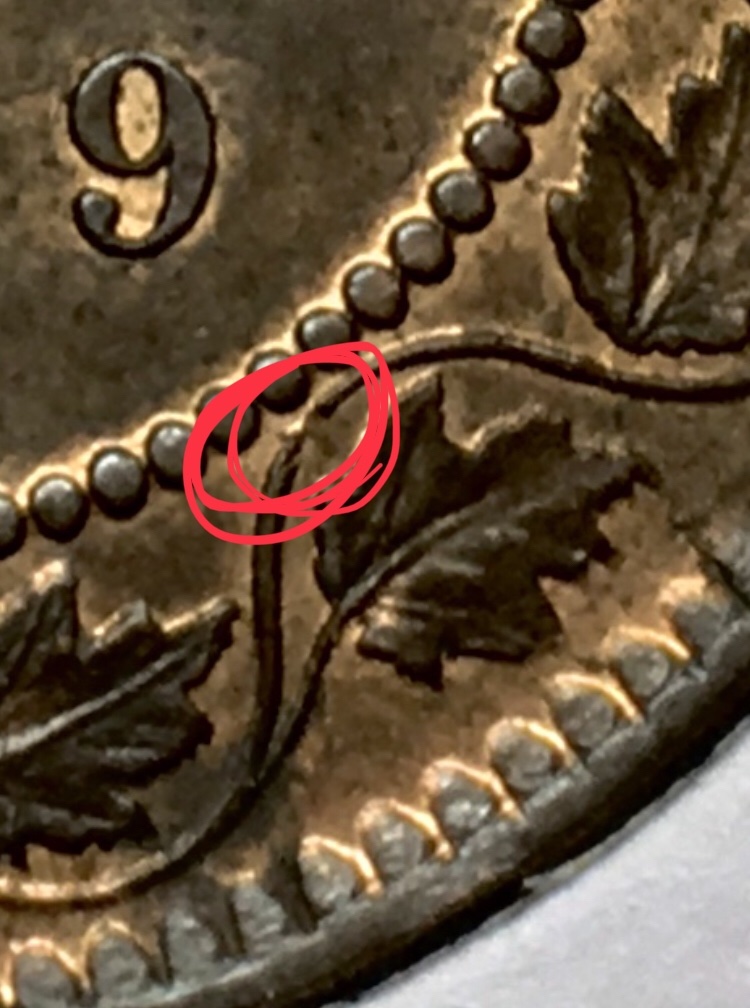
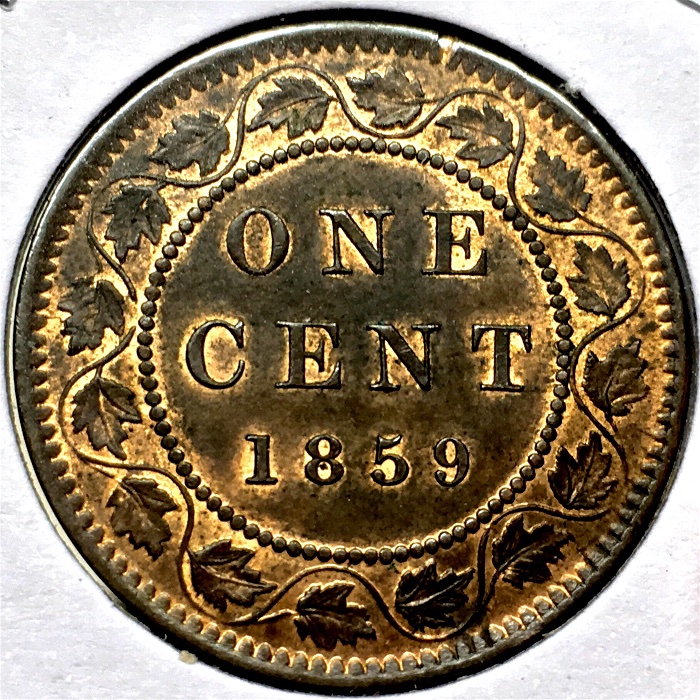
Yes, you number the Reverse leaves starting at 12:30 on the clock CW to leaf 16. Leaf 7 is the inside leaf by the 9. Relatively early in the 1858 striking cycle, a portion of the hub broke off by leaf 7, just a little at first and then the gap got gradually larger as the hub chip got bigger, through the rest of the 58's and all the way through the 59's. About half of the 58's will show a small gap there and all of the 59/8's and 59's.
With a 10 million order for Canada to the
RCM in London, they had a hard time getting things ready at the mint to strike bronze planchets 1/3 thinner than the Brit halfpenny of the same diameter. The thinner planchets and intricate design, especially the reverse, was hard on both the hub(s) and the dies that the hubs made/struck. As such, the hub chipped off the vine at leaf 13 after making just 4 1858 working dies ... 3 with all 16 leaf stems and 1 with just 15. Shortly thereafter, the hub broke at leaf 7, so ALL 1859's will have vine gaps at 7 & 13... then one started at leaf 2 as well.
So much time had ensued (all 10 million were actually ordered for 1858) that only a little over 1 million 1858's were struck before 1859 started. But all the mint had were 1858 hubs and dies .. no 1859's. The Mint took the remainder of the 1858 working dies already made and handpunched a larger font 9 over the 8 and made somewhat over 1/2 million of the 1859/8's to get to the banks and merchants. Then they took the 1858 hubs and ground off the last 8 and struck all the remaining working dies with just 185. Then, they had to handpunch 9's (2-4 whacks at a time)into every one of the remaining Reverse working dies to make the 10 million total. There are actually fewer 1859/8's around than 1858's. At about 50,000 coins to a Reverse Working Die, that's lots of hammering and lots of varieties. Because of the evolution that ensued, you can tell about when in the minting cycle any 1859 came out.... small gap vine(less than 1/2 bead) at 7, very early; small gap (1/2 bead width) early; full bead width, no gap at 2, midyear; full bead gap, bigger gap at 2, later; and finally a beadwidth or more at 7, wide gap at 2, late in the year.









 Posted 03/04/2018 10:38 am