| Author |
 Replies: 8 / Views: 9,641 Replies: 8 / Views: 9,641 |
|
|
Valued Member
Australia
66 Posts |
Hello. I did post a picture of a 1942 penny with I have been told ghosting. I have found my dad has 2 x 1942 ghost penny's (1 more ghosting) and also 1941 and 1940. He may have liked that that period had this problem. I have no idea. Please comment. The picture id of the 1942 which shows this flaw clearly. Veronica http://i289.photobucket.com/albums/...t=1212959176Edited by Dolly
06/08/2008 5:06 pm
|
|
|
|
Formerly nancyc
Australia
5385 Posts |
This is a fairly common occurence on Aussie pennies, might add a small % to the value, but wouldn't be much. Of course if it's a very low mintage coin, the coin may attract a nice premium. It's a good idea to post pictures of both sides of the coins, that way anyone looking at them should be able to identify where it was minted correctly. Some of the pre-decimals might have several mints involved in minting them & sometimes the mint mark is on the Obv (front), sometimes on the Rev (back), sometimes a combination of both. You're doing well with the photos, keep it up & you'll soon have a heap of info about your coins.   life is a mystery to be lived not a problem to be solved
|
|
Pillar of the Community
United States
5318 Posts |
Wow, that's a pretty dramatic ghosting! And, judging by the details on the reverse, would that be a very worn die? I notice that Farnbycoins has a 1942 penny with similar ghosting. Does anyone see the different shape to the 2 in the date--strike or die wear perhaps?  |
|
Valued Member
Australia
206 Posts |
Quote:
This is a fairly common occurrence on Aussie pennies Yes and especially on the war time coins. The need being urgent, the mint really extended the life of the dies, and ramped up the strike pressure to extend the dies life. This has caused a great many weak detail/ worn die strikes for the 40's coins and this ghosting phenomenon is common on these coins. Yours however, is a very strong example, and if the roo also shows through the Kings head in the same manner, then would spark some interest from collectors. I have seen this effect sell for into the $20.00- $30.00 range for very strong examples in the mid grade range, that appear both sides, but normally reach this price on only the 41 varieties for some reason. Edited by farnbycoins
06/09/2008 12:39 am
|
|
Valued Member
Australia
206 Posts |
You will see on the picture of mine Kurt, a slight strike through type spur showing in the field above the 1 in the date under the roos hind. These seem to gathering a following on auctions, mainly on Eliz II obv coins, referred to as shark fin spur, but normally are stronger than mine, hence, I would not class nor sell this 42y as such, is just interesting is all. 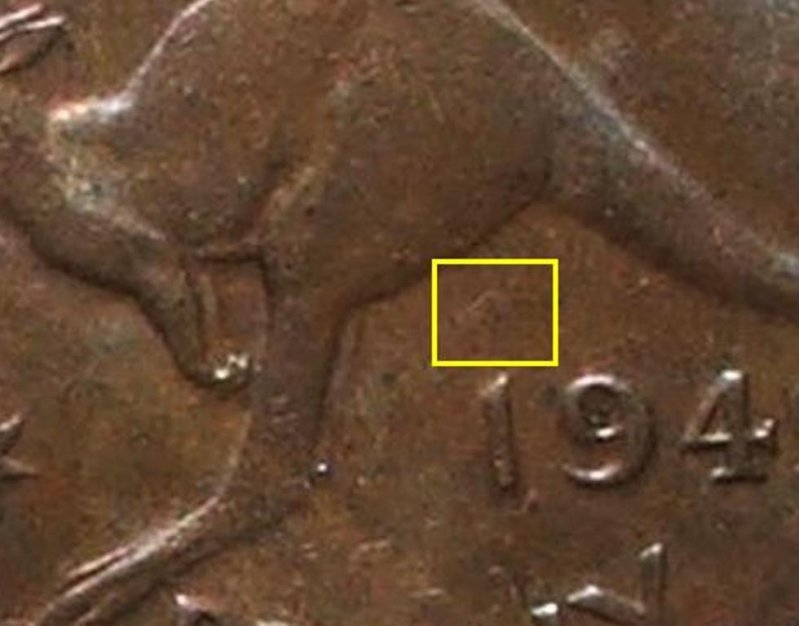 |
|
Valued Member
 Australia
66 Posts |
Edited by Dolly
06/08/2008 11:09 pm
|
|
Pillar of the Community
United States
5318 Posts |
Edited by KurtS
06/08/2008 11:20 pm
|
|
Valued Member
Australia
66 Posts |
Hello. Sorry loaded the wrong pic. Have another look. Please.
|
|
Valued Member
Australia
206 Posts |
Ah, ok dolly, well there was no " no mint mark" coins struck for the 42 varieties, only 42y dot= Perth or the Bombay coins (dot before and after penny). Your dad probably marked it M as the Perth coins were derived from the 1938 Melb master tools. He was more than likely investigating the different mint mark positions. It is suggested they come from many dies, each dot individually hand punched onto each die. The Dots appear in different positions on the Perth coins. The first you have pictured sits low and wide, and the second higher and closer to the Y. Is very interesting to observe, but due to the high possibility of numerous different positions, collector interest in terms of investment are not at a high level. As to that bum bite roo Kurt, it looks as though the dingos got to it first, lol. Possibly just a foreign object or dollop of grease at time of minting. Has always baffled me that one. |
| |
Replies: 8 / Views: 9,641 |
|










 Posted 06/08/2008 8:08 pm


