| Author |
 Replies: 24 / Views: 7,492 Replies: 24 / Views: 7,492 |
|
Valued Member
Belgium
54 Posts |
Hello there, As I do with all coins before putting them in my storage, I give them an acetone soak just to remove grease and other stuff which could be residing on the surface. Recently, I did the same to some 18xx copper coins which are in AU/MS quality but after the acetone evaporated they started to look dull with some greyish parts around the letters. Greyish and white parts around the edges after an acetone soak are signs of residue from cleaning products but I am 100% certain these coins have not been cleaned. Sometimes, dirt that has been on these coins for a long time can create the same issue. The question is, can I get rid of this stuff? A longer soak didn't help. I added pictures of one of the coin before the soak   |
|
|
|
Pillar of the Community
Australia
1366 Posts |
Quote:
... but after the acetone evaporated they started to look dull with some greyish parts around the letters Hi jagoedo, would you be able to post a photo of one of the coins after it has been soaked in acetone? |
|
Pillar of the Community
Canada
9590 Posts |
You should try Verdi-Care after the acetone bath.
|
|
Pillar of the Community
 Canada
9901 Posts |
Do not use acetone for copper, bronze, or brass coins.
"Dipping" is not considered cleaning...
-from PCGS website
|
|
Valued Member
 Belgium
54 Posts |
I will post some pictures this week.
@DBM, could you please explain why not to use acetone on copper or brass coins? This is pure acetone so no risk of residue on the coin. I haven't seen any scientific evidence that acetone would react with copper or brass. Have soaked hundreds of copper coins without problem. This just happens sometimes
Edited by jagoedo
03/18/2018 1:13 pm
|
|
Moderator
 Canada
10473 Posts |
Quote:
I give them an acetone soak just to remove grease and other stuff which could be residing on the surface. Whether you soak the coins in acetone or not, the biggest factor in protecting your coins in storage is humidity. That said, DBM is partially correct, I know that acetone can detrimentally impact the surface lustre of mint state red copper and bronze through a photo-chemical reaction, but usually the patina of brown coins protects against this happening. Quote:
I haven't seen any scientific evidence that acetone would react with copper or brass https://www.sciencedirect.com/scien...468601003590 It is not the acetone itself, but in sunlight or bright light, it is the acetic acid produced that then reacts with the copper. In the absence of light, this does not occur. "Discovery follows discovery, each both raising and answering questions, each ending a long search, and each providing the new instruments for a new search." -- J. Robert OppenheimerContent of this post is licensed under a Creative Commons Attribution-NonCommercial 3.0 Unported License. See: http://creativecommons.org/licenses...0/deed.en_USMy eBay store
|
|
Pillar of the Community
Canada
9901 Posts |
I read about the effects of acetone on copper here on this forum.A few years ago on a bright June day I gave some red cents an acetone bath outside on my patio. Sure enough some of them discolored. Since then I err on the side of caution and do not clean any "copper" coins with acetone.
"Dipping" is not considered cleaning...
-from PCGS website
|
|
Valued Member
Belgium
54 Posts |
I knew of this paper but never read it. Just went through it. Quote:
A 99.9985% pure copper foil of thickness 0.1 mm (Johnson Matthey, Massachusetts) was cut into coupons measuring 1 cm2. The coupons were coarsely polished with 240-grit SiC paper and rinsed in acetone for 15 min. Each coupon was dropped into a glass beaker containing approximately 15 ml of acetone. The beakers were then placed in a glass trough containing water and covered with another inverted glass beaker, to ensure sufficient humidity at room temperature as shown in Fig. 1. To facilitate testing in darkness one of the covering glass beaker was wrapped with aluminum foil as shown in Fig. 1(b). The surface of pure copper after exposure to acetone in the presence and absence of ambient light was photographed under an Olympus BH-2 binocular microscope, which was interfaced with a Javelin CCD camera and computer.
...
Over a period of 18 h the copper foil that was immersed in acetone and exposed to ambient light developed blue crystal deposits as shown in the optical photomicrograph ... Given, the right conditions, of course. But I don't soak my coins for longer than a minute or a few minutes (unless longer periods are needed) and do it in a darker room of my house in a closed jar. These are quite experimental settings and as a researcher myself I don't disagree with the findings but I think that chances of hitting this sweet spot during a normal daily routine are pretty low. @DMB pure acetone? Because I do know that unpure versions can indeed cause discolouring. Edited by jagoedo
03/18/2018 2:37 pm
|
|
Moderator
United States
23522 Posts |
Some day I hope to be able to duplicate this "damage." I've been trying off and on for a decade now, and haven't succeeded. Until I do, as usual every coin I buy gets an acetone soak.
And I only buy copper.
|
|
Valued Member
Belgium
54 Posts |
@SsuperDdave. Did you maybe had the issue I've encountered today?
|
|
Valued Member
Belgium
54 Posts |
Managed to get a picture done. Different condition and freehanded macro but good enough to see the difference. Especially noticeable around the edges of the monogram (dark greyish spots). 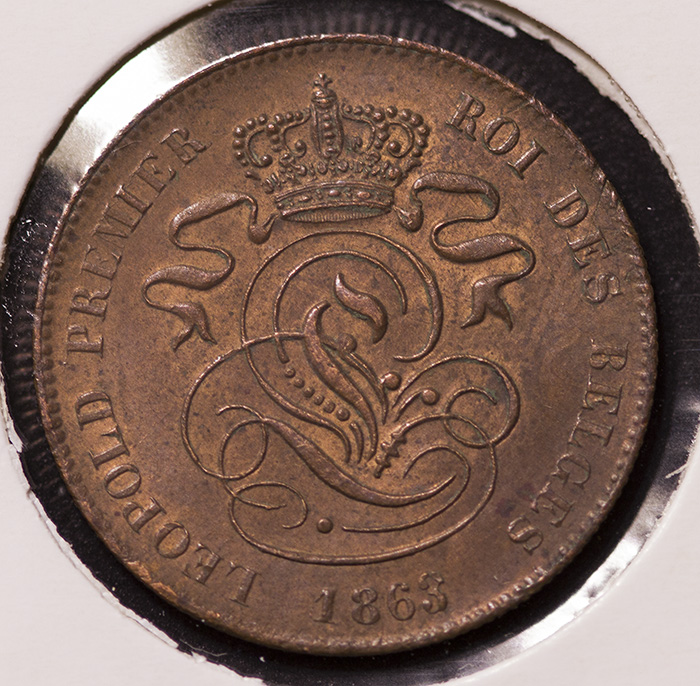 |
|
Valued Member
Australia
369 Posts |
In my opinion the original looks much better than the "cleaned" version. It now looks just like a cleaned coin.
I would not have used acetone on it.
|
|
Valued Member
Belgium
54 Posts |
That's something you don't know in advance unfortunately
|
|
CCF Advertiser
United States
1533 Posts |
A trick that some people would do when selling copper with some minor residue on it is rub a small amount of olive oil on the coins. This soaks into the residue and makes it dark while making the surfaces glossy. Of course an acetone bath removes the oil and then the residue stands out.
|
|
Rest in Peace
United States
18456 Posts |
Your coin before the Acetone soak was nicely toned brown .
That's good ,no problem . I would have used just Verdi-care on it probably with great results .
|
|
Moderator
Australia
16963 Posts |
Acetone never discolours bronze coins under normal use (if you're soaking coins for 18 hours, and letting the acetone all evaporate away, then sorry, but you're doing it wrong). What acetone can do, however, is reveal damage that has been done in the past and has attempted to be hidden, as Andrew99 suggests. If the coin now "looks cleaned", then I suspect it actually was cleaned by a previous owner, perhaps treated using oil, verdi-care, or something similar. The acetone has removed the cleaning agent, showing the true nature of the coin.
The nature of the grey deposit cannot be determined by the pic, but it is one of two possibilities: "dirt" (which should eventually come off with distilled water and acetone rinses) or "corrosion" (which isn't going to come off without harsh chemicals that will destroy the coin). If the coin has actually been previously cleaned, then I'm afraid the likeliest answer is "corrosion" - whoever did the cleaning tried to remove the corrosion from the coin, but whatever they used to clean it didn't get down into these recessed areas of the coin.
Don't say "infinitely" when you mean "very"; otherwise, you'll have no word left when you want to talk about something really infinite. - C. S. Lewis
|
| |
Replies: 24 / Views: 7,492 |





 Posted 03/18/2018 09:23 am





