| Author |
 Replies: 11 / Views: 3,580 Replies: 11 / Views: 3,580 |
|
|
New Member
United States
2 Posts |
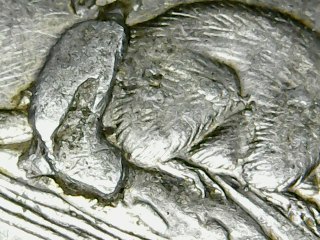 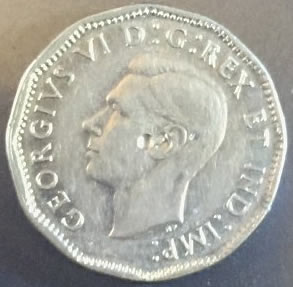 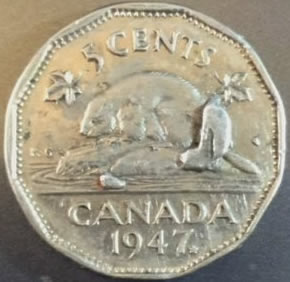 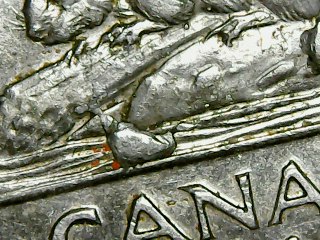 Can anyone guesstimate the value of this coin with Cuds and indentions in the face. Thank you, this is my first post! Sorry some of the pics are reversed. *** Moved by Staff to a more appropriate forum. ***
|
|
|
|
Pillar of the Community
7234 Posts |
|
|
Moderator
 Canada
10473 Posts |
You would need some pretty serious cavities in the hammer die to create that. I am sorry, butI do not think it is a legitimate error.
Those raised elements are even a different colour - I think that is a coin with metal solder on it and not a legitimate error.
"Discovery follows discovery, each both raising and answering questions, each ending a long search, and each providing the new instruments for a new search." -- J. Robert OppenheimerContent of this post is licensed under a Creative Commons Attribution-NonCommercial 3.0 Unported License. See: http://creativecommons.org/licenses...0/deed.en_USMy eBay store
|
|
Bedrock of the Community
Canada
21855 Posts |
I agree with SPP-
Whatever it is on the beaver, it wasn't done
at the mint so it is not an error.
Also the indentation om the face looks like
someone tried to drill it. Also not done at the mint.
|
|
Pillar of the Community
Canada
5341 Posts |
This beaver deign was ahead of it's time, it's a jackoloupe beaver! as everyone mentioned PMD |
|
Pillar of the Community
Canada
1632 Posts |
I agree with the solder theory
Looks like someone tried to make a pin out of it
Edited by johnnysprawl
04/01/2018 06:24 am
|
|
New Member
 United States
2 Posts |
Hi, I posted a Canadian error 5 cent coin and was told the Cud error was a different material. It turned out to be the same material and I would still like a guess-timate of its value. Some of the responses were quit juvenile and I would truly like someone with more experience or expertise to give me their opinion. I mean no disrespect but I was told this was a serious collectors website. Thank you. |
|
Bedrock of the Community
Canada
21855 Posts |
Apostolic-
This is a not only a serious but probably the best coin website around, but we are not so serious that a little humour from time to time deters from the facts.
As far as wanting someone with more experience, you had one of the best error knowledgable collectors around in SPP tell you what his opinion was. He not only shares his expertise with this forum, but has written several articles for coin magazines. So I would say you can take his opinion seriously. You have to realize for a coin to be an error, it has to be done during the striking process and if you know how a coin is struck you would realize it would be impossible to be done at that time.
It doesn't matter how it was done after being struck or what the substance on the coin is, it is not an error. My guess-timate on the value is 5c.
|
|
Bedrock of the Community
United States
94367 Posts |
Well said and  |
|
Moderator
Canada
10473 Posts |
Ok, you are new here, so I'll give you the benefit of the doubt. Our members here are pretty knowledgable with errors, some of them who posted in this thread have Canada's best errors in their collections. So, our members see a _lot_ of damaged coins and after a while, their responses tend to be quite succinct, but reading back, they were not juvenile. First of all, a Cud is a broken die at the rim. More than that, it is a missing piece that provides equal and opposite pressure on the opposite side of the coin. These, are examples of Cuds: http://www.error-ref.com/cuds/ For a die break as large as you think yours is, there would be missing elements on the opposite side of the coin... there is no evidence of that with your coin. When metal chips off the surface of the dies, it almost always happens on the highest points of the dies - the fields. These chips usually result in raised small areas and dots. For the hammer die to break of a chip the size of what you are showing, would be unprecedented, because it would have occurred in the middle of the die and inside the devices. Even collapsed dies and shattered dies do not produce a feature like that. http://www.error-ref.com/?s=shatter http://www.error-ref.com/die-subsidence/Your coin does not have these features. Hypothetically speaking, if this did happen, it would likely have happened progressively, and there would be associated die cracks - that would mean since 1947, sharp-eyed collectors from Hans Zoell to those who love varieties on Numicanada, would have seen this coin in various stages. They have not. Therefore, your coin is not a striking error. It was damaged after it was struck. "Discovery follows discovery, each both raising and answering questions, each ending a long search, and each providing the new instruments for a new search." -- J. Robert OppenheimerContent of this post is licensed under a Creative Commons Attribution-NonCommercial 3.0 Unported License. See: http://creativecommons.org/licenses...0/deed.en_USMy eBay store
|
|
Bedrock of the Community
Canada
24885 Posts |
 To the Forum. |
|
Pillar of the Community
Canada
2303 Posts |
PMD no more no less. Who ever told you it was a Cud should refrain from commenting when they have no clue.
|
| |
Replies: 11 / Views: 3,580 |
|










 Posted 03/31/2018 12:03 am


