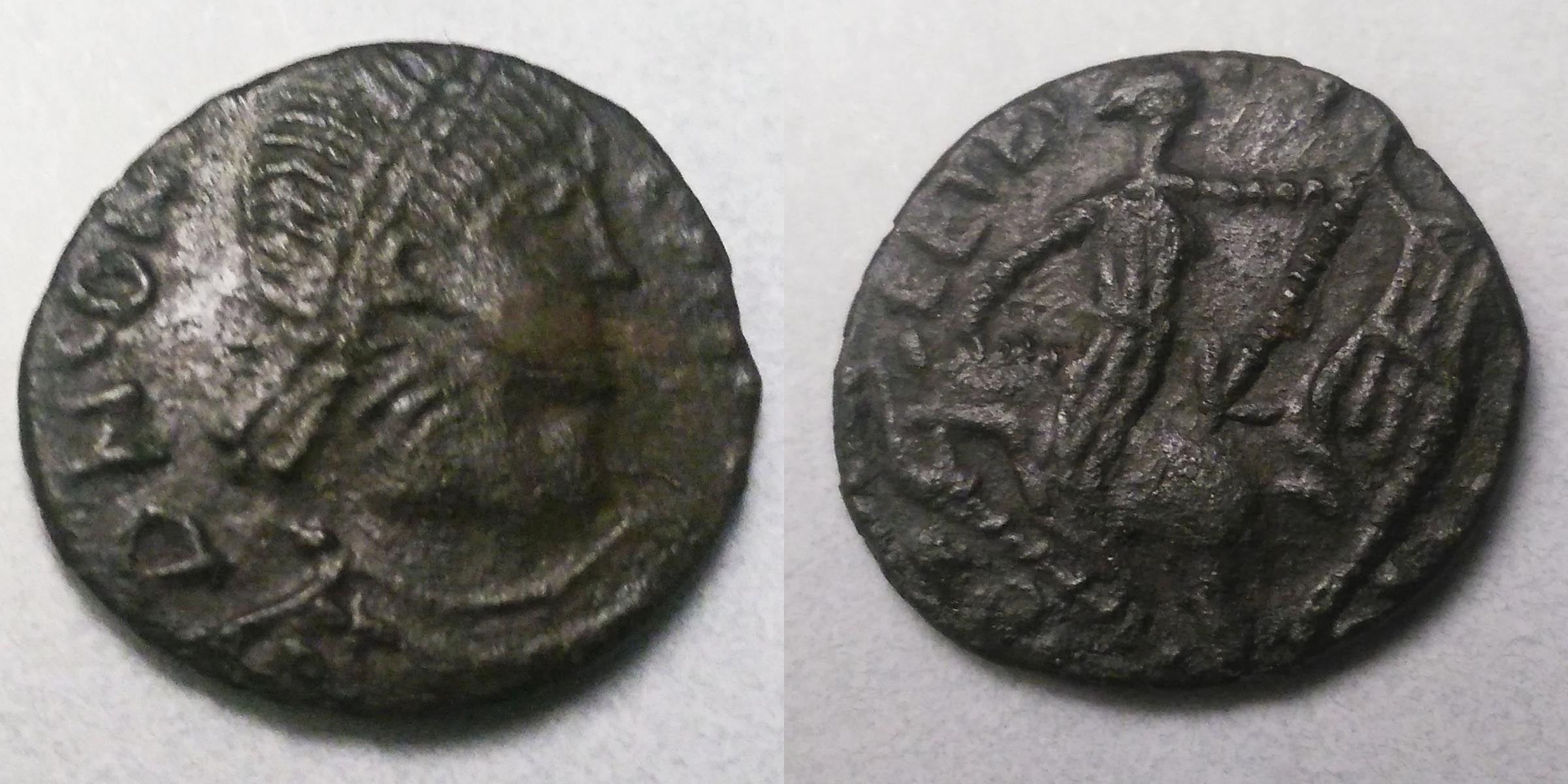
Yes, it's a fallen horseman imitation. Once upon a time, I was a serious collector of Roman barbarous. Three of the seminal references for this particular type are:
Pierre Bastien (1980), 'Imitations of Roman Bronze Coins, A.D. 318-363', ANS Museum Notes 30, pp. 143-177.
George Boon (1988), 'Counterfeit coins in Roman Britain' in John Casey and Richard Reece (eds), Coins and the Archaeologist (2nd ed.), London, pp. 102-182.
R.J. Brickstock (1987), Copies of the Fel Temp Reparatio Coinage in Britain: a study of their chronology and archaeological significance including gazetteers of hoards and site finds, BAR British Series 176, Oxford.
I own the first two and refer to them often. The third I have long been aware of but have never read.
There were two phases to the fallen horseman imitations. The first came soon after the reform of 348 which introduced the large FEL TEMP coins. Imitations of this phase tend to be nearly the size of the originals but a bit lightweight, sometimes overstruck on earlier Constantinian coins. The second phase kicked in when the large coins were replaced with an AE3 version just a few years later. Imitations of this second phase begin at close to official module but descend rapidly to tiny minimi. Examples from the Roman Temple excavation at Brean Down in the UK ranged from 16 down to 2 mm (no, that's not a typo!). This "epidemic counterfeiting" (as Bastien calls it) continued until the reform of Julian II.
Edited by Kushanshah
04/14/2018 8:46 pm










 Posted 04/14/2018 4:12 pm


