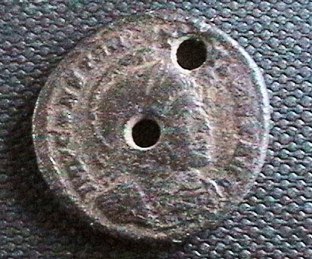
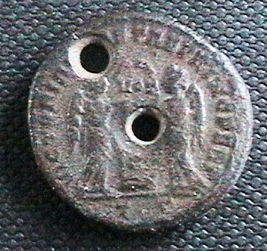
| Author |
 Replies: 12 / Views: 8,613 Replies: 12 / Views: 8,613 |
|
|
Valued Member
France
334 Posts |
Dear Comunity friends, I have a very simple question about holed ancient coins (especially greek, since they are what I am collecting mostly) : how much would you say that a hole on a coin reduces its value, in the case in which it doesn't affect any significant part of the design? Does it lower the price of 50%? More?
|
|
|
|
Moderator
 United States
23731 Posts |
It all depends on the type of coin and the location of the hole. Here is one from my collection where the hole is located on an extended edge. IMO, it adds character to this coin and maybe a little more value. 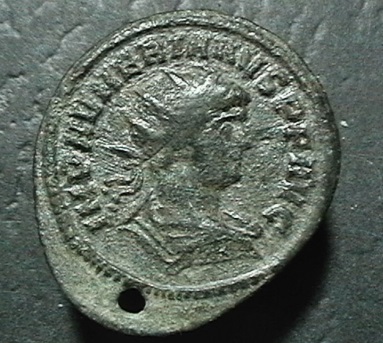 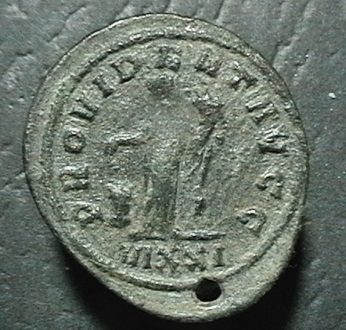 |
|
Pillar of the Community
Canada
5297 Posts |
For modern coins, I would say that it drops to the value of a coin at least 2 grades lower, often quite a bit more. probably a minimum of 25%. Very few people want a holed coin at any price.
|
|
Bedrock of the Community
United States
94367 Posts |
I would venture that, for modern coins (c.1700 and forward) that holes would reduce a coin's value by closer to 90%.
|
|
Pillar of the Community
 Spain
2752 Posts |
I agree when it comes to more modern coins a hole would reduce its value more than 50% unless it was very very rare and very cheap...
But I think Ron has 'hit the nail on the head', pun intended, when it comes to ancients it really does depend on where and when it was made. If it can be determined that the hole was made around the time of the coin being in circulation or a couple of hundred years later, this for me gives the coin some character and maybe reduces the value 15% or so....You'll find many Islamic gold and silver coins with punch holes as they were used by the women to decorate themselves especially belly dancers for example. As for Greek coins I wouldn't think it would reduce the value 50% or more unless it ran straight throught the centre and destroyed all the beauty of the coin. But I may be wrong and will be interested in what others have to say.
Paul
Edited by Palouche
04/29/2018 8:25 pm
|
|
Pillar of the Community
United States
8062 Posts |
Quote:
I would venture that, for modern coins (c.1700 and forward) that holes would reduce a coin's value by closer to
90%. Not necessarily. We've got a thread over on the World Coins forum on sales of holed coins. My experience is the reduction on decent quality 18th/19th c. coins (say F or better) is in the 50 to 75% range. I have no experience with ancients. Edited by tdziemia
04/29/2018 9:26 pm
|
|
Pillar of the Community
United States
6130 Posts |
 with Ron that holes can often provide character. I wouldn't want to drop big bucks on a holed coin unless it was very rare, but I have come to appreciate how ancients can show us how people used coins 1500+ years ago, and not just to buy a loaf of bread! One of my favorite coins "ruined" by holes is a denarius of Domitian with the she-wolf reverse. It was clearly circulated, but someone liked it enough to transform it into a necklace pendant. I haven't really considered selling it, but I have honestly no idea what it would fetch if I were to put it on ebay tomorrow. Along the same vein, arguably the most coveted of all ancient coins is Brutus' EID MAR denarius, struck to defend and celebrate the group decision to murder Rome's first "Perpetual Dictator". An extremely small number (like 3-5?) Aureii were struck from the same dies, one of which was holed for suspension as jewelry--and not entirely out of the realm of reason that the wearer was one of Caesar's assassins, or even Brutus himself! I probably wouldn't hesitate to drop the same amount of cash on that coin... you know, if I had an extra million bucks laying around! |
|
Pillar of the Community
United States
8715 Posts |
Holes in ancient coins don't reduce the value nearly as much as modern coins made after 1700 AD.
I will almost never purchase a holed coin made after 1700 AD. I consider them junk cull coins.
Ancient coins, on the other hand, often have holes. They add character to the coin.
|
|
Pillar of the Community
United States
717 Posts |
Interesting discussion. I appreciate all of your posts.
|
|
Valued Member
 France
334 Posts |
Very helpful. Thank you very much for all your comments.
|
|
Pillar of the Community
United States
6130 Posts |
Decided to hunt down the images of my Domitian necklace denarius:  Note that the metal is deformed on the obverse, indicating that the nails were driven through from the reverse. I am still amazed that Domitian's nose wasn't removed in the process! As for value, here is a recent find from a job lot I am preparing to sell on ebay. I had another roughly comparable follis of the same emperor and reverse type... we'll see how it impacts the final sale price! Constantius I Chlorus, father of Constantine Reverse: Moneta holding scales and cornucopiae Ticinium mint 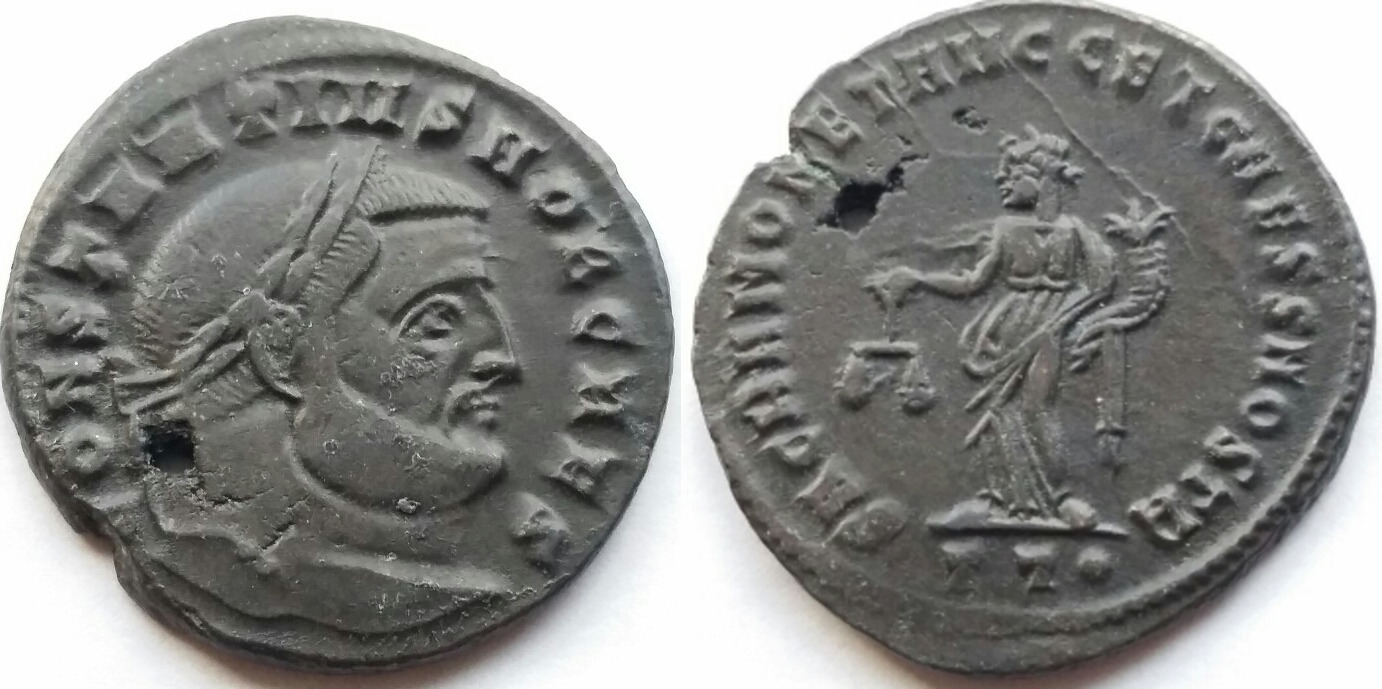 Not sure whether this one was holed for a pendant, or nailed to something--I have heard this was sometimes done to make an offering at a temple. It certainly did not circulate much before being holed! |
|
Moderator
United States
23731 Posts |
|
|
New Member
Bulgaria
5 Posts |
Some of mine 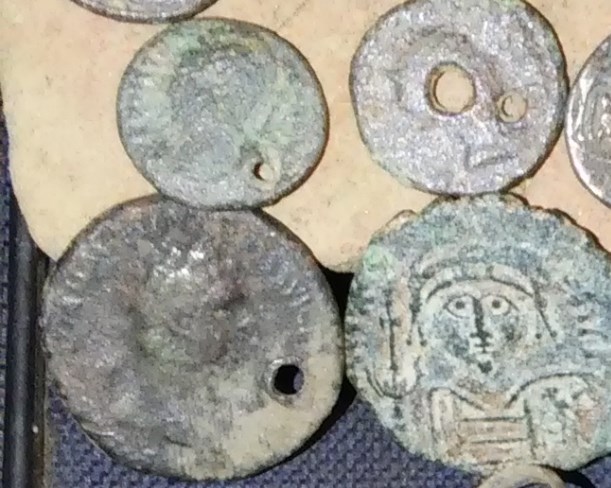 Anyone have theories about the double holed coins ? Holes are different size Edited by IvoThunder
04/30/2018 3:58 pm
|
| |
Replies: 12 / Views: 8,613 |
|




 Posted 04/29/2018 7:03 pm