| Author |
 Replies: 35 / Views: 5,111 Replies: 35 / Views: 5,111 |
|
|
|
Pillar of the Community
United States
4637 Posts |
Agreed, special has a different meaning to different collectors. Some collectors hone in on a specific serial number. Everyone has their reason. I collect serial #12, so this pair was special to me. Same denomination, same district, same serial number, including the suffix letter, and both graded the same. 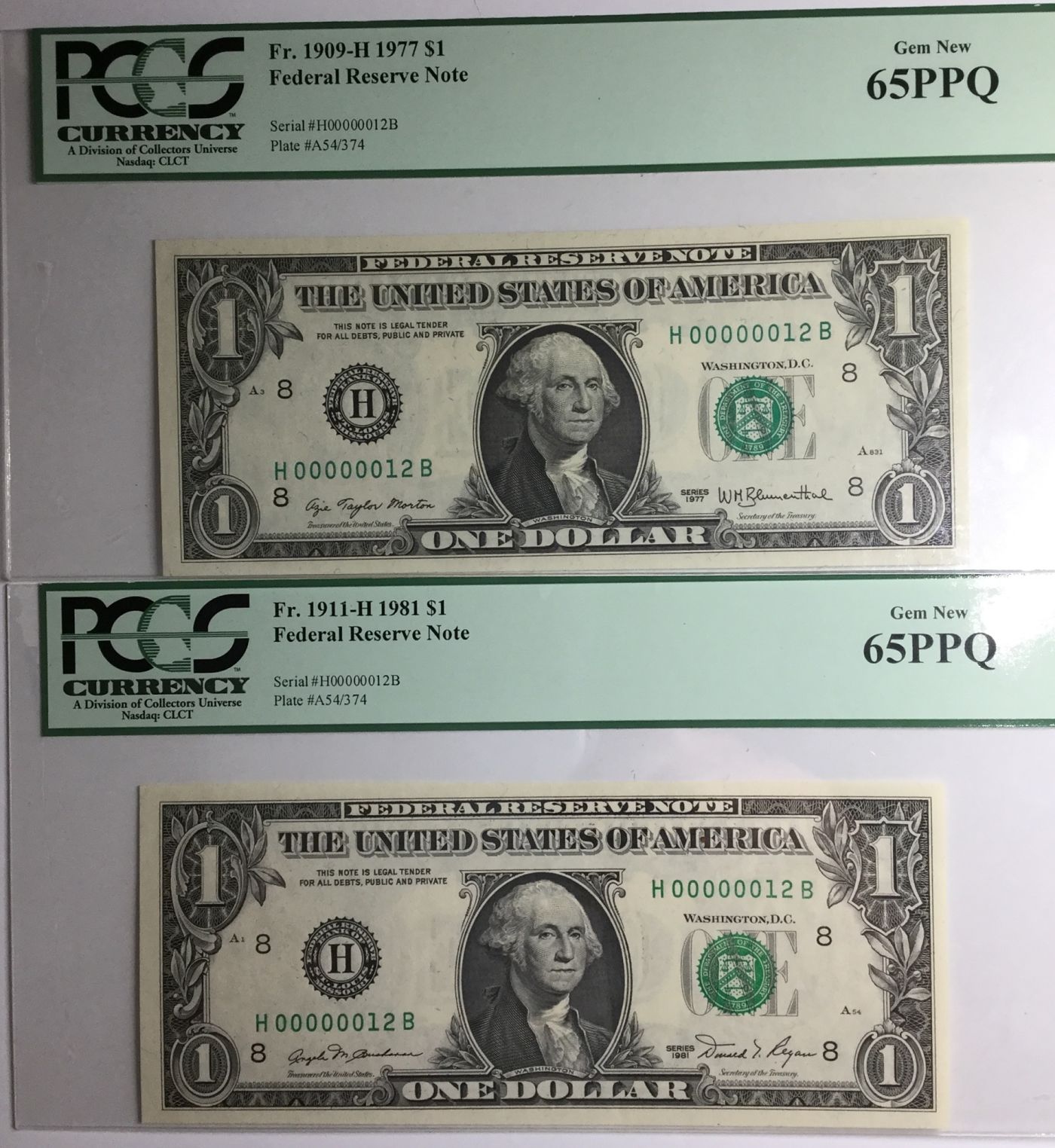 |
|
Bedrock of the Community
United States
94367 Posts |
All of these pairs are remarkable, and I certainly most appreciate it when experts take the time to answer simple questions that may seem trivial to them.
|
|
Pillar of the Community
United States
1376 Posts |
Here's a pair of uncirculated notes (raw) that have always been interesting to me. 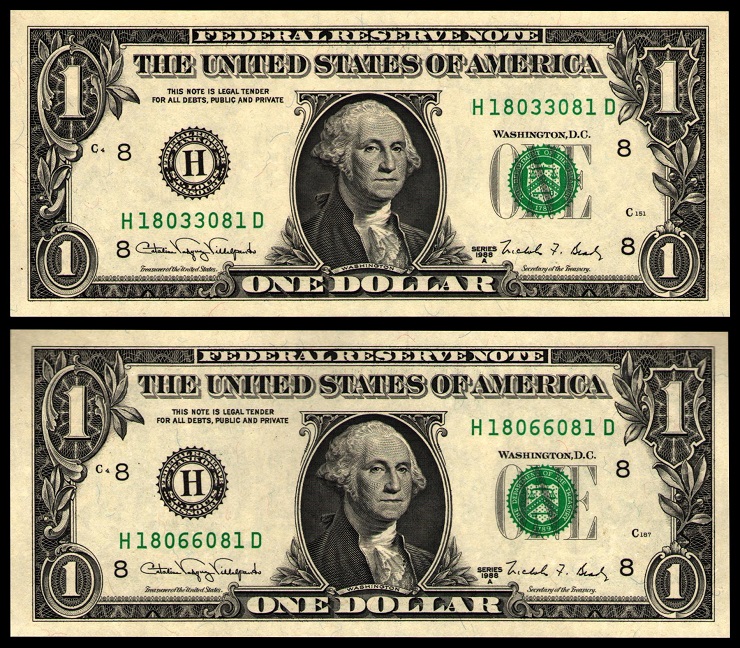 A couple of RADAR notes from the same series (1998A), the same FRB (St. Louis), same serial number suffix (D), and same digits in serial numbers except for the central 2 digits (which couldn't be the same of course, but the six is a multiple of 3). The series isn't particularly rare (410,400,000 H notes in the series), although the D suffix is the smallest (only 3 runs for a total of 19,200,000) number of notes (suffixes went up to I), but all of similarities between the notes made them interesting to me and definite keepers. Some might call them "special". |
|
Pillar of the Community
United States
4637 Posts |
Someone please ask the nice people that operate this incredibly informative and entertaining Forum, to add a "LIKE" button to click on whenever we see something that makes us happy to be part of the paper money community.
|
|
Pillar of the Community
United States
3402 Posts |
Really wonderful combo notes.
KK
|
|
Bedrock of the Community
United States
94367 Posts |
I think the mods have suggested in the past that a "LIKE" button fails to stimulate conversation, so important to the success of the forum. Or something to that effect.  |
|
Pillar of the Community
United States
4409 Posts |
Quote:
I see a J-A, and a J-*, does the star replace another end letter boo-boo? Guesss I'm asking how the plates layout and what the error predicated the need to replace. A specific plate series? I'll try providing the answer I wish I would have come forth rather than the sharp retort that was posted. Plates are made here's a great detailed explanation by the BEP https://www.moneyfactory.gov/hmimplatemaking.htmlThe "working" plates (the ones that go on the press) are used to print the main parts of the notes: everything but the seals, serial numbers, district numbers and signatures on the front. Backs are printed first. Then, the front is printed, which is also known as the 2nd print. The unfinished sheets are inspected. IF problems are found with a specific plate it is either repaired and returned to service or replaced with another. Next, the overprints are applied, this step is considered the third print. Afterwards, the sheets are inspected again. If defect(s) are found the sheet is pulled and replaced with an uncut star sheet off the top of the pile. On to the cutting phase--sheets are cut, bills stacked and bundled. The bundles are inspected any that are found to be less than perfect are pulled out and replaced with a pack of star notes. In essence, sheet star notes are "rarer" and typically have smaller print runs. Whereas, solid packs of star notes are more common. I realize I may have misstated some information and I apologize in advance. If anyone reading this has questions or wants something that I may not have gotten fully explained, explained I'll give it another go. -MV |
|
Bedrock of the Community
United States
94367 Posts |
An often misunderstood point is that star notes have their own separate numbering system, and when they are used to replace a defective note/sheet, there is no correlation between the original S/N and the replacement star S/N. That is why having a perfect note (using the original numbering sequence) and a star replacement note (using a different numbering sequence) with the same serial numbers in the same TPG grade (!!) is so remarkable. Edited by Coinfrog
07/22/2018 8:04 pm
|
|
Pillar of the Community
United States
1376 Posts |
Quote:
there is no correlation between the original S/N and the replacement star S/N Coinfrog, I'm not sure I understand what you're getting at. I agree that Star note runs and regular note runs aren't correlated with each other, but aren't the same serial numbers used? In other words, an initial star note run starts with serial number 00000001 as does an initial regular note run. So, when a star note sheet replaces a damaged/misprinted regular note sheet then identical serial numbers (but one with a star suffix and the other with a letter suffix) are pretty much guaranteed aren't they? That is unless the star note sheet happens to replace the regular note sheet that has the same serial numbers on it. Finding two same serial number notes seems like it would be difficult, and having them graded by the same TPG and get the same grade probably even more difficult, but since two examples have been shown, obviously it's very possible to do. |
|
Bedrock of the Community
United States
12477 Posts |
Quote:
So, when a star note sheet replaces a damaged/misprinted regular note sheet then identical serial numbers (but one with a star suffix and the other with a letter suffix) are pretty much guaranteed aren't they? That is unless the star note sheet happens to replace the regular note sheet that has the same serial numbers on it. I don't follow you, BadDog. Those sentences seem to contradict each other.  What Coinfrog meant, I believe, is that the star note sheets (with their own sequential run) are used in sequence to replace defective sheets whenever one is found regardless of serial number. My instinct is to say that star note serials will generally be lower than the original note serials they replaced?  In Memory of Crazyb0 12-26-1951 to 7-27-2020
In Memory of Tootallious 3-31-1964 to 4-15-2020
In Memory of T-BOP 10-12-1949 to 1-19-2024
|
|
Pillar of the Community
United States
4637 Posts |
The BEP offers matched serial numbers on some of their Premium sets. This set is an example of the Texas $2 Step Anniversary Currency Set celebrating the 25th anniversary of the BEP's Western Currency Facility in Fort Worth Texas. 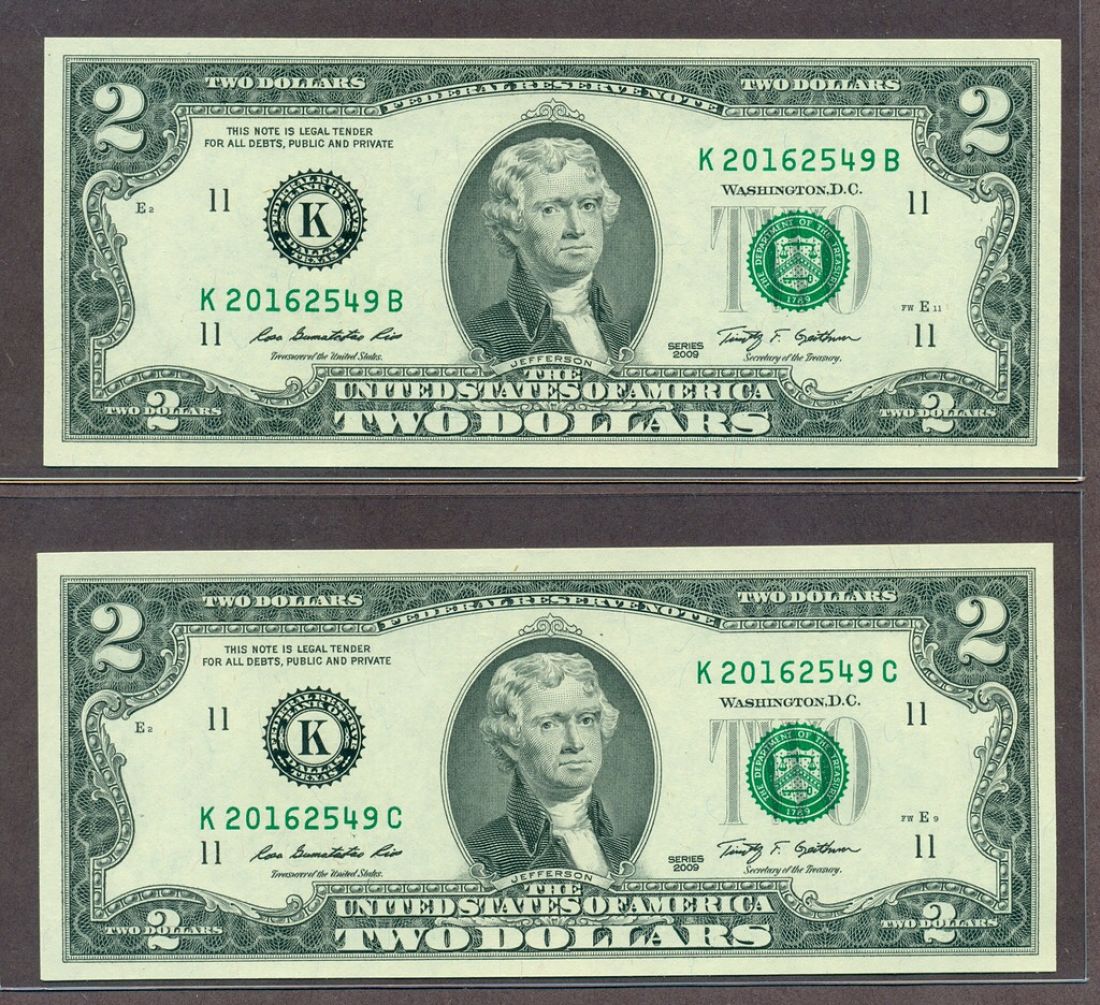 Matching serial numbers from the K-B and K-C blocks. |
|
Pillar of the Community
United States
1376 Posts |
Quote:
I don't follow you, BadDog. Those sentences seem to contradict each other. Probably didn't express my thought very well  I'll give it another go. Let's say the BEP has to replace a $1 regular Kansas City FRB sheet with a star sheet. The star sheet happens to be the first one, so a note on it has serial number J00000001*. Unless the regular sheet being replaced was also the first regular sheet, then eventually there will be notes with serial numbers J00000001A and J00000001*. The same would be true if the BEP replaced a bundle instead of a sheet. So, it seems to me that it's pretty much guaranteed that notes will exist with the same serial number digits with different suffixes (one a star and one a letter) whenever a star note is introduced into the system. That is unless the star note happens to be replacing the note with the same digits, which is unlikely (as coinfrog said there's no correlation in the replacement process). Finding those notes with same FRB and digits and then getting them graded and then having the grades be same would seem to be impossible, but obviously it can be done as two examples were shown. My guess is that there are probably many more, since the notes from the HA auction I referenced didn't go for that high of a price. Is this any clearer |
|
Moderator
 United States
194164 Posts |
Quote:
I think the mods have suggested in the past that a "LIKE" button fails to stimulate conversation, so important to the success of the forum. Or something to that effect. You are correct.  |
|
Pillar of the Community
2225 Posts |
 I like them all  |
|
Pillar of the Community
United States
3340 Posts |
So let me ask another question:
I am assuming that the BEP prints a certain number of star notes in anticipation of problems during the regular run. I also assume that they don't use all the star notes. So, do they destroy unused star notes at the end of the production run? Or, are the star notes only printed at the end of the run and only in a number needed to replace defective sheets / bills?
"Nummi rari mira sunt, si sumptus ferre potes." - Christophorus filius Scotiae
|
| |
Replies: 35 / Views: 5,111 |







 First Page


 Posted 07/22/2018 1:37 pm





