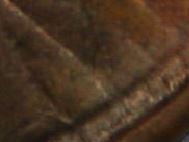
Here is what intrigues me most about this coin:
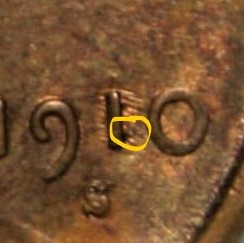
And an unmarked copy:
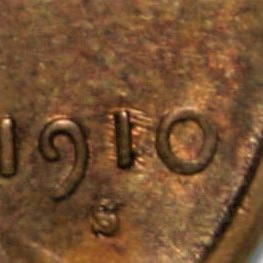
I can make a case for the die gouges. What puzzles me is the raised area east of the second "1." It continues across the "1," though weakly. That suggests two different processes were involved.
Let me toss out a possibility for discussion. What if the die were hubbed normally, and during handling or striking coins, sustained shallow surface damage near the second "1." The deepest part of the "1" would be largely unaffected (as it appears), but the field near the "1" would have indentations, which would appear as bumps on the coins. I could see a mint worker trying to file or scrape the field to reduce the indentations, leaving the gouges in place of most of the indentations. After additional coins were struck, I could see a mint worker observing the gouges and polishing that area of the die to remove the gouges.
Another note. David Lange wrote that the steel used in dies pre-1915 was inferior to the 1915 and later dies. The dies wore more easily, and produced fewer coins (about 140,000 to 150,000) per die pair than the later dies. That suggests the steel in the early Lincoln series would have been softer and more susceptible to damage than later dies.
Just some speculation here, and I'm sure open to other thoughts.
You have quite the interesting coin there.





 First Page


 Posted 08/24/2018 3:09 pm


 The ones in the date are rounded. This is correct for 1909-1910