Hi,
You are sorta adding something I didn't mean so I will try to clarify.
OK..Take a 5 and imagine it on the surface of the piece of wood I used before:-)

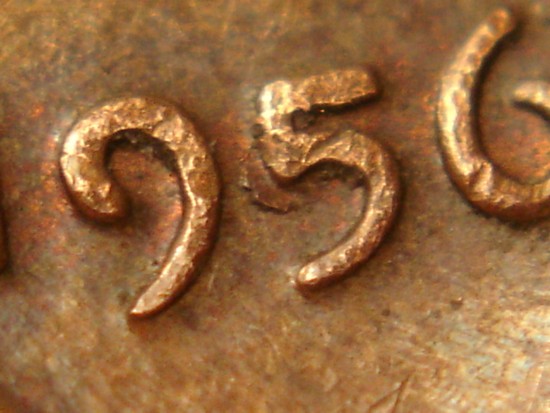
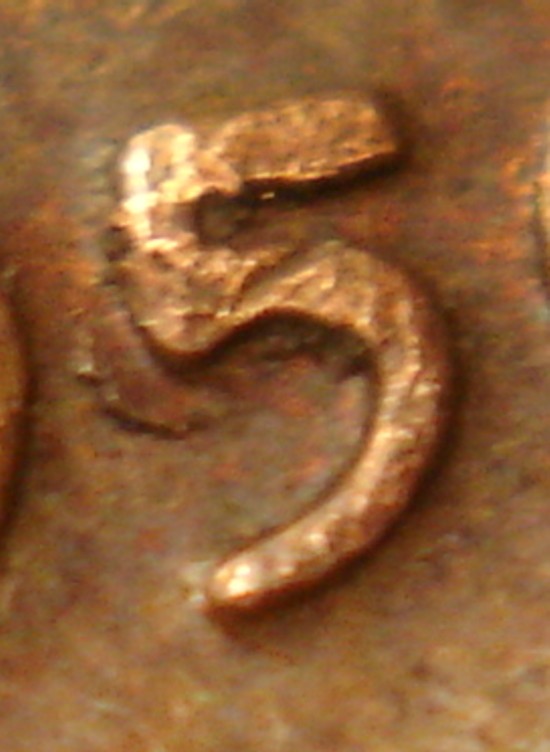
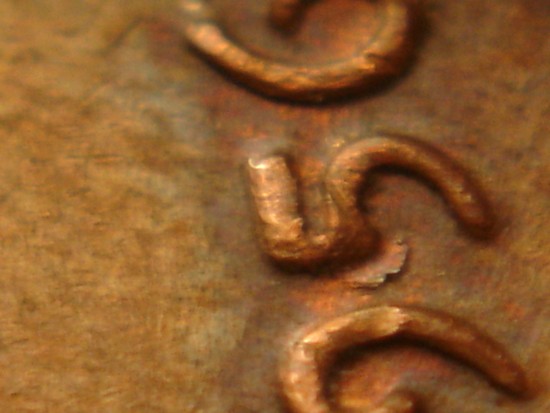
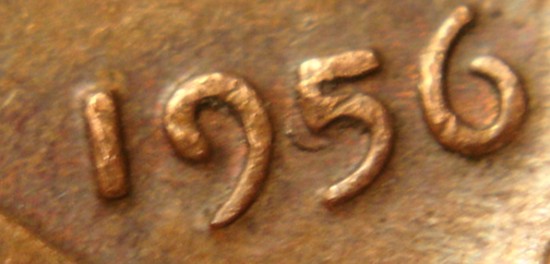
Now take a hammer and whack the 5 in the comparable spot that the damage is seen on the 5 on the coin at the beginning of this thread. The orange circle represents that spot. After the hit, that spot would show a depression of some sort based upon the shape of the object hitting the numeral. In the case of this example... a hammer. In the case of the coin in the original picture...some unknown force:-)

Now imagine what would happen around the point of impact, some of which is indicated by the blue area. The wood would splinter in an upward direction coming off the surface of the wood.

Now put the entire picture together Wood (coin) takes a hit on the 5.
Area around the 5 on the Wood (coin) splinters coming up off the surface of the Wood (coin).
Notice I did not use the word lamination when referencing the coin. The reason is that "lamination" is a term that is most often used in numismatics, by error specialists to denote a type of specific error. The use of the word implies an error and I don't want to do that on a coin that is simply damaged.
Technically, on the coin, metal has separated as a layer from the surface was broken when damaged by the hit. So by a dictionaries definition, in non-numismatic terms, we are looking at what might be called a lamination, or for some, the results of a delamination of the surface metal caused by damage.
Numismatically though, it is a damage and the term lamination should only enter the picture when describing the damage. Indicating in any way that this "lamination" due to damage has anything to do with "lamination" as a descriptive term being applied to "lamination errors" can paint a confusing and possibly false impression.
So to encapsulate this. The coin was damaged, the surface shows lamination due to the damage and this is in no way to be confused with a "lamination error".
I think that is about as clear as I can get it:-)
Thanks,
Bill
Edited by foundinrolls
07/12/2008 3:02 pm







 1956jpeg1.jpg
 1956jpeg2.jpg
 1956jpeg3.jpg
 1956jpeg4.jpg


 Posted 07/11/2008 4:39 pm





 BINGO
BINGO


