| Author |
 Replies: 8 / Views: 1,433 Replies: 8 / Views: 1,433 |
|
|
Valued Member
United States
119 Posts |
I noticed that the edging on this bicentennial half looks different than the edges on my other bicentennial halves. The last photo shows (left to right) the edge of a 1999 quarter, the half in question,then two other bicentennial halves. 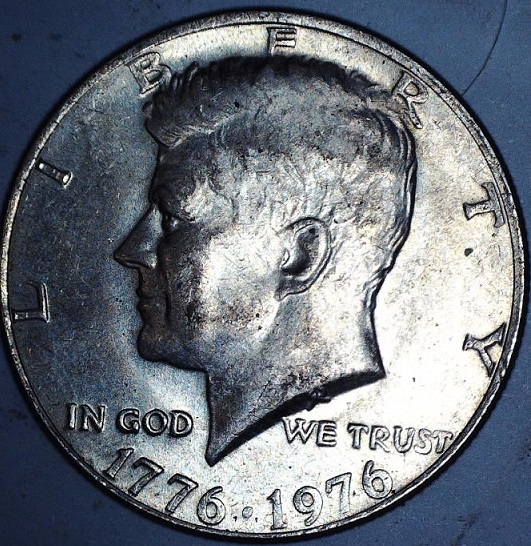 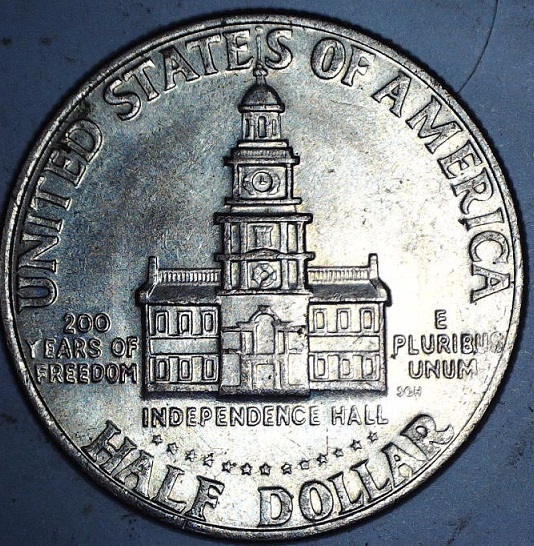 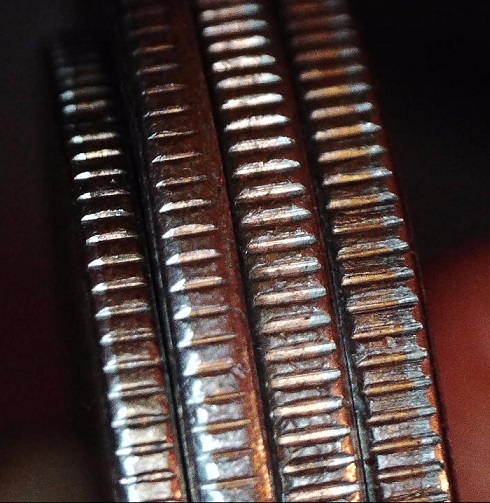 Any significance?
|
|
|
|
Rest in Peace
10197 Posts |
No. You didn't make a case for any differences. What is the weight, grade(condition) composition and die state. Just because it "looks" different don't mean diddly squat. from the little shown, if coin in question is left one, it may have spent more tin=me in a vending machine to be worn off. (?)
|
|
Moderator
 United States
34562 Posts |
@TBR, I'm also having a hard time seeing what you are seeing. Is it the color or shape or something else?
"If you climb a good tree, you get a push."
-----Ghanaian proverb
"The danger we all now face is distinguishing between what is authentic and what is performed."
-----King Adz
|
|
Valued Member
 United States
119 Posts |
Thanks. I knew I should have named the four coins after the picture instead of before it. 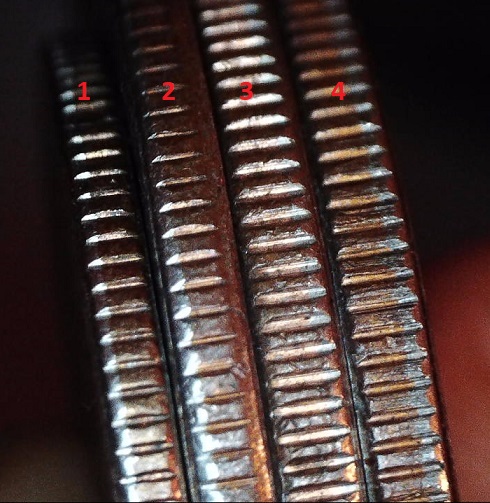 Number one is a quarter, number two the bicentennial half in question, numbers three and four are other bicentennial halves. I think I got my answer, which is that people who are more experienced than I (almost everybody) see no significant difference. I had read that some halves were made on quarter planchets and to my inexperienced eyes the half in question (no. 2) looked as much or more like the quarter than it looked like the other bicentennial halves. It is both slightly narrower (when viewed from the edge) than the other halves, but what first attracted my attention is the spacing between the indentations. In that regard the half in question appears to be more like the quarter than the halves. The indentations on number one and two appear to me to be farther apart than the space between the indentations on the other halves. I don't think that would have anything to do with the planchet. The edge might just be more worn down, and the different apparent spacing might have given the illusion of the coin being narrower. Most pictures (especially mine) leave something to be desired, and I understand how the viewer is handicapped by that. My conclusion from the responses is that there are no significant differences apparent in the photos between the halves. I just had a question and as usual learned from the people on CoinCommunity. I appreciate those of you who took the time to look and respond. Thanks. Edited by TBR
09/06/2018 11:28 am
|
|
Pillar of the Community
United States
7594 Posts |
I can see what OP is asking, the reason the coin in question's edge( coin#2) is different is because of heavy wear, it is worn down either due to heavy circulation or simply being a Slot machine coin.
|
|
Bedrock of the Community
United States
62064 Posts |
The collar is what put the reeds on the edges. During the strike this happens. So a different collar may have different reed patterns. Also different years/denominations would be not an accurate comparison.  |
|
Rest in Peace
10197 Posts |
I do get what you are asking. YELLOW shows the edge of #2, RED shows the depth of reeding. That is just plain wear. It spent time rolling on it's edge, some kind of mechanism that caused that pattern of wear. #'s 3 & 4 apparently escaped that fate and languished in a teller tray! Quarter shows that wear pattern too. 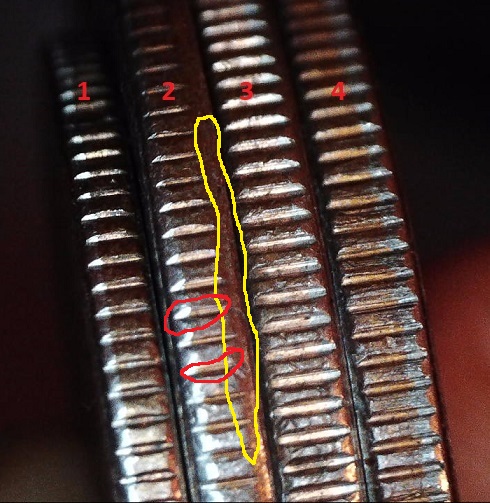 Edited by Crazyb0
09/06/2018 1:12 pm
|
|
Valued Member
United States
119 Posts |
I can see the wear that crazyboy outlined. Thanks.
Also, I learned from coop's reply, that different collars and reed patterns can indicate different varieties.
Thanks to all. Very helpful.
|
|
Bedrock of the Community
United States
79381 Posts |
Yep, that happens quite a bit on the reeded edges. If the coin has been in circulation long enough, the reeding will start to fade away from wear.
Errers and Varietys.
|
| |
Replies: 8 / Views: 1,433 |
|








 Posted 09/05/2018 9:21 pm


