Heritage Auctions - In our current January 9-14 FUN Signature
US coins auction, we are pleased to offer a newly discovered,
18th example of the 2000-P Sacagawea dollar/Washington Statehood Quarter mule. This is the Holy Grail of U.S. Mint errors. The first discovery was made in May 2000, by Frank Wallis, of Mountain Home, Arkansas, in a roll of ordinary
Sacagawea dollars. At the time, the concept of a Mint-made mule — a coin struck with mismatched dies — was foreign to many collectors, as such an error coin was either not known or not widely publicized. That changed with Wallis's discovery. Even more spectacular than the discovery of a coin with mismatched dies, was the fact that the dies were for two different denominations.
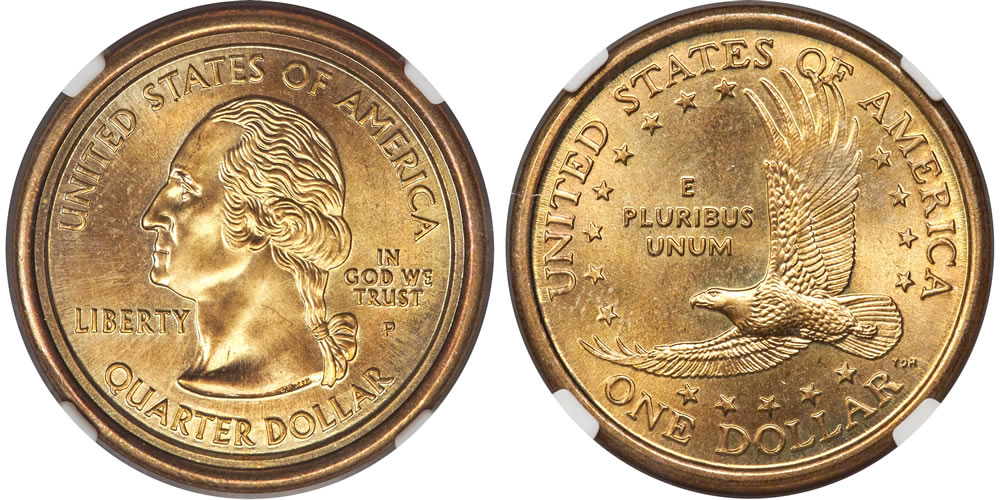
The probable course of events leading to this error's creation, outlined in 100 Greatest U.S. Error Coins, by Nicholas P. Brown, et al, includes a request from a press operator for a new dollar obverse die, which was inadvertently fulfilled with a quarter dollar obverse instead. The two denominations were similar in diameter (26.5 mm vs 24.3 mm), and new dies were stored with a protective plastic cover over the face that, if not removed by the press operator before installation, would have obscured viewing of the design and allowed for one of the most fantastic blunders in Mint history:
"The
Washington quarter obverse die, according to the story, was duly installed into the coining press and mated with a
Sacagawea dollar reverse die along with the proper (plain-edge) dollar collar. At some point this error was discovered. The Mint source supposed that three tote bins of finished
Sacagawea dollars were destroyed — the bin that produced the mule strikes and the bins on either side of that press (in case an errant coin or two had been tossed into the wrong bin)."
Any effort to destroy all of the errors failed, as several pieces escaped into public hands. Given how some of the coins were later discovered — in bank rolls and change — it appears that their release was at least partially through standard distribution channels.After the Wallis discovery, additional mules were located in the Philadelphia area. On August 4, 2000, the Mint issued a statement regarding the now widely publicized error coins. It read in part:
"The U.S. Mint goes to great lengths to avoid making mistakes when it manufactures coins. In fact, in its 208-year history, coin errors are a rare occurrence, but occasionally, misstrikes happen...Of the 29 billion coins we're producing this year, at least one billion Golden Dollars will be struck. As of today, there have been four confirmed error Golden Dollar coins found. Recently, there were unconfirmed reports that another 15 were discovered. To put this in perspective, if 19 error coins have been found, based on production figures, that means there is a 0.0000019 percent chance that an error Golden Dollar has been produced this year."
As late as 2010 — a decade after the initial discovery — only 10 different examples of the error had been documented. Additional finds have occurred since then, although the infrequency with which new pieces have been brought forward cannot even be called a trickle — what has been a glacially slow increase in the mule's known population over the past eight years has been vastly outpaced by growth in collector demand for this intriguing rarity.
Fred Weinberg, coauthor of 100 Greatest U.S. Error Coins, records just 17 distinct examples of the Sacagawea dollar/Washington quarter mule, and they are struck from three different die pairs: Die Pair #1, the variety of the discovery coin, has a distinctive die crack at the F in OF; Die Pair #2 has three die cracks along and below the bottom edge of the eagle's lower wing; Die Pair #3 has a perfect reverse with a small die gouge on the obverse in front of Washington's lips. The existence of three die pairs suggests that the Mint's blunder was either not isolated to one press operator and one die swap, or Mint employees intentionally recreated the fantastic error with different dies after the initial discovery was made public. The legality of owning examples from any die pair has never been challenged.
Most of the mules are from Die Pair #1, the variety of the discovery coin and of others that were found in commercial channels. Almost all are tightly held in private collections.
The newly unearthed, 18th example offered here came out of the woodwork in August 2018. NGC has certified it as MS67, making it the seventh piece certified in Superb Gem, and it is the 13th known representative of Die Pair #1. The satiny surfaces reveal no discernible flaws. Washington's portrait and the eagle have satiny, luminous mint luster, while the obverse fields are semiprooflike in between die stress lines, caused by the coin being struck with two different diameter dies. Coloration is mainly brass-gold, although it trends toward an orange hue on the reverse. Wisps of rose, lilac, and mint-green appear at certain angles. This is one of the most perfect examples known of the "king" of U.S. Mint errors. There is perhaps no better summarization of the importance of this offering than the conclusion of Scott Schechter and Jeff Garrett's discussion of this Mint error in 100 Greatest U.S. Modern Coins:
"For its rarity and influence, this is among the most important of the 100 Greatest U.S. Modern Coins. The coin is distinctly modern, as it combines the new-composition
Sacagawea dollar and the obverse of the
Statehood Quarter, two highly important, seminal coin series of the new millennium. Its first sale established
ebay as a legitimate marketplace for coins in the eyes of many dealers. And, of course, it is among the most valuable of all modern U.S. coins and U.S. error coins of any era."




 Posted 01/08/2019 9:32 pm





