| Author |
 Replies: 13 / Views: 2,361 Replies: 13 / Views: 2,361 |
|
|
New Member
Australia
42 Posts |
Hi everyone, I as wondering is there a specific characteristic to tell the 1937 an 1938 Proff coins apart from the reg UNC CROWNS?
If they are stabbed, does that mean when they were graded would have they been identified as proff coins then? Do they weigh diff amounts or have an extra read or dot?
Any help would be greatly appreciated
Thank u
Sabrocks
|
|
|
|
Pillar of the Community
Australia
605 Posts |
Apart from the general appearance, there would be die markers visible on the proofs.
Maybe check out the PCGS population report - nice high res pics are available.
Watch your top knot
|
|
Pillar of the Community
Australia
2180 Posts |
There was an article a few years ago in the Australasian Coin and Banknote magazine that listed die markers for the 1937 crowns, and possibly one for 1938 proofs in general but I'm not sure.
I wouldn't trust PCGS to positively identify a proof based on die markers though.
|
|
New Member
 Australia
42 Posts |
Thank U very much for your help. 2 of the crowns I have a 1937 & 1938 are very lustrous, both a really strong strike, and are both flawless,so I'm very confused also I had a cra cra relative that got coins slabbed quiet a few of them and before I brought the collection from him he smashed all the slabbed coins out of their cases so no longer slabbed! Seriously! I have another cpl of crowns that are perfect strikes but not as lustrous etc. Anyway I know for sure 2 of them were slabbed, guess that doesn't make a difference now anyway! Thanks heaps for responses
|
|
Valued Member
269 Posts |
105 1937 proof crowns were struck. Coinworks recently sold one for 35,000 and they incorrectly stated that 100 were struck. 200 were struck in 1938 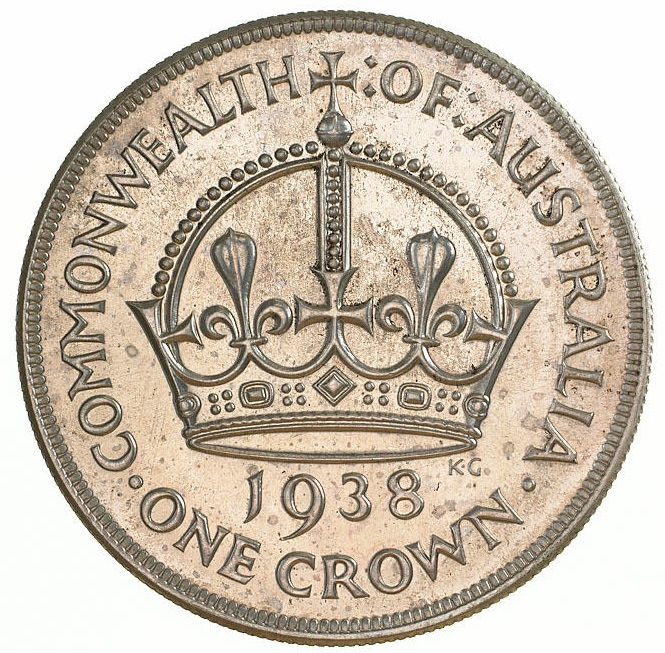 This one looks like someone sneezed near it 80 years ago but it's a proof 1938 crown. |
|
Pillar of the Community
Australia
852 Posts |
There were well under 100 1938 proofs struck, this is based on both research by Dr Briggs as well as the relative numbers of 1938 proofs sold compared to 1937 proofs. PCGS has slabbed 2 crowns as proof but only one of them (PR63) is a proof and the other (PR62) is almost certainly a circulation strike as I possess other examples with the same die markers and doesn't have that WOW factor that the other example has with its near flawless surfaces. It was thought to be a proof on the basis that it was submitted for grading with a set of 1938 proofs.
You can view both "proofs" on the PCGS website
|
|
New Member
Australia
42 Posts |
Thank u so much for your response and the information u have given me.... I am sorta young and a bit slow and even though FEARFUL of looking incompetent I'm going to ask anyway, so if it was PGSC Stabbed MS63 that wouldn't automatically mean it's a proff coin would it?
|
|
Valued Member
269 Posts |
Quote:
There were well under 100 1938 proofs struck I got the 200 from Museums Victoria who have at least one. It might be wrong, hard to say. 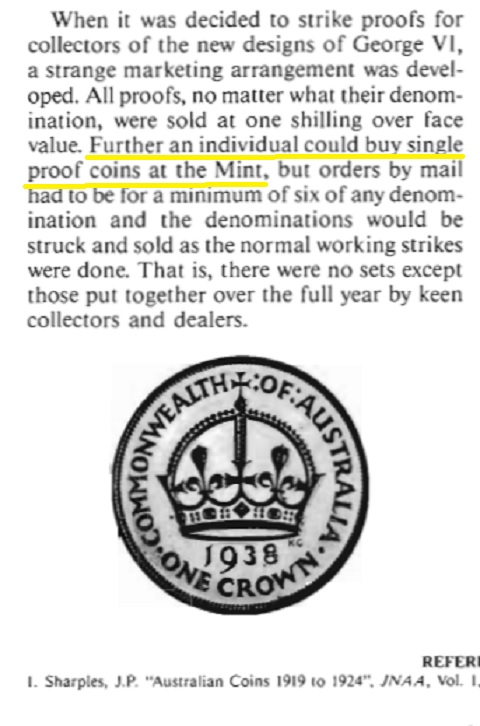 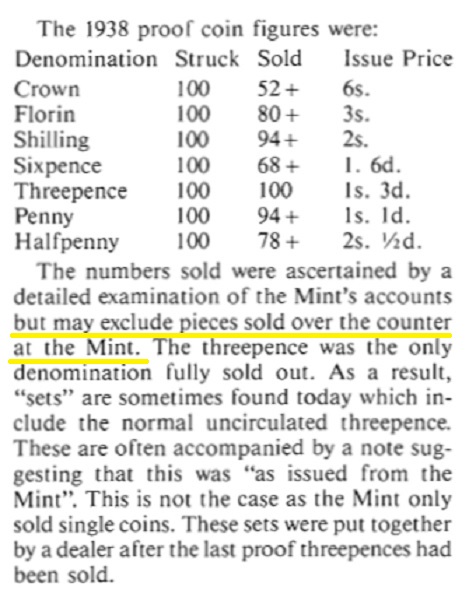 :Sharples, J. (1990). Journal of the NAA - Volume 5. Journal of the NAA - Volume 5, pp 17-21 I should think quite a few were sold individually from the mint. Quote:
this is based on both research by Dr Briggs Well done Briggs. # |
|
Valued Member
269 Posts |
Quote:
so if it was PGSC Stabbed MS63 that wouldn't automatically mean it's a proff coin would it? 'proof' not 'proff' Answer: No. |
|
Pillar of the Community
Australia
2180 Posts |
There was an article on the 1938 proof sets in the Australasian Coin and Banknote magazine in recent years - anyone remember it?
|
|
Pillar of the Community
Australia
852 Posts |
Sharples was the curator at Melbourne museum and he is unfortunately prone to errors in both his research and record keeping. The museums (Sharples) figure of 200 contradicts Sharples figure of 100 struck and 52+ sold. Dr Briggs sent me an email a few months ago stating that 18 were sold (per a letter dated 1939 to Dave Raymond, a noted dealer of the time, from the Melbourne Mint).
|
|
Valued Member
269 Posts |
Quote:
Sharples was the curator at Melbourne museum and he is unfortunately prone to errors in both his research and record keeping. I value his opinions. His research on the Syd-Melb 1923 halfpenny issue was brilliant. If you want to make spurious claims here that question him, you stand alone. My comment on the proof stands as correct. # |
|
Pillar of the Community
Australia
541 Posts |
I've always gone with 100 of the 1938 proofs (all denoms struck) - that is consistent with what has turned up and the records show 100 were struck (it is possible that Sharples has found records that another run was produced but I haven't confirmed this), as to how many were sold, that's up for debate but the 1938 proof crown is extremely rare, I've seen maybe 10-15 surface in my lifetime so I'd lean towards the conservative figures for that.
|
|
Pillar of the Community
Australia
852 Posts |
CoinOS, the claim is not spurious, I gave an example of Sharples contradicting himself over the numbers of 1938 crowns. If you want more examples just look at the paper he published on the 1920 penny where if you analyse his dies stock he had minus 2 dies at one stage (an impossibility), one of over 20 errors in a single paper. Or look at the mess that was made with the records about the 1946 florin on the museum website where the website states that the samples were struck for examination by a certain government body (and that overlooks the fact that the body had already been disbanded by act of parliament). It isn't possible now to determine how that mistake was made as when I contacted the museum a few years ago to ascertain the facts they told me that the original details accompanying the transferred coins had been destroyed after Sharples had uploaded the (often wrong) details into the museums records. Without those original records it isn't possible to determine if the mistake happened when originally recorded, or when the Melbourne Mint was transferring stuff to the museum or when Sharples entered wrong details. Those sorts of foul-ups are really sub par for someone who is a museum curator
Perhaps you should read the detailed books on pre decimals by Dr Briggs first.
So how does your comment on the proof stand correct?
|
| |
Replies: 13 / Views: 2,361 |
|








 Posted 09/23/2018 04:30 am


