It took nearly 100 years, and several unsuccessful attempts dating as far back as 1925, but Canada finally got its own distinctive national flag in 1965. Prior to that, the only official flag to fly over Canadian soil was the Royal Union Flag, though the Canadian Red Ensign (in various versions) often served as the nation's unofficial flag.
 Union Jack
 Canada Red Ensign (1957 version)
Upon taking office as Canada's Prime Minister in 1963, Lester Pearson pledged to introduce a national flag for Canada. During the summer of 1964, debate over the flag's design raged in the House of Commons; one camp argued for the adoption of the Red Ensign, the other sought a flag that incorporated traditional symbols associated with the United Kingdom (Union Jack) and France (the fleur-de-lis).
In September 1964, a committee was formed to make recommendations for the new flag. The committee reviewed thousands of designs submitted by people all over Canada. In the end, three general design categories were created: designs with three maple leaves, designs with one maple leaf and designs with the Union Jack and/or the fleur-de-lis.
After much deliberation, the committee ultimately recommended George Stanley's design of a single red maple leaf on a white field at center with two red bars flanking. In November 1964, Jacques Saint-Cyr prepared an official rendering of the Stanley design; it featured the 11-point maple leaf seen on the flag adopted.
The committee's recommendation of a single maple leaf flag design was accepted by the House of Commons on December 15, 1964 by a vote of 163 to 78. On January 28, 1965, Queen Elizabeth II issued a proclamation that defined Canada's new national flag with the specification that it would become effective as of February 15, 1965. On that Monday, the Red Ensign on Parliament Hill was lowered, and the new maple leaf flag was raised. It has been flying ever since!
The
Royal Canadian Mint (
RCM) celebrated the 40th anniversary of the first official raising of Canada's national flag by issuing a non-circulating legal tender (NCLT) commemorative silver dollar in January 2005. Brilliant Uncirculated and Proof versions of the silver dollar were struck, as was a selectively gold-plated version that was included in the year's proof set and a standalone red enameled version.
A special package option for the SD was also available: the "2005 Brilliant Uncirculated Silver Dollar & Interactive CD-ROM" set. The set commemorated the 40th anniversary of Canada's national flag and the 25th anniversary of the adoption of Canada's national anthem. The included CD is compatible with PCs running Windows and Macs.
The CD is a product of its time. By this I mean, it is not a flashy full-motion video with touch and swipe features. The CD offers what is essentially an interactive slide show that a user navigates via either clicking on a timeline graphic or by clicking on "Next" and "Previous" buttons. It also includes an audio track that plays several different versions of "O Canada." Anyone taking the time to go through the CD, however, will learn much about the history of Canada's flag and a bit about some of the coins used in Canada over time. I've enjoyed it on multiple occasions.
Following are several screen shots from the CD:
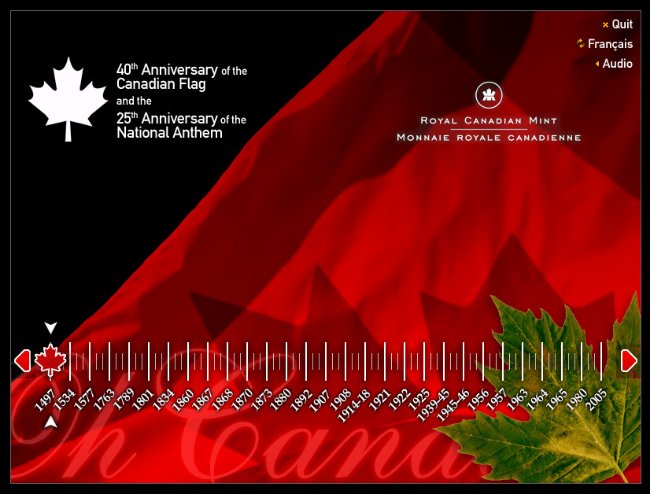 Main Menu
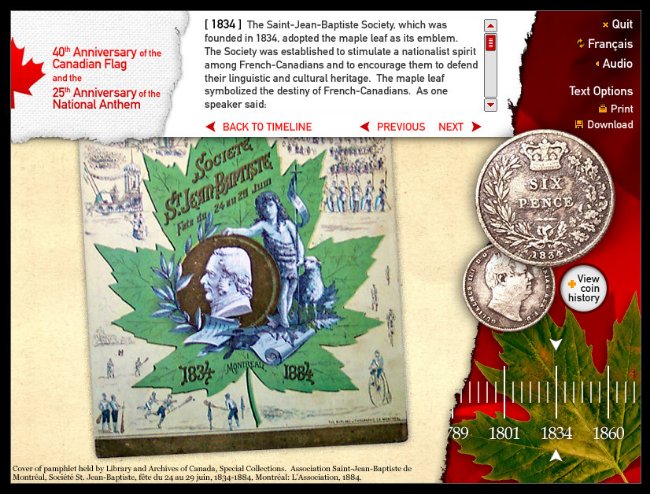 Discussion of early adoption of maple leaf as symbol of Canada
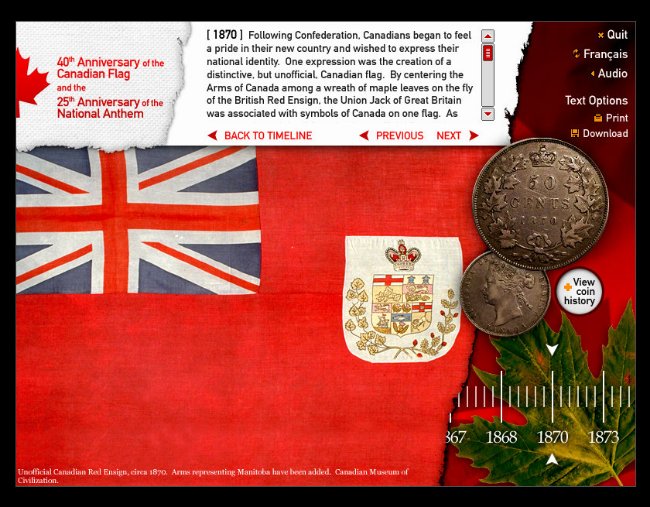 Early version of Canada's Red Ensign Flag
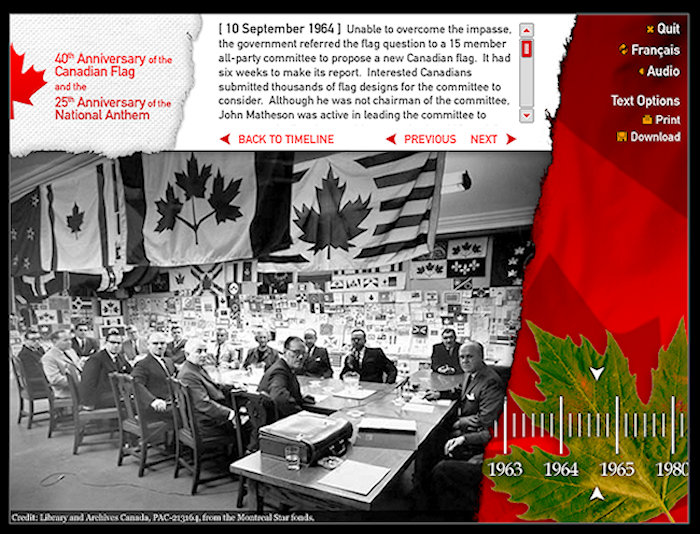 Flag committee with flag design submissions.
As the timeline is explored, brief descriptions of coins used in Canada are also available as a supplemental storyline.
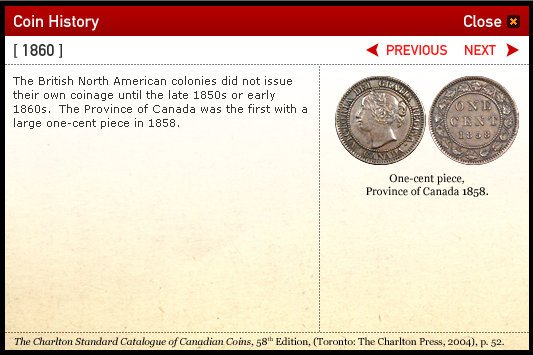 Brief discussion of Canada's early Large Cent.
The total mintage for the BU version of the 2005 SD is listed as 50,948 in the
RCM's 2006 Annual Report, but no breakdown for the number of CD-ROM sets is provided. At the time, the
RCM indicated that the set would be produced based on demand vs. to a specific limit. The issue price for the set was $34.95 CAD vs. $24.95 for the coin alone; the standalone proof version of the SD was issued at $34.95.
The commemorative reverse design for the coin depicts Canada's flag waving in the breeze at the center with a firework burst above it and the Peace Tower of the Parliament building at its lower right. The dual anniversary dates of "1965" and "2015" are also included. The SD is 36.07 millimeters in diameter with a weight of 25.175 grams. It is struck on a 0.9999 fine silver planchet and has a reeded/serrated edge.
 Commemorative reverse design of 2005 National Flag SD.
The custom packaging for the set is printed in full colour on glossy coated card stock. The SD is mounted within a corrugated cardboard insert that is faced on each side with a full-colour glossy commemorative wrap. I've included images of the various panels of the set's package below.
I believe the set was a noble effort by the
RCM to create a highly educational supplement to one of its commemorative coins - one that celebrated an important event in Canada's history. It's too bad, however, that it does not appear to have been a major "in demand" success. Today, the set sells for roughly the same as its issue price and is generally available from dealers and online auction sites.
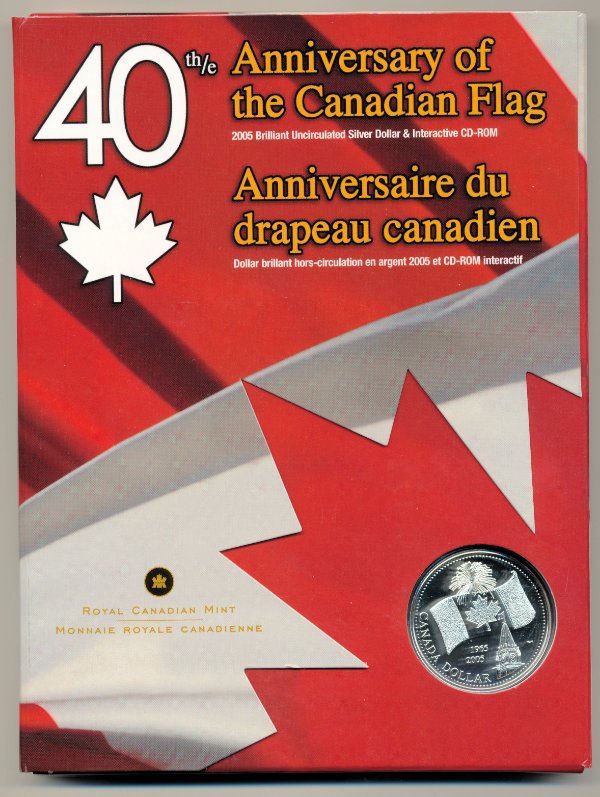 Front cover of packaging with die-cut maple leaf.
 Back cover of packaging with technical specifications.
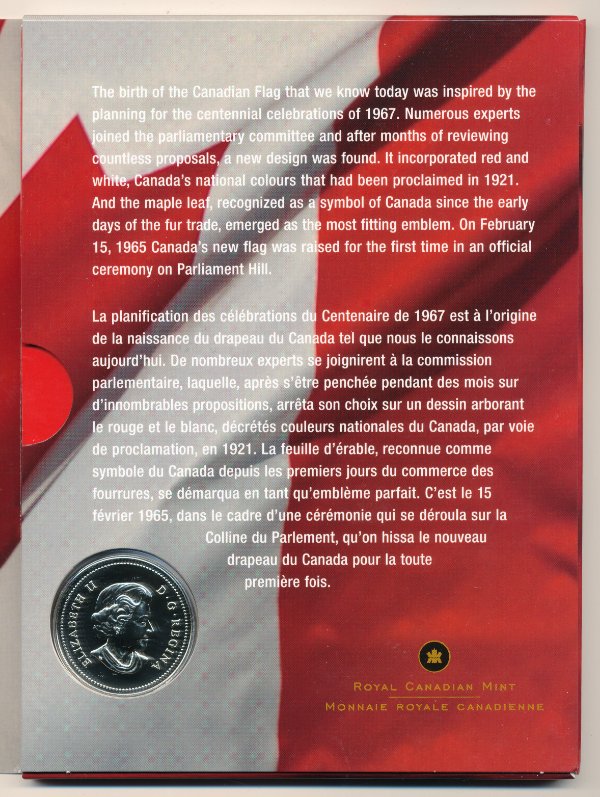 Interior panel with brief history of Canada's flag.
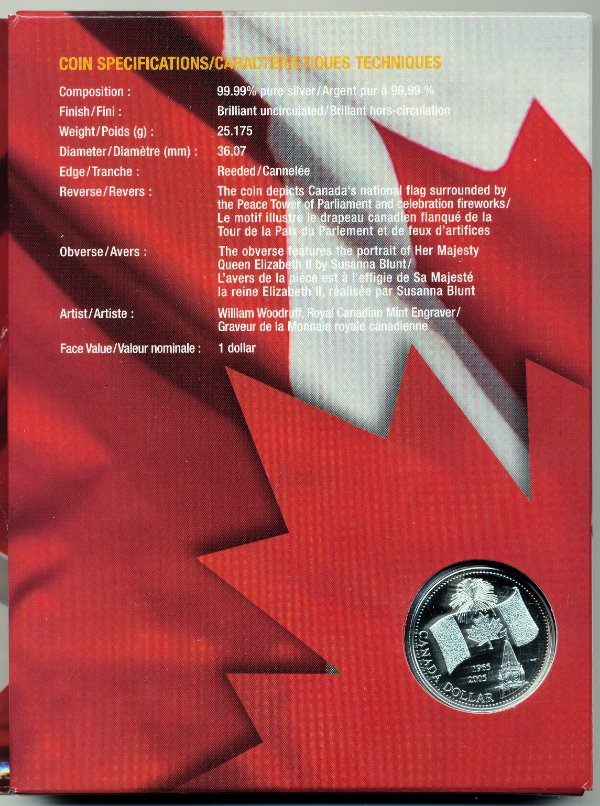 Interior panel with silver dollar specifications.
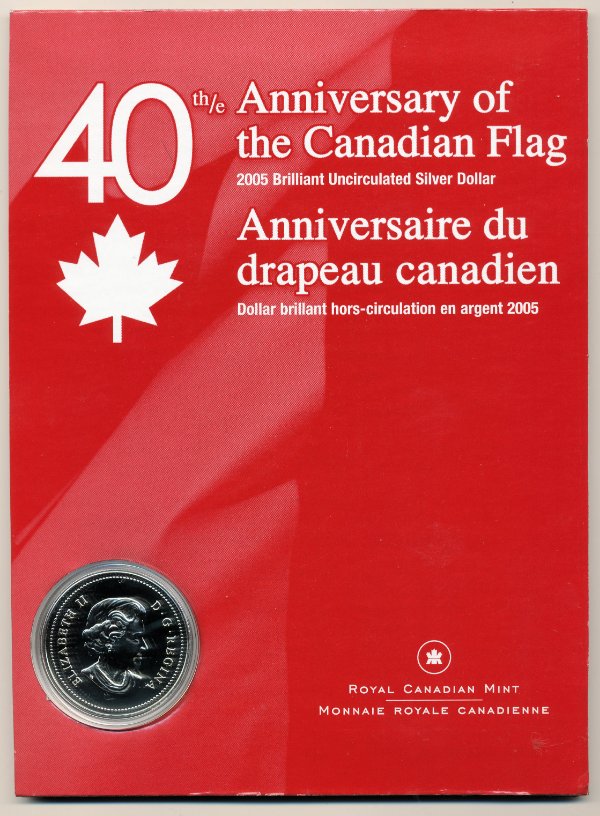 Silver dollar insert panel: Front/Obverse.
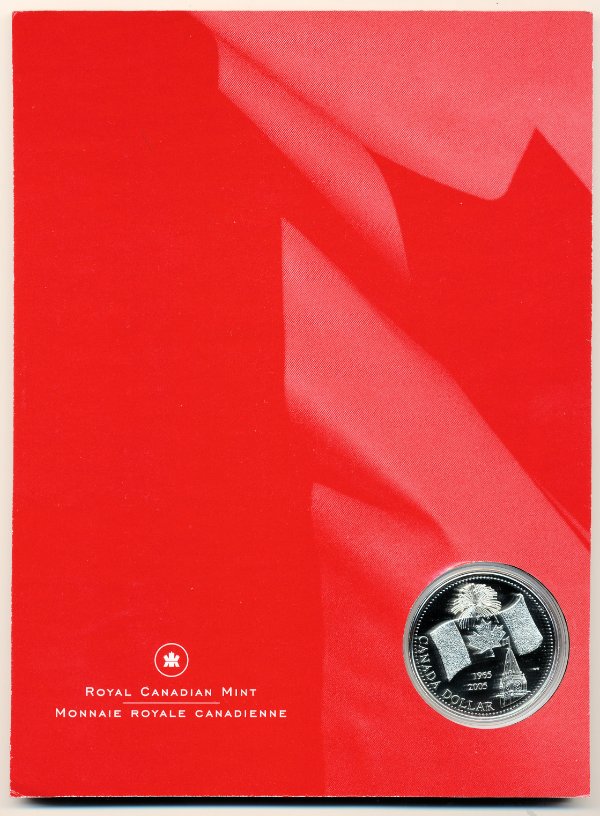 Silver dollar insert panel: Back/Reverse.



 Posted 10/15/2018 08:48 am





