| Author |
 Replies: 8 / Views: 1,434 Replies: 8 / Views: 1,434 |
|
|
Pillar of the Community
United States
6130 Posts |
Got this fascinating little piece a couple CNG auctions ago, but just got around to imaging it. Sicily, Himera AE Hexas / Hemilitra 3.91h Struck before 409 BC Obv: Head of nymph Himera left Rev: Six pellets within wreath 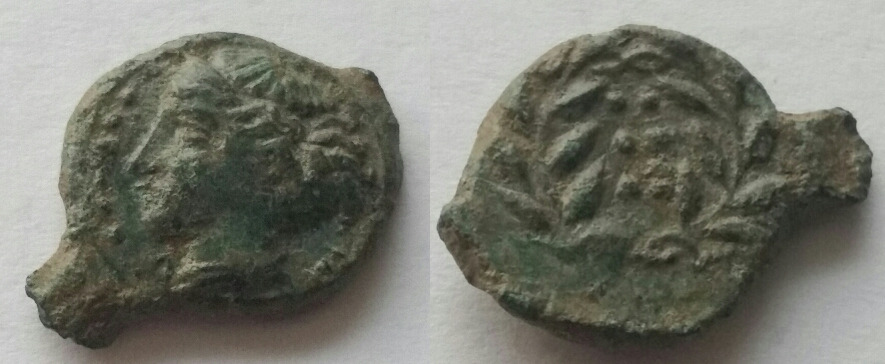 Himera was an important trade city on the northern coast of Sicily. They gained fame throughout the Greek world for thwarting an invasion by a vastly superior force of Carthaginians under Hamilcar in 480 BC, but were weakened thereafter by decades of tyrannical rule and civil unrest. Carthaginian general Hannibal Mago then invaded and destroyed the city in 409 BC. Ancient historians claim it was never re-settled. This coin is noteworthy for how clearly it betrays the method of manufacture - the casting sprues tell us that the flans were cast in trees, clipped apart, and then struck, probably while the metal was still soft. Most examples of this type had, at a minimum, their casting sprues removed, and some were filed into more or less round shape. |
|
|
|
Pillar of the Community
United States
616 Posts |
Wonder why they didn't just add the designs to the molds the way the Chinese would in their cash coins...
|
|
Pillar of the Community
 United States
6130 Posts |
That is a good question. My guess is that it was either too much work to create casting molds with designs already in them, or else they tried and the results weren't satisfactory. Recall that the Chinese practiced casting coins for centuries until they finally got it right, and even then, incompletely cast coins were commonplace. Just compare an official Chinese coin to a contemporary imitation and you can see the difference.
Cast-struck coins are actually fairly common; many especially smaller Ptolemaic coins have visible areas of thickness where the sprue was removed, and Judaean coins also often have "flan handles" from where the flan was cast. It is not common, however, to find one with such a dramatic sprue still in place!
|
|
Moderator
 United States
23731 Posts |
Those casting spurs make a nice coin more interesting.
|
|
Pillar of the Community
United States
1122 Posts |
Quote:
This coin is noteworthy for how clearly it betrays the method of manufacture Thank you for posting, this is the first time I'm seeing a fine example of this. Very nice & unique pick up! Edited by travelcoin
10/25/2018 7:05 pm
|
|
Valued Member
United States
253 Posts |
FYI. A lot of collectors don't realize that the Ptolemaic bronze coins were also cast in trees and then cleaned.
|
|
Pillar of the Community
 Spain
2752 Posts |
Very nice coin!
You do find some very interesting coins Steve...
Do you think this system of coin production was centred on the output per capita?
|
|
Moderator
United States
34543 Posts |
I agree that you picked a nice one to add to your collection. Thanks for posting.
"If you climb a good tree, you get a push."
-----Ghanaian proverb
"The danger we all now face is distinguishing between what is authentic and what is performed."
-----King Adz
|
|
Pillar of the Community
United States
6130 Posts |
Thanks all!
@Paul, if I had to guess, you are probably right; casing 20-100 flans at once and then striking them quickly was probably both a way to increase output and reduce wear on the dies, as the bronze would be a lot softer, provided it could take the heat.
@Pendrak, I know the small ones were, but the large ones? I thought those were prepared in the typical way?
|
| |
Replies: 8 / Views: 1,434 |
|










 Posted 10/25/2018 12:44 pm


