| Author |
 Replies: 60 / Views: 4,994 Replies: 60 / Views: 4,994 |
|
|
|
Pillar of the Community
 United States
751 Posts |
Mike these are deep cracks. like I mentiuoned before I could literally peel off portions of the obverse of the coin. I just don't understand how this happens. Would it have to be several smaller pieces of copper laying on top of a planchet that got pressed together during striking ?
I'll take more photos to try to better capture the defect.
Dan
|
|
Pillar of the Community
United States
2752 Posts |
Cracks will never follow the sinuous course seen on your coin. And as I said before, if these imperfections had been present from the outset, they would be shallower and fainter over the heavily worn parts of the design. Since they show no loss in strength or clarity, they must represent some sort of damage that occurred well after the coin entered circulation.
Error coin writer and researcher.
|
|
Pillar of the Community
United States
751 Posts |
Here are a few more photos to try to better show the cracks. the surface of the coin is level on each side of the crack. so I rule out an etching, because I would assume one side would be higher than the other to show material had been removed. This is NOT the case. The more I use the scope the more detail I can capture. This is really a nice tool, and I highly recommend them. I purchased it from WISH, I paid $23.00 including shipping. Dan 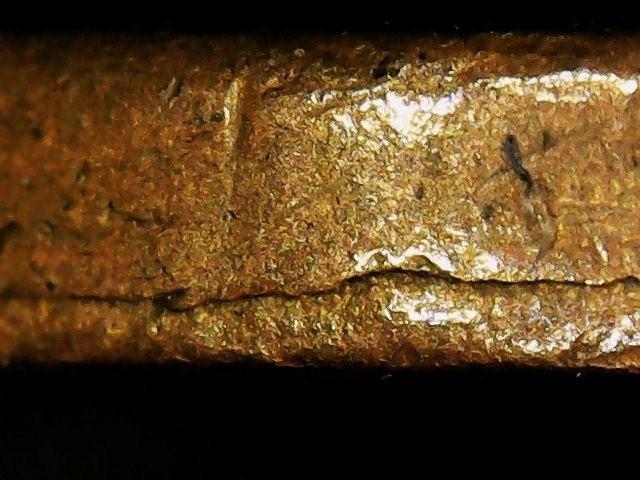 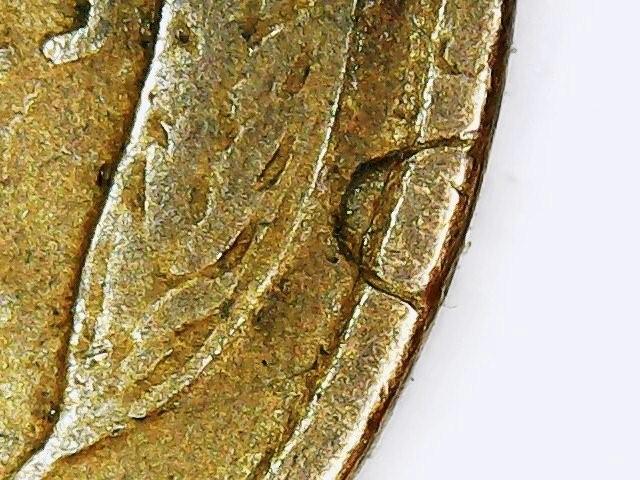 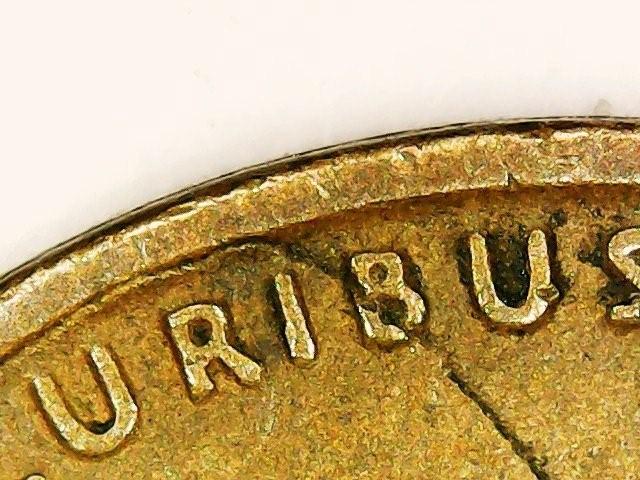 |
|
Pillar of the Community
7234 Posts |
Quote:
and appear that you could actually pry the layers apart. Well then - start prying and let us see the results! |
|
Moderator
 United States
56855 Posts |
What make and model scope? Just so you are aware, Mike is one of the top members here on CCF and knows what he is talking about. Maybe you should send the coin to him if he wants to see it in hand. John1  |
|
Pillar of the Community
United States
751 Posts |
I'm not saying anything negative about anyone. I know what I am looking at, and so far it does not match anything proposed.
The best way to describe how I would duplicate this coin if I had the opportunity to do so. I would take the thickness of one half of one planchet required to make a penny, the take another half of a planchet and break it up into pieces, lay the pieces on top of the previous mentioned half planchet, THEN strike a coin from that. If indeed those pieces would in effect bond with the other half. What I see here in person is what I would expect that union to accomplish.
It is not A strike through, it is not die cracks, it is not residue, it is not portions etched away.
All I asked was does anyone know what this is, and so far no one has identified or shown what I see in front of me.
Not meaning to step on any toes.
Dan
|
|
Pillar of the Community
United States
751 Posts |
One more point.
As far as cracks are concerned. Holding the coin and using a jewelers eye magnifier, I can see into portions of the cracks, and in some instances the crack goes into the surface of the coin as far as 1/4 the thickness of the coin, and evidence of that can be seen in one of the early edge photos.
Regardless of when it happened before or after circulation, can someone explain that, and can anyone post a photo showing the effect in another example. Keep in mind, this coin was minted in 1917, during a World War, and using equipment much more primitive than anything in use today. Copper was most likely scarce, because of the war effort, so maybe it was some form of experimental alloy.
Dan
|
|
Pillar of the Community
United States
2624 Posts |
On 11/20 you posted seven pics of your coin from an earlier post. In the sixth pic between the wheat and the rim it is clear that there is either two surface textures or two levels of "surface". A soak in acetone would provide useful info. Use industrial strength acetone and let it soak for several hours. If nothing changes you will have eliminated glue or any foreign substance.
I am not disputing what you say you are seeing, just trying to figure out what I am seeing.
|
|
Bedrock of the Community
United States
10635 Posts |
Dan, can you please share with us more about your photo microscope? Is it easy to use and easy to set up?  |
|
Moderator
United States
56855 Posts |
Yes,and make and model please. John1 |
|
Pillar of the Community
United States
751 Posts |
I'm trying to find info on model and brand. this is a Chinese instrument, sold as many different models. I bought it from WISH.Com. The box just says Digital Microscope, NO MODEL NUMBER.
Go to WISH.com, search for Digital Microscope, and SEVERAL: will come up.
Dan
|
|
Moderator
United States
56855 Posts |
I tried that,they want me to sign up before they show me anything.Not doin' it. John1 |
|
Pillar of the Community
United States
751 Posts |
Dr. Don; Referring to the photo posted on 11-20. I have noted on the photo areas that show that the surface is LEVEL on each side of the crack. Any illusion of difference in level of surfaces is simply small portions of the coins surface have been broken off over time. After all the coin was minted 101 years ago. If you could point out the exact spots you refer to I will attempt to get higher resolution photos of that spot. The coin has been rinsed in Acetone, I did not want to leave it too long in fear of causing any damage or effecting the surface of the coin. I am not used to using Acetone to clean coins, and I'm just cautious. Placing a coin into pure Acetone and then wiping it dry will not effect the coins surface except to remove foreign objects is that correct. How do you rinse the coin ? Can you rub the surface with a Q-Tip to remove residue ? Dan 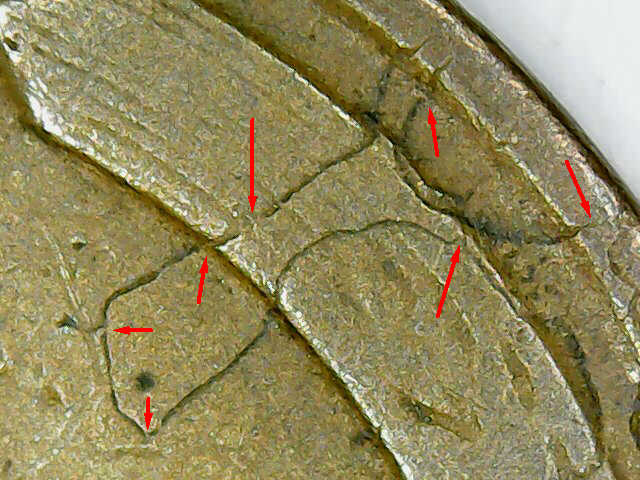 |
|
Pillar of the Community
United States
751 Posts |
John1;
I don't know where you can buy one. So if you want one you will have to sign up for Wish.com.
Dan
|
|
Bedrock of the Community
United States
37206 Posts |
 to CCF! |
| |
Replies: 60 / Views: 4,994 |








 First Page
 Previous Page


 Posted 11/21/2018 6:17 pm


