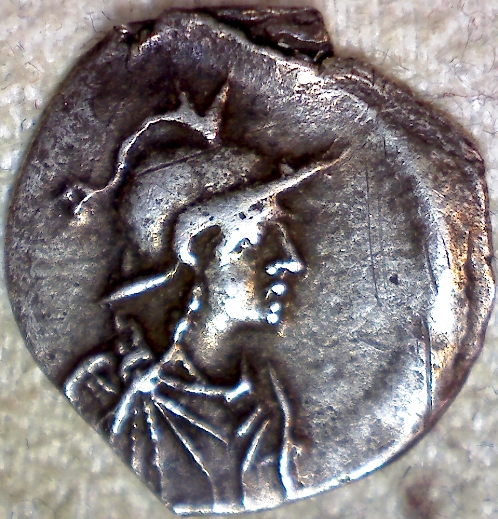
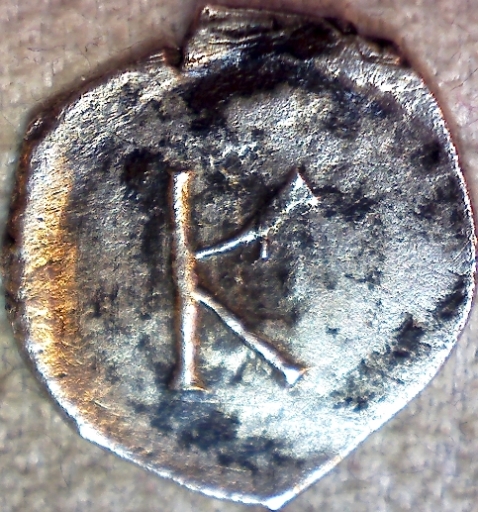
I recently picked up this silver Half Siliqua showing a helmeted and draped bust of Constaninopolis on the obv and a large K on the rev (the abbreviation for Constantinople). I really liked the provenance (Agora, CNG, Gorny & Mosch, and Thomas Bentley Cederlind) and the stated date (530s AD). I understand that the small silver pieces (such as mine) are actually donative or distribution medalets.
After some research, I am now a bit confused about the dating. Specifically, I am unsure if my piece dates to the original celebrations (i.e. the 330s AD) or is one of the centennial or bicentennial commemoratives. Vagi has this to say:
Quote:
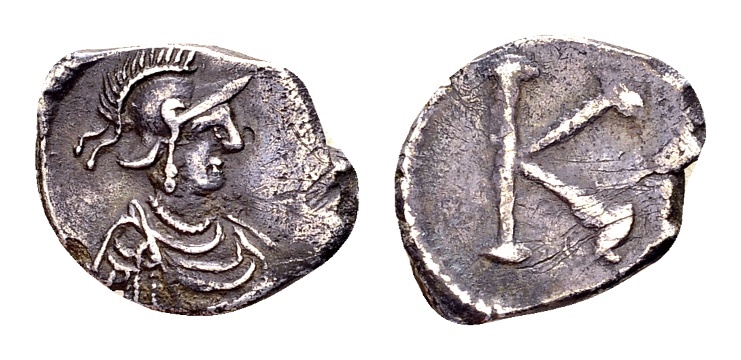
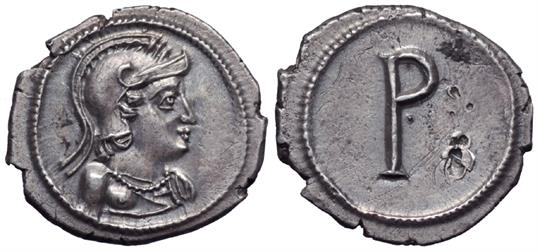
Some of these small pieces are engraved in fine style (compact, high relief), whereas others are of debased style (low relief, coarse execution). The former probably belong to the period 330 to 346 (and perhaps specifically to 330) whereas the coarse ones are from a later period, seemingly the 5th-6th centuries. Indeed it is probably that they were struck for centennial and bicentennial celebrations in Constantinople.
In looking at RIC, I only see one other example, and this specifically has a legend mentioning Justinian I. I guess that the relief and execution are roughly equivalent between that piece and mine, so it seems that I could conclude that mine is also a bicentennial. On acsearch.info, a couple dozen are listed, but I don't see a clear correlation between level of detail and date on these. Rather every single piece from Constantinople is listed as being from the 530s. More evidence that my piece is a bicentennial commemorative, but not particularly definitive.
I know we have some Roman experts here on CCF--I would appreciate any further thoughts or determining features, so please weigh in. Similarly, if you have one of these pieces, please post it here as it may be useful for making comparisons. Thx.











 Posted 11/10/2018 7:24 pm


