Coin Community Family of Web Sites Join Thousands of Coin, Bullion, & Money Collectors
Join Thousands of Coin, Bullion, & Money Collectors Royal Estate Auctions - $1 Coin AuctionsSpecializing in Modern Numismatics Royal Canadian Mint products, Canadian, Polish, American, and world coins and banknotes. Vancouvers #1 Coin and Paper Money Dealer Coin, Banknote and Medal Collectors's Online Mall 300,000 items to help build your collection!


Username:
Password:
Save Password
Forgot your Password?


This page may contain links that result in small commissions to keep this free site up and running.

Welcome Guest! Registering and/or logging in will remove the anchor (bottom) ads. It's Free!

26 New Parthians, With No Tiaras, Seated Archers, Or Tyches In Sight

To participate in the forum you must log in or register.
Author Previous TopicReplies: 11 / Views: 3,745Next Topic  
Pillar of the Community
Kamnaskires's Avatar
United States
7066 Posts
 Posted 11/10/2018  6:15 pm Show Profile   Bookmark this topic Add Kamnaskires to your friends list Get a Link to this Message Number of Subscribers
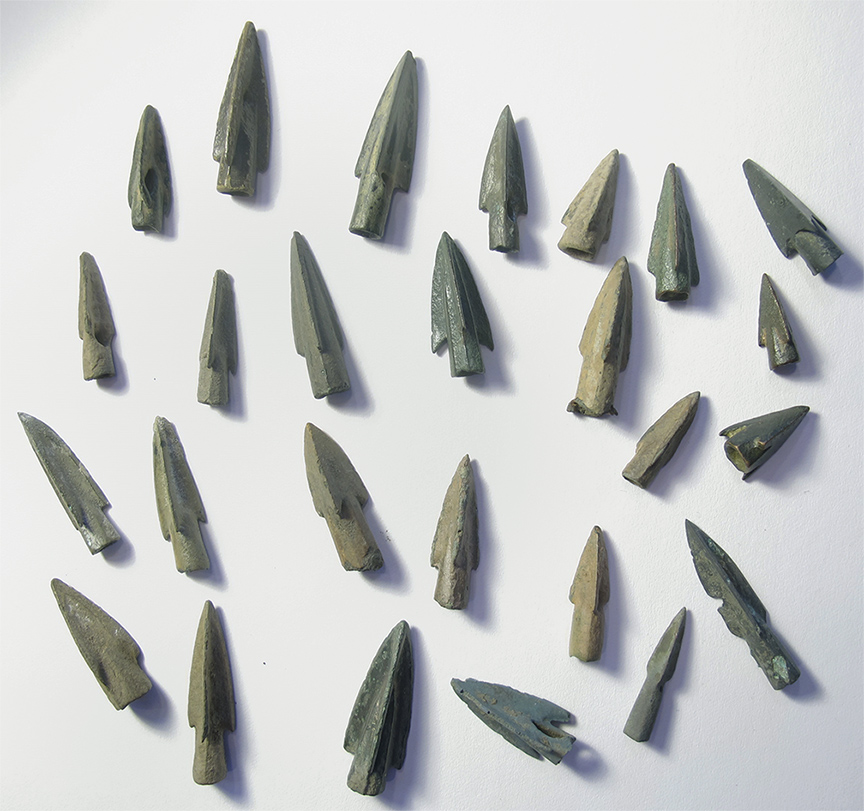
My latest Parthians come with no busts-in-tiara, no seated archers, no Tyche's presenting diadems to kings, and no garbled Greek legends. Here is the group as it currently stands, with some awaiting cleaning and conservation:
26-New-Parthians,-With-No-Tiaras,-Seated-Archers,-Or-Tyches-In-Sight

Recently, on a whim, perhaps to give my coin collection some context and some company, I started scouring sources for Parthian arrowheads. These have the distinct advantage of costing considerably less than my typical Parthian coin purchases. They have the disadvantage of being hard to definitively attribute - and, so, a disclaimer here: I believe most in my group, above, to be Parthian based on research I have done. Only six of my recent arrowhead purchases (including three from a VCoins dealer and three others that were ex-Agora Auctions from a Florida collection) were actually identified as such - that is, as Parthian. And, as it turns out, I eventually concluded that the ex-Agora ones are likely Macedonian rather than Parthian, and so they are not pictured in the group above. The others, above, were listed simply as generic ancient arrowheads, and so I attributed them myself, I believe successfully, based on selected sources. It is possible, however, that a couple non-Parthian arrowheads may have slipped in here. It is also possible that the Parthians copied earlier regional Pre-Scythian and Scythian types, and so some of these could predate Parthia. As you'll see below, it comes down to whose word - which scholar, that is - you choose to put your faith in when ID'ing arrowheads.

In any event this is quite a departure for me, especially since I haven't collected artifacts of the non-numismatic variety for years - for example, the two items at the start of this old thread: http://goccf.com/t/198163
(By the way, I'd love to see some of you revive that thread if you own any antiquities)

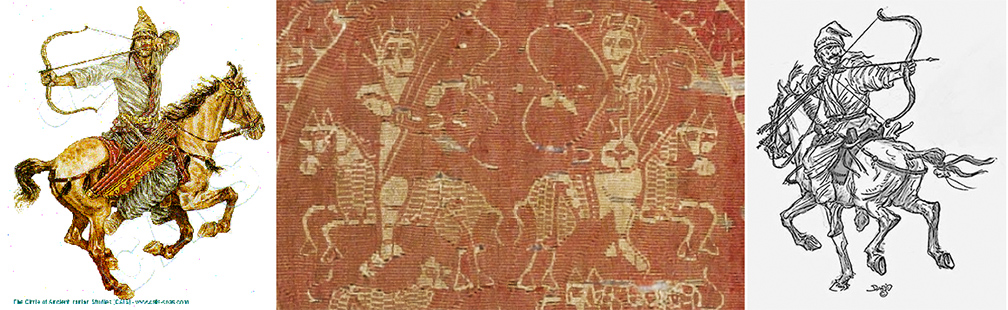
Parthian warriors were known - and feared - for their skill with bow and arrow. The Parthian sagitarii - the light cavalry - were particularly skillful at shooting while riding at fast gallop. A couple of years ago I described their prowess with the bow, and their "Parthian Shot" strategy that worked so effectively against Crassus' legionaries in the Battle of Carrhae: http://goccf.com/t/253250
26-New-Parthians,-With-No-Tiaras,-Seated-Archers,-Or-Tyches-In-Sight

Making a determination about attribution where these or any other ancient arrowheads are concerned can be challenging. It's truly astonishing how many ancient arrowheads are incorrectly described in listings, with the most common sellers' defaults being "Roman," "Scythian," or "Viking." I recall a CCF post a couple years back in which an ancient Chinese arrowhead had been sold to the poster as "Roman." The title of that post, complicating matters even more, was "Bronze Parthian (?) Arrowhead Pre-Coin." The poster thought it might have been Parthian. It wasn't.

As stated on Numiswiki's "Identifying Ancient Metal Arrowheads" page, "Even when the origin of arrowheads should be clear from the type, they are still often mis-described. In one example, the exact same type of arrowhead is labelled - in different archeological reports - as 12th century Mongol, 8th century Avar, 4th century Sarmatian, and 2nd century Roman."

An added complication is that some ancient cultures used arrowheads with a number of formal similarities. Parthian arrowheads, for example, are similar to some of the trilobate specimens from Macedonia. As if that is not enough to contend with, different sources (particularly the older references) seem to associate identical types to different cultures/regions - in other words, there are disagreements between these sources concerning the origins of some ancient types. In addition, it may be that some ancient cultures adopted types employed by others. As Joe Sermarini states the problem, "Unfortunately, ancient arrowheads are very poorly documented. There is no good overall reference. The references that do exist only cover a limited number of types and most are full of errors and conflicts. Many antiquities dealers arbitrarily call nearly all ancient bronze arrowheads, especially trilobate arrowheads, Roman. In fact, relatively few arrowheads can accurately be described as Roman."

There are certainly conflicting suggestions regarding Parthian types. Alex Malloy lists only socketed types as Parthian, while Oscar White Muscarella includes several tanged types too. Arrowheads with tangs would be associated with other (non-Parthian) cultures by scholars like Malloy. Similarly Malloy's type 116, which he identifies as Parthian and which is represented several times in my group above, was described in an earlier study by Erich Schmidt (1953) as "Achaemenid Persian" and by David Stronach (1978) as, more generally, "Post-Achaemenian" - a term which, technically, is applicable to Parthia in with regard to its geography and time. A paper I spotted on academia.edu has them as Scythian.

Sermarini clearly agrees with Malloy down the line with regard to his attributions - and with Malloy's description of the formal characteristics of Parthian arrowheads. I have trusted these two guys, above all others, in forming my fledgling collection. However, I have also referenced Oscar White Muscarella's Bronze and Iron: Ancient Near Eastern Artifacts in the Metropolitan Museum of Art and W. M. Flinders Petrie's Tools and Weapons illustrated by the Egyptian Collection in University College, London, and 2,000 Outlines From Other Sources. Technically the arrowheads in my group span the following types (all of these sources list them as Parthian or at least of Iranian or Iraqi origin from the Parthian period - which amounts to the same thing): Malloy Weapons 115-118, Petrie XLI-65 and 69, Muscarella 173 and 180, and Montilla 521-523, as well as 526.

26-New-Parthians,-With-No-Tiaras,-Seated-Archers,-Or-Tyches-In-Sight

Arrowheads are only very rarely listed by sellers with attributions to scholarly sources. Although it's a commercial rather than truly scholarly source, Malloy's Ancient and Medieval Art and Antiquities XXIV: Weapons, from 1993, seems to be the one that is cited most for arrowhead attribution. It is very short - frustratingly so - since, I believe, it is essentially just a very descriptive catalog of items Malloy had for sale at that time. It is available online at:
http://www.forumancientcoins.com/nu...oy%20Weapons

I also relied heavily on the various other Numiswiki pages that Sermarini pulled together, especially:
https://www.forumancientcoins.com/n...%20Arrowhead

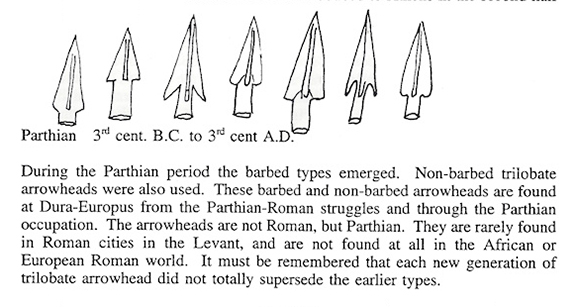
Getting back to the common mislabeling: Occasionally one sees the types of arrowheads in my group pic described erroneously in listings as Roman, but Malloy (as well as Oscar White Muscarella and Joe Sermarini) identified these varieties as Parthian:
26-New-Parthians,-With-No-Tiaras,-Seated-Archers,-Or-Tyches-In-Sight

Parthian arrowheads are also sometimes listed by sellers as Scythian. Given that the Arsacids, the ruling family line in Parthia, are believed to have had Scythian roots, and also given Scythia and Parthia's close proximity (the Central Asian lands surrounding the Caspian Sea), this mislabeling is closer to the truth than the Roman mis-attribution, but it is still apparently incorrect. The fact that the Scythians sometimes used socketed trilobate types - as did the Parthians - probably adds to the confusion. But, unlike Parthian arrowheads, Scythian trilobates had a long, curving leaf-like (the fancy term is "deltoid lanceolate") forms and no barbs - at least according to Malloy.

Parthian arrowheads, by contrast, have socketed cylindrical stems (no tangs, as per Malloy), they are often (but not always) barbed, and are always trilobate and most often tri-bladed. Sermarini adds that they are "nearly all triblade or trilobate solid (and have) mostly small heads with (a) comparatively standard design."

Among the difficulties encountered in attributing these is the fact that, as previously stated, some Macedonian, and also some Byzantine arrowheads share some of the same attributes, including trilobate form and barbs. The differences can be subtle and therefore there is no comforting sense of absolute certainty where attributions are concerned. But I am cautiously optimistic (as opposed to absolutely certain) that most, if not all, of these launched from Parthian bows.

These arrowheads are all bronze and, as Parthian products, they should date to the span of the empire: between the 3rd century BC and 3rd century AD. That's a broad date range, I know, but - as mentioned in the Malloy excerpt above - the usage of different Parthian arrowhead types (there are several, as seen in his illustration) overlapped - it's not as though one distinct type was used in each period in Parthian history. All in my group are pretty small, ranging from 16 - 35 mm.

In addition to the frequent misattributions (and common lack of attributions) in listings, other challenges included the fact that ancient arrowheads are often sold in group lots with a mix from different ancient cultures - which is a problem if, like me, you're only after specimens from one distinct ancient culture. This forced me to purchase a number of arrowheads from outside Parthia - not something I had initially wanted to do. So, in addition to the group above, I also now own what I've tentatively identified as Graeco-Scythian, Macedonian, Hellenistic Greek, Roman Republican, and Achaemenid types. I'm not displaying those here with this post. Many in this additional group are in rough shape, some with BD, but a few are nice. BD and deposits do seem very common with arrowheads since, presumably, many are recent MD finds. A number in my group will need cleaning and conservation. Another issue: fakes definitely exist! I spotted many, particularly from China. They look bogus even to my untrained eyes.

Prices of the arrowheads in my group varied considerably, but most were purchased for under $20, and quite a few were actually less than $10.

I enjoyed searching for these and learning about them. (The learning part is an ongoing process - this is all new to me) They seem to be wanting to fill the role of a tertiary collecting focus for me (after my Elymaean and Parthian coins). Kushans used to hold that spot but I am in the process of unloading those. These arrowheads might be just what the doctor ordered to pick up the slack. They're fun - although I strongly suspect that the legionaries in Crassus' army didn't share that opinion.

Pillar of the Community
Learn More...
Palouche's Avatar
Spain
2752 Posts
 Posted 11/10/2018  6:38 pm  Show Profile   Bookmark this reply Add Palouche to your friends list Get a Link to this Reply
Wow what a surprise!

A lovely collection and a very interesting write up Bob....

What are the main differences between Parthian and Roman arrowheads?
Moderator
Learn More...
echizento's Avatar
United States
23731 Posts
 Posted 11/10/2018  6:45 pm  Show Profile   Bookmark this reply Add echizento to your friends list Get a Link to this Reply
Bob, I like your new area of collecting, so this is what you were referring to when we spoke last. I see these arrow heads being sold on ebay by a few sellers. I find them interesting and have thought about picking up one or two but not knowing anything about them or having any reference material have stayed away thinking they were modern reproductions.

Your excellent thread has made me want to look into these further.

Being made from bronze they must have some weight and must have needed a long shaft to counter that. Is there an average weight or does it vary a lot?
Pillar of the Community
United States
1554 Posts
 Posted 11/10/2018  6:51 pm  Show Profile   Bookmark this reply Add Kushanshah to your friends list Get a Link to this Reply
I think you are on the right track. Without specific archaeological provenance, it may be difficult to distinguish points used by Arsacid forces from those used by their Scythian neighbors or others and Parthian points might rightly fall under the broader rubric of 'Scythian'. Good technologies tend to cross frontiers with some ease. I would suggest comparing your points to those recorded in archaeological site reports. There must be a number of published Parthian sites where projectile points have been recovered and discussed. Fun stuff!

Years ago, I recall a seeing a box of several hundred similar socketed trilobate points at a major show (the Chicago International, I think) labelled "Roman from Pakistan". Still gives me a chuckle .
Edited by Kushanshah
11/10/2018 7:10 pm
Pillar of the Community
Kamnaskires's Avatar
United States
7066 Posts
 Posted 11/10/2018  6:52 pm  Show Profile   Bookmark this reply Add Kamnaskires to your friends list Get a Link to this Reply
Thanks, guys. Ron, I haven't weighed mine - and, in any event, I am due for a new gram scale...my old one died.

Here's a relevant excerpt, below, from Sermarini's page at: https://www.forumancientcoins.com/n...%20Arrowhead

(Paul, that same page has a section devoted to Roman types, which are quite different overall from the Parthians...see the "Roman, c. 300 BC - 500 AD" part...having said that, though, Sermarini does state: "The eastern auxiliaries used the same trilobate arrowhead as was employed by the Parthians"...I guess, then, KS, it's possible that label was right...)

"Elements and Shapes of the Arrowhead
In approaching the study of metal arrowheads, their function must he considered. The elements used by the archer are the bow, an arrow consisting of arrowhead, shaft and feathers, and later the quiver. The earliest shafts were reeds: naturally straight, somewhat stiff, and light in weight. These were ideal for use with an arrowhead with a tang. The socketed arrowhead would he used with slender wooden shafts. The arrowhead is a ballistic device; its weight must be considered in relation to the "weight" of the bow (the force necessary to draw the bow). The weight of the arrowhead must be in a 1:7 ratio to the total weight of the arrow (the sum of the arrowhead, shaft, feathers, and binding material). Scholars long contended that the weight of an arrowhead could not exceed 10 grams, however, recent research proved that points weighing up to 22g could have been used as arrowheads. Still, heavy points were more likely used on javelins. The Neo-Assyrians had javelin throwers in their army along with bowmen. Each Roman soldier had a javelin as part of his accoutrements."
Edited by Kamnaskires
11/10/2018 6:56 pm
New Member
Sarcophoguy's Avatar
Canada
3 Posts
 Posted 02/06/2019  10:36 pm  Show Profile   Bookmark this reply Add Sarcophoguy to your friends list Get a Link to this Reply
Thanks for this great post Bob!

I am in the same boat, having a large lot of "Graeco Sycthian" arrowheads I have been researching to death, distinguishing Scythian, Macedonian Greek, Hellenistic Greek, Achaemenid, Byzantine etc..
I have a few I highly suspect are Parthian, but find a lack of academic information online frustrating. So many eBayer sellers are misidentifying them. As an ebay seller myself I try to be extremely accurate in my listings. I have also used Malloy, FORVM and Petrie in my research. I found your posted photo to be a great help in seeing a better quality image. Thanks.

One thing I found a great help for the eternal Graeco-Scythian question, which I didn't see in your post, is the Scythian use of "white bronze", an alloy of bronze mixed with pewter (copper and tin). These arrowheads are very noticeable in your hand. Lighter in color and weight, they are shinier and have a very tinny ring when dropped on a hard surface. They appear to be more like silver. I was then able to pull a few out of my Macedonian pile.

If you have arrowheads with a distinctly more lighter shiny silver tone that is clearly not your average cast bronze, its a pretty good chance its definitely Scythian.
Pillar of the Community
Kamnaskires's Avatar
United States
7066 Posts
 Posted 02/07/2019  08:31 am  Show Profile   Bookmark this reply Add Kamnaskires to your friends list Get a Link to this Reply
Welcome to the community, Sarcophoguy. Good info there, about the lighter toned metal in Scythian arrowheads. Yes, attribution with the arrowheads can be terribly frustrating, not only due to the dearth of information available online (and some of that is contradictory) but also because there seems to have been some cross-currents in antiquity where the arrowheads are concerned, with types spanning across distances and cultures.

The rabbit hole I started down with these has become more complicated. I delved into the arrowheads to provide some context for my Parthian coin collection. Then the arrowheads prompted additional interest in even more ancient Iranian weaponry (Luristani, Elamite, Amlash).

Then I discovered a similar problem (meaning similar to the challenges with the arrowheads) with the "Luristan" bronze blades I started collecting: that attributions were fluid and that a term like "Luristan" is used pretty liberally for many Western Asian weapons, whether or not those weapons are truly from Luristan. So I have settled into a more broad collecting area: ancient weaponry of Western Asia. Some items I have recently collected I can attribute as Luristani with some confidence; for others the broader label "Western Asian" is safer, dealers' descriptions notwithstanding.
Moderator
Learn More...
jbuck's Avatar
United States
189142 Posts
Moderator
Learn More...
echizento's Avatar
United States
23731 Posts
 Posted 02/07/2019  8:08 pm  Show Profile   Bookmark this reply Add echizento to your friends list Get a Link to this Reply
to the community

Bob has gotten into this new and fascinating area which I want to learn more about. I'm looking forward to seeing more of these.
New Member
Sarcophoguy's Avatar
Canada
3 Posts
 Posted 02/14/2019  2:56 pm  Show Profile   Bookmark this reply Add Sarcophoguy to your friends list Get a Link to this Reply
Thanks for the welcome everyone!

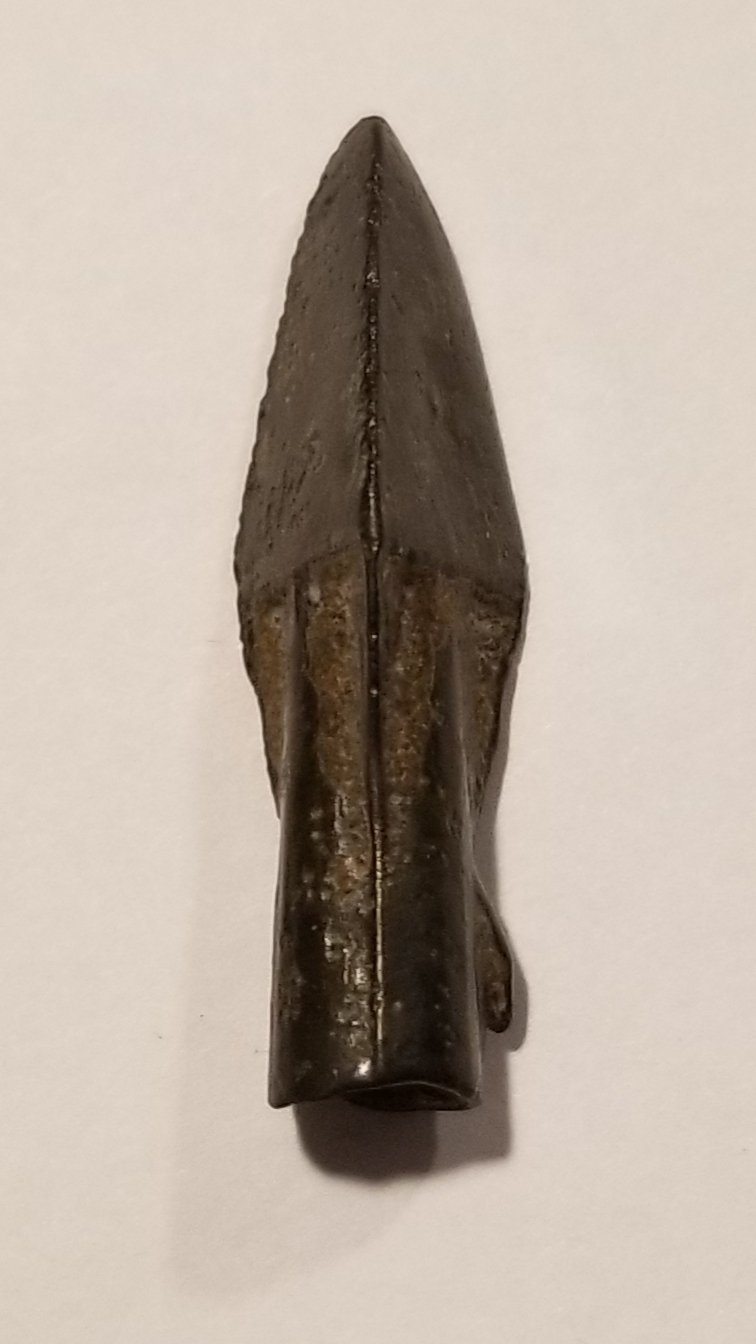
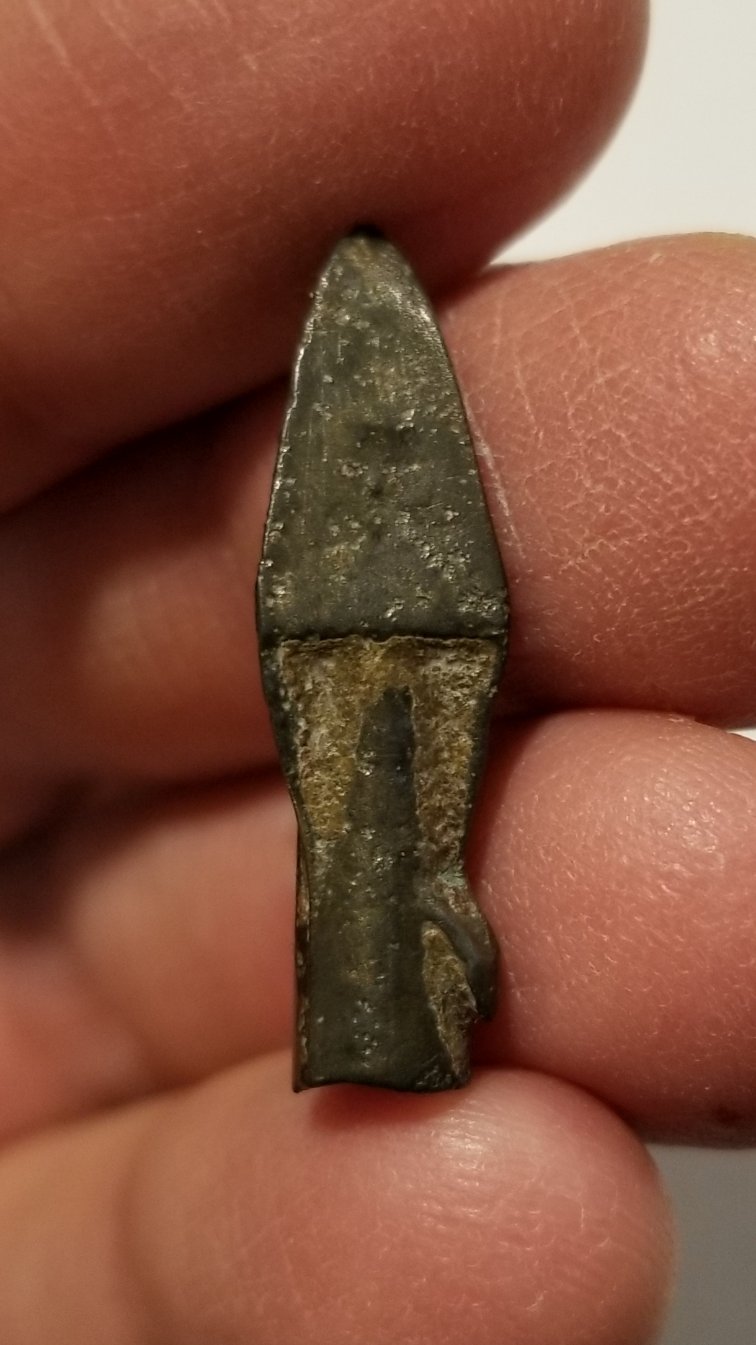
Hey Bob, have you come across this type in your Parthian research? I can't find any info anywhere on it.

Trilobate, solid tip. No barbs, but where the barb would be blades run down to the socket. Tiny little spur. 29 mm length. Do you think it might be Parthian. It is an unusual and uncommon design, like a hybrid between types.

Thanks,
Brett

26-New-Parthians,-With-No-Tiaras,-Seated-Archers,-Or-Tyches-In-Sight
Pillar of the Community
Kamnaskires's Avatar
United States
7066 Posts
 Posted 02/14/2019  8:39 pm  Show Profile   Bookmark this reply Add Kamnaskires to your friends list Get a Link to this Reply
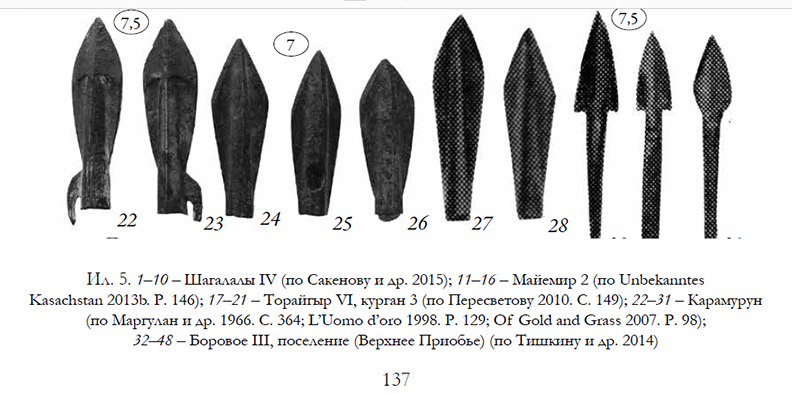
Brett, Marina Daragan's Arrowheads of Prescythian and Early Scythian Time: Manufacturing Techniques, Metrology, and Marks has somewhat similar looking types illustrated on page 137. See numbers 22 and 23 below - perhaps not identical, but of the same general typology.

The pdf of that resource is available on academia.edu.

A word of caution: there are many different types listed in that book, including types that Malloy, Sermarini, and Muscarella clearly label as Parthian. So, again, we are on that slippery slope of Central and Western Asian ancient arrowhead attribution.

The author makes reference, as you see, to other sources with regard to illustrations 22-31 on that page. Google translate comes up with this from the Russian: "22-31 - Karamurun
(Margulan et al. 1966. p. 364; L'Uomo d'oro 1998. R. 129; Of Gold and Grass 2007. R. 98)"


26-New-Parthians,-With-No-Tiaras,-Seated-Archers,-Or-Tyches-In-Sight
New Member
Sarcophoguy's Avatar
Canada
3 Posts
 Posted 02/15/2019  1:09 pm  Show Profile   Bookmark this reply Add Sarcophoguy to your friends list Get a Link to this Reply
Awesome! Thanks Bob, I'll head over there
and read that one, must have missed it so thanks
for the tip. No pun intended.

Brett
  Previous TopicReplies: 11 / Views: 3,745Next Topic  

To participate in the forum you must log in or register.


Disclaimer: While a tremendous amount of effort goes into ensuring the accuracy of the information contained in this site, Coin Community assumes no liability for errors. Copyright 2005 - 2026 Coin Community Family- all rights reserved worldwide. Use of any images or content on this website without prior written permission of Coin Community or the original lender is strictly prohibited.
Contact Us  |  Advertise Here  |  Privacy Policy / Terms of Use

Coin Community Forum © 2005 - 2026 Coin Community Forums
It took 0.43 seconds to rattle this change. Forums