| Author |
 Replies: 9 / Views: 1,965 Replies: 9 / Views: 1,965 |
|
|
Pillar of the Community
United States
851 Posts |
I was going through my box of world silver and thought of a question...
I have several silver 1/2 francs from Switzerland - right now their melt value is about US$0.98 and their exchange value is about US$0.51...
If silver drops back to US$7.00 or so then then face value would actually exceed melt. I know we haven't seen silver that low since '05 but even then the Swiss Franc was near par with the US dollar.
I wonder how many silver coins were in circulation in Switzerland back then...
Any other examples you can think of?
|
|
|
|
Pillar of the Community
Sweden
1078 Posts |
Well, speaking of Switzerland you've got the 5 Franken coin just there to think about. Its face value is not proportional to its weight in silver like the ½, 1 and 2 Franken coins, so if silver would dorp just a little bit more than the CHF would rise, then based on intrinsic value it would be better releasing them into circulation again... (one silver 5 Franken is CHF 5.87 at the time of writing)
However, the Swiss National Bank has what I consider to be a weird policy - they quickly withdraw coins and revoke their legal tender status of coins with compositions that are non-current, despite design and size being exactly the same. They do however, to my understanding, redeem coins at face value provided the denomination is still in circulation. So technically all Swiss silver coins are only worth their melt value and don't have a face value anymore, but practically, few in the public would know about this nor notice as the designs are still the same.
Also worth noting is that the 5 Franken coins I see for sale online tend to go for about double melt regardless of date. So it's better to keep them for now.
Edited by X2an
12/18/2018 5:57 pm
|
|
Pillar of the Community
 United States
851 Posts |
@X2an -
Thanks for the input - I have a few of the 5 franc coins as well - but they're in a different folder so I didn't think to check their melt value recently.
I hope other readers have more input for other currencies!
|
|
Moderator
 Australia
16964 Posts |
For the vast majority of countries, silver has never fallen low enough (or their currency risen in value against silver high enough) for this to ever be an issue, since the silver spike of the late 1960s drove silver out of circulation worldwide.
The Germans were one of the last to persist in issuing "circulating" silver coins, with the silver 5 marks not being replaced with cupronickel until 1975. But the melt value was way over 5 marks by that point and very few were made. Neighboring Austria continued to issue high-face-value silver coins through the banks, but these did not circulate.
The Mexican case of the 1990s is an outlier, created by a government that was both desperate to stabilize its currency and influenced by a powerful silver mining lobby. The lobby convinced the government that putting silver back in circulation would help stop the New Peso from falling. Bimetallic coins with a small silver core were struck for circulation 1992-1995, before the peso fell to below melt value and the coins were, not surprisingly, destroyed and melted down. Turns out that making coins out of silver doesn't actually help support the currency much at all, in this modern age when the vast bulk of the amount of money that exists is electronic/virtual.
Technically, things like the Canadian "$20 for $20" scheme are coins where the face value exceeds the melt value. But governments that issue such coins usually go to considerable lengths to ensure that the coins do not actually get spent. The Canadian $20 for $20 coins, for example, are theoretically "legal tender", but the maximum number of these coins you are allowed to submit per legal tender transaction is "zero". So for all practical purposes, they aren't actually legal tender.
Don't say "infinitely" when you mean "very"; otherwise, you'll have no word left when you want to talk about something really infinite. - C. S. Lewis
|
|
Pillar of the Community
United States
5362 Posts |
jeffbuckles You raise one of my favorite topics when you say: Quote:
Last time face value exceeded melt value on world silver...?
Most collectors seem to believe that before 1965 that the US produced coinage that was based on "intrinsic" value and that the US was on a "silver standard". Both of these beliefs are actually incorrect. Virtually the entire world used a gold standard by the first half of the twentieth century. Silver coins were "tokens" with a value set by law (fiat value) higher than the intrinsic worth. The US has been operating on a Gold standard since 1873. That was when a new monetary policy was passed into law. Silver interests referred to the Act as the Crime of 1873. At that point in time silver was abandoned for use in intrinsic coinage and all silver coins including the silver Dollar became "tokens". Only gold coins were treated as having a full intrinsic value. Everything else had fiat value. The driver for this change was manifold. A driving factor for the US was the discovery of the Comstock lode of silver in Nevada. This discovery made the US the largest producer of silver in the world. It created a silver glut. Supply exceeded demand. As world economic pressure moved to adopt the gold standard, the US found itself fighting the tide. If silver was coined at a 16 to 1 ratio - gold would flow to Europe to prop up silver values and we did not have adequate reserves. Germany adopted the gold standard and dumped millions of ounces of silver on the world silver markets causing an immediate devaluation of silver. So on world markets a silver dollar was worth less than a gold dollar and creditors overseas demanded payment in gold not silver. So in 1873 we chose gold as the standard monetary metal. That meant that silver itself became only a commodity. The price was based on supply and demand for the metal. There were only a few exceptions to this. Some like China were important but that is another story I have told many times. By 1893 the intrinsic worth of a US silver dollar hovered in the 30-40 cent range. In the 1930's the value of a dollar fell to it's lowest point ever at just under 30 cents. Government mints now operate as profitable businesses. That fact is often lost in the process of many historical discussions. At one time, it was not so. Coins contained intrinsic value based on metal content. When the coins were worn down to 95% of full weight they were melted and re-coined. Allowing worn coins to circulate meant that newly made coins would be hoarded and never circulated. (This happened in England). In those days the government absorbed the loss to maintain a respected currency. Coins that circulated and were worn past the 95% mark often were discounted by businesses. They used to weigh silver coins to determine actual value. This discussion may seem to be simply academic detail, but when history is not understood correctly (at least on this macro-level) incorrect ideas can cause us to make errors particularly in my field of authentication. To distinguish a Contemporary Circulating Counterfeit from a Numismatic Forgery these historic concepts often form the basis on which a decision rests. The availability of a profit for the manufacture of any coin by a counterfeiter or forger must first exist. It is a truly rare counterfeiter that makes his wares for his own amusement. Sorry to digress, but all coin collectors should understand the main forces behind the manufacture of coinage.
|
|
Moderator
United States
194816 Posts |
This is an interesting discussion. I am moving it to the Main Coin Forum for more exposure.  |
|
Pillar of the Community
United States
851 Posts |
@swamperbob @Sap Thanks for the extensive and detailed input. I think the Swiss coinage is most interesting because their coinage has changed so little in the last 150 years or so. It would be fairly simple for some silver coinage to find its way into circulation, much like we sometimes find a silver dime or quarter here in the US. But not so in the UK, Mexico, or Germany, etc. where the coinage has been replaced or completely redesigned in recent years. Makes me wonder if we have any coin roll hunters from Switzerland here who can share their experiences? On a related note, in my collection I have a silver (0.925) commemorative 5 euro coin (Barcelona) from 2010. Its face value is about US$5.69 but it's bullion value is about US$5.89: https://en.numista.com/catalogue/pieces45422.htmlOf course, I paid about US$30 for it at a shop in Spain, so I wouldn't ever spend it, but I'm sure that more than a few kids cracked open their coin sets and spent those silver coins on candy etc. Kudos to the lucky cashier who pulled those out of the drawer. (edited for spelling) Edited by jeffbuckes
12/19/2018 11:33 pm
|
|
Pillar of the Community
United States
6130 Posts |
Japanese ¥10,000 yen 1986 is legal tender for $89.61 today, melt value of $9.61. Supposedly the numismatic premium precludes the incentive to spend them, but I have seen them go for as little as $60 on ebay. 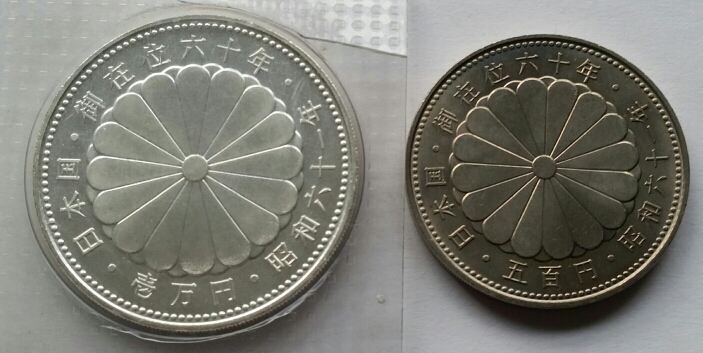 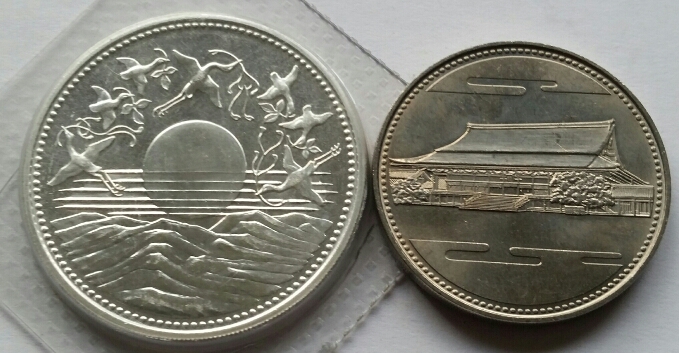 Similarly the ¥5000 from various years is worth $44.80 exchange, $6.60 melt today. 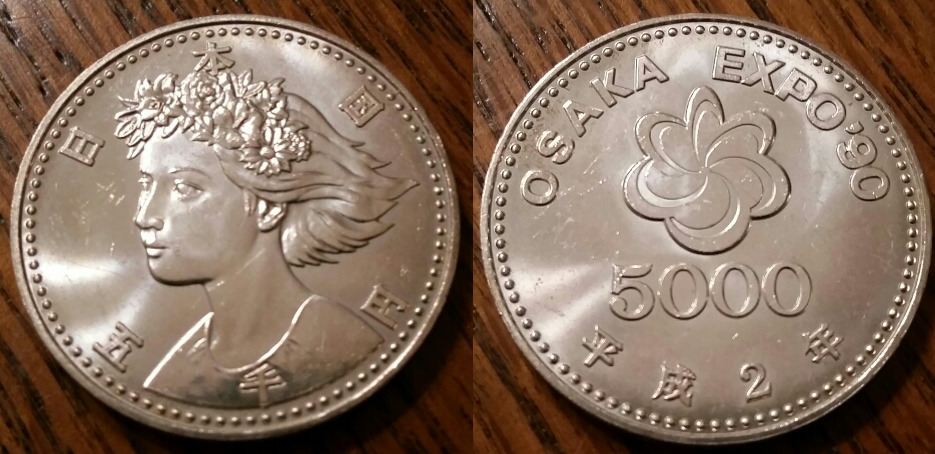 I don't own any due to the price tag, but there are two ¥100,000 gold coins (1986 and 1990) that at 20g are currently worth more as money than as gold. Those however are more rare and generally do sell for a premium. |
|
Bedrock of the Community
United States
17884 Posts |
Quote:
The US has been operating on a Gold standard since 1873. It could be argued since 1853. Until then anyone could bring silver to the mint and it was made into coins of nearly full intrinsic value with unlimited legal tender status. In 1853 the government cut that off and from that time forward silver was purchased but coins were only made for the government account, The silver content was reduced and the legal tender status was restricted to no more than $5. The silver coinage became to some extent a subsidiary coinage. |
|
Bedrock of the Community
United Kingdom
18594 Posts |
Quote:
I think the Swiss coinage is most interesting because their coinage has changed so little in the last 150 years or so. It would be fairly simple for some silver coinage to find its way into circulation, much like we sometimes find a silver dime or quarter here in the US. I spent a lot of time in Switzerland in the early 2000s. I actually found two silver coins in circulation, both half-francs. I received one in change in a post office when buying some stamps. The other was when I was travelling on a city bus where you have to buy your ticket from a machine in the bus. A woman who boarded before me was having problems purchasing her ticket as one of her half-franc coins kept being rejected by the machine. Suspecting what the problem was, I offered to swap it with a different half-franc from my pocket change. Result: I got a 1962 silver half-franc and the passenger got her ticket! On another occasion I went to a bank to exchange some sterling and saw the teller counting out some silver 5-franc coins he had exchanged at face value from another customer. I asked if I could buy some for face value, and he let me do so. Switzerland has issued quite a few silver 20-franc coins since abandoning the coinage of silver for circulation. These are available from banks at face value but I've never received one in change or tried to spend one! They are usually prooflike and supplied encased in plastic, like this 2001 example commemorating Johanna Spyri, author of the 'Heidi' books:  |
| |
Replies: 9 / Views: 1,965 |
|








 Posted 12/18/2018 7:53 pm


