| Author |
 Replies: 11 / Views: 1,921 Replies: 11 / Views: 1,921 |
|
|
Pillar of the Community
United States
3207 Posts |
Has the ink employed on the backs of US notes changed with time? To me older notes usually more green on the back than newer notes. Has the BEP changed the ink color, or does this reflect fading or yellowing with time? As an illustration, below is one note of similar grade from each of the 1950s (top), 1960s, and 1980s (bottom). The 1950s note looks the most green to me. 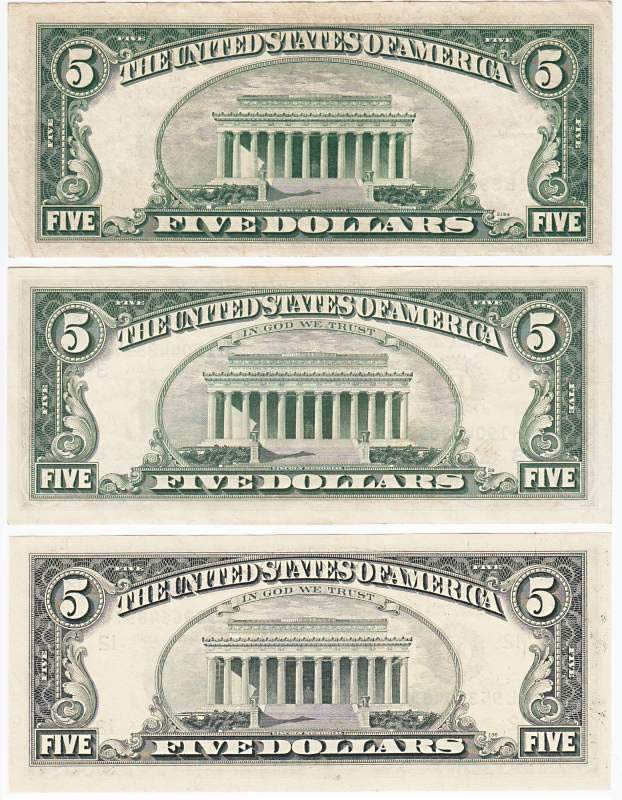 |
|
|
|
Bedrock of the Community
United States
94367 Posts |
I think we would need a larger sample!  |
|
Moderator
 United States
194970 Posts |
Interesting. I only have a few older notes and the green does seem more vibrant than what is in my wallet (at least for the ones).
|
|
Pillar of the Community
 United States
3207 Posts |
It might be more a case of a grayback becoming a greenback with time. In a photo editor I adjusted colors to turn the yellow paper of the oldest note toward white. Doing that also made its green ink more gray. Of new notes the RGB or CYMK breakdown of the reverse ink reveals no particualr greennees. It seems the green emerges as the paper yellows.
|
|
Bedrock of the Community
United States
94367 Posts |
 Sorry, don't buy that. These haven't been called "greenbacks" for 150 years for no reason. |
|
Pillar of the Community
United States
3207 Posts |
I was surprised too, but with no evidence for a BEP ink color change, simple aging is left as the cause. The ink color might be intended to look more green with circulation since a note will spend most of its life in that condition.
|
|
Bedrock of the Community
 United States
12910 Posts |
Do you have any more examples? As frog said, a (much) larger sample would be necessary to back such a theory.
|
|
Moderator
United States
194970 Posts |
Still interesting.  |
|
Pillar of the Community
United States
3207 Posts |
I did not post more images because the color difference seems obvious to me, and I suspect to anyone who has a collection of "greenbacks" that spans decades. To my eye the color change seems to happen around 1980, but that might reflect the condition of notes I have, with older ones being in poorer condition generally.
I scanned two other 5s and computer sampled the Red-Green-Blue makeup at 10 random inked locations on each note's reverse. Here is the data
F $5 1950B L-B Block
R G B values at 10 spots:
52 74 57
46 65 57
55 78 58
61 86 63
51 81 78
54 73 61
63 84 72
28 60 66
88 107 96
54 92 77
Average R G B
55.2 80.0 68.5 (much more green than blue)
EF $5 1988A G-H block
R G B values at 10 spots:
53 57 49
34 55 60
32 48 52
22 35 39
35 48 35
51 51 53
44 56 48
53 58 66
48 63 64
50 62 53
Average R G B
42.2 53.3 51.9 (about same amount of green as blue)
The newer note, despite being lightly circulated, is barely more green than blue and indeed looks fairly grayish. The older note displays much more green to both the computer and the eye. The tone is overall brighter as well, which could reflect ink fading with time.
|
|
Bedrock of the Community
United States
94367 Posts |
Interesting work, I'll have to pay more attention! |
|
Moderator
United States
194970 Posts |
Data? We love data.  Yup, still interesting. |
|
Bedrock of the Community
United States
12910 Posts |
Nice try - but we need more samples.
|
| |
Replies: 11 / Views: 1,921 |
|







 Posted 12/19/2018 08:58 am





