| Author |
 Replies: 9 / Views: 4,876 Replies: 9 / Views: 4,876 |
|
|
Moderator
 United States
23731 Posts |
Recently I have been branching out a bit into English hammered coins a lot of which are bent in some way. I came across a Youtube video that I've tried which seems to work fairly well. Here are a few that I have tried in on, it's a slow process but I have plenty of time to work on them. They still need some work though. Here is the Video: https://www.youtube.com/watch?v=W3AkrVTrbGEThere are two methods shown on Youtube, the other involved using a touch to heating the coin to cherry red. I'm not keen on that idea. 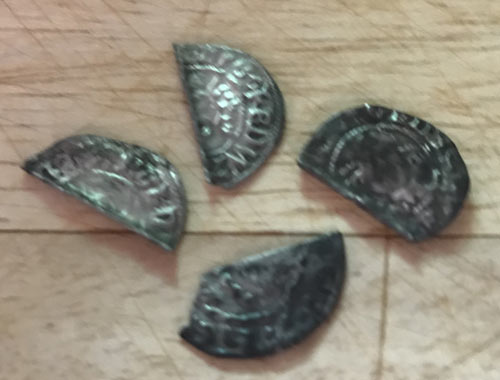  Two Edward I half pennies and a Henry III half penny. |
|
|
|
Pillar of the Community
United States
7067 Posts |
Now, how many people could claim (or would admit) they spend their down time straightening bent medieval hammered coins? We are a special kind of folk, aren't we? Personally I would just call Uri Geller to take care of this. (I suspect very few people reading this are old enough to get that reference...  ) |
|
Moderator
 United States
23731 Posts |
I'm sure your right. |
|
Bedrock of the Community
Australia
21789 Posts |
I have flattened quite a few bent coins, but they have to be reasonably thin to begin with.
Get two small sheets of thin rubber, and sandwich the coin between these, and squeeze in a vise. Rubber best used because scratching is far less likely as the coin is being squeezed.
You will not get rid of the evidence of the previous bending, because the coin has usually suffered wear on the ridge of the bend area.
However, I think that the flattened coin is much better off, and is more attractive for being flattened out, even with previous wear being obvious.
WARNING ! - there is a risk.
Medieval hammered coins can suffer from silver crystallization which may not be evident, even with close examination.
The flattening process in the vise may cause the coin to snap in two.
Fortunately, this has never happened for me.
|
|
Pillar of the Community
United Kingdom
4208 Posts |
I believe the rational behind using the torch is that it anneals the silver - after all, it crystallises like any other silver. For that, I'd get a piece of thick leather and glue it to the face of a hammer and lightly tap the coin when hot (maybe a couple of annealing cycles first).
Only coin I ever flattened was a commonwealth farthing that was still pliable anyway. When I had it mostly flat, I put it between 2 sheets of leather and put it in a vice to get it as flat as I could.
|
|
Moderator
United States
34542 Posts |
Interesting post Ron--thx for posting. I have a couple coins with a wavy flan so perhaps they have already been straightened by someone.
"If you climb a good tree, you get a push."
-----Ghanaian proverb
"The danger we all now face is distinguishing between what is authentic and what is performed."
-----King Adz
|
|
Pillar of the Community
 United States
8047 Posts |
Very interesting.
But ... to play devil's advocate, if cleaning is frowned upon, would this process also be frowned upon?
|
|
Moderator
United States
23731 Posts |
Ancient and medieval coins are mostly found in digs and have been cleaned so I wouldn't say it's frowned upon. From my reading English hammered coins were bent and given as religious offerings to churches. IMO unbending a coin that has been folded in half is restoring it, though I'm sure some purest's would disagree.
|
|
Bedrock of the Community
Australia
21789 Posts |
Hammered medieval coins generally speaking are thin, and so are much more subject to accidental bending.
As such bending of this sort, I think, is a type of restorable damage.
|
|
Pillar of the Community
United States
8047 Posts |
Quote:
I believe the rational behind using the torch is that it anneals the silver - I agree. The annealing temperature of sterling silver is over 500C. So that's probably what the torch approach is doing. The boiling water approach is different. Temperatures like 90C (the water will instantly be below 100 just by pouring it into the ceramic cup) will give a slight reduction in the elastic modulus and yield stress of the metal, making the silver a bit easier to work when it comes out of the cup. That workability disappears as soon as the silver cools down, which happens very quickly. The water will stay hotter if you nest two styrofoam cups together, and pour the water into them. Edited by tdziemia
12/22/2018 08:48 am
|
| |
Replies: 9 / Views: 4,876 |
|





 Posted 12/21/2018 6:53 pm





