First Page


 Posted 06/07/2019 09:51 am


I have stumbled on to another observation which may be relevant, although it seems a bit counter-intuitive. I would be interested in any comments.
It is that the lower the Tensile Strength, the less likely a metal is to produce laminations. Here is a summary of that information:
Tensile Strength (UTS)
Incumbent Materials¹
Cent: Copper Plated Zinc Tensile Strength = 26 ksi**
Nickel: Cupronickel Tensile Strength = 96 ksi
Quarter: Cupronickel-Clad C110 = 65.5 ksi
There is a negative linear relationship between tensile strength and adjusted delamination factor.²
1. ALTERNATIVE METALS STUDY
Contract Number: TM-HQ-11-C-0049
FINAL REPORT
August 31, 2012
Submitted to: United States Mint
801 Ninth Street, NW
Washington, DC 20220
2.https://www.researchgate.net/public...tic_emission
It is that the lower the Tensile Strength, the less likely a metal is to produce laminations. Here is a summary of that information:
Tensile Strength (UTS)
Incumbent Materials¹
Cent: Copper Plated Zinc Tensile Strength = 26 ksi**
Nickel: Cupronickel Tensile Strength = 96 ksi
Quarter: Cupronickel-Clad C110 = 65.5 ksi
There is a negative linear relationship between tensile strength and adjusted delamination factor.²
1. ALTERNATIVE METALS STUDY
Contract Number: TM-HQ-11-C-0049
FINAL REPORT
August 31, 2012
Submitted to: United States Mint
801 Ninth Street, NW
Washington, DC 20220
2.https://www.researchgate.net/public...tic_emission


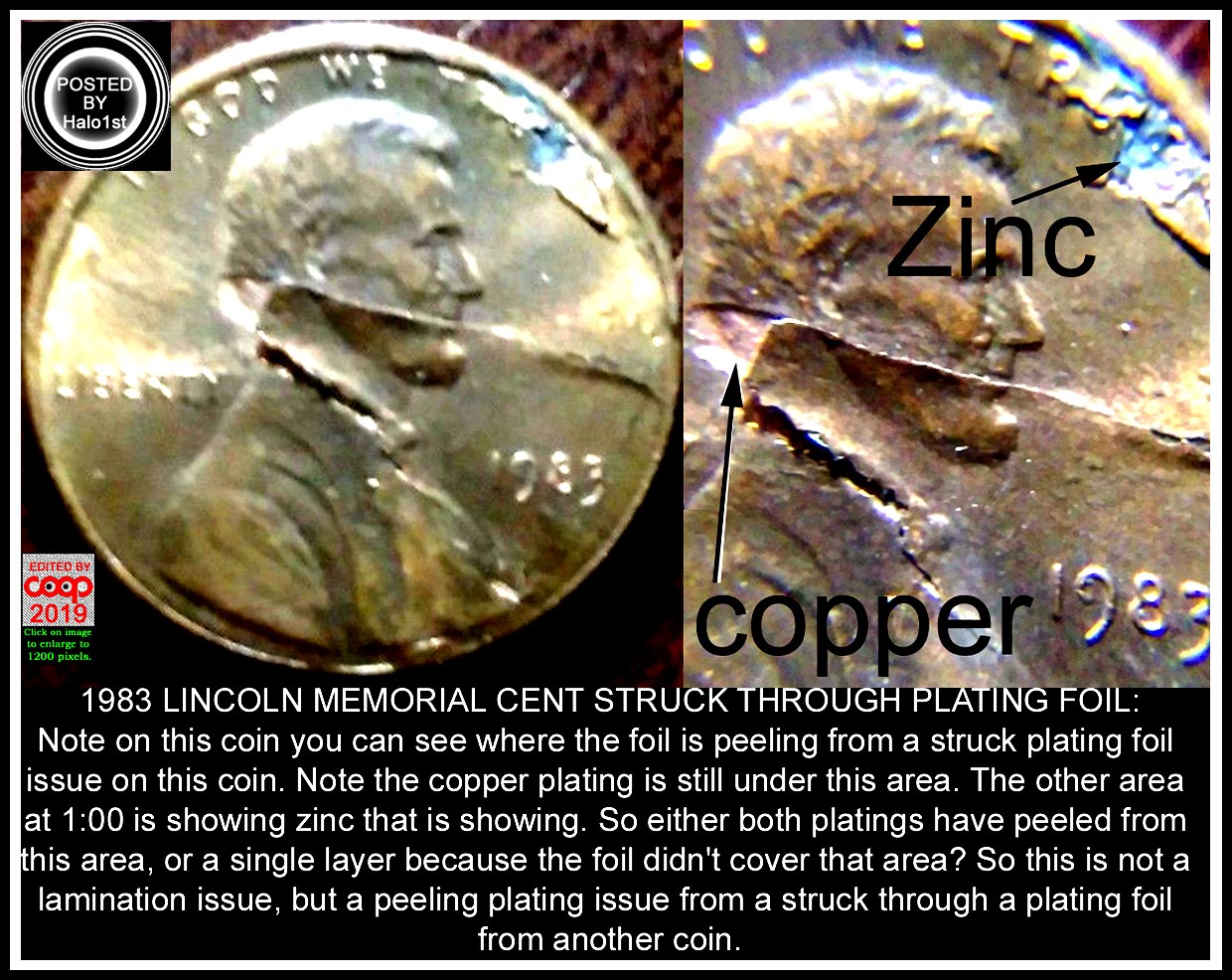

 is the silver piece that seems to be attached to the underside of the raised copper plating. Noted in the center of this cropped image. Thanks, Doug.