| Author |
 Replies: 20 / Views: 3,915 Replies: 20 / Views: 3,915 |
|
New Member
Canada
10 Posts |
My niece found this 1853 half dollar in a box of old coins and has asked me to find the value and any additional information concerning the counterstamp. I was wondering if the counterstamp is found on other coins and does it increase or decrease the value. She does have BAKERs in her family tree but cannot find any reference to anyone with the intials 'N C'. Note that the counterstamp is on the reverse and the obverse. My first post so please be nice if I messed up. Thanks in advance. 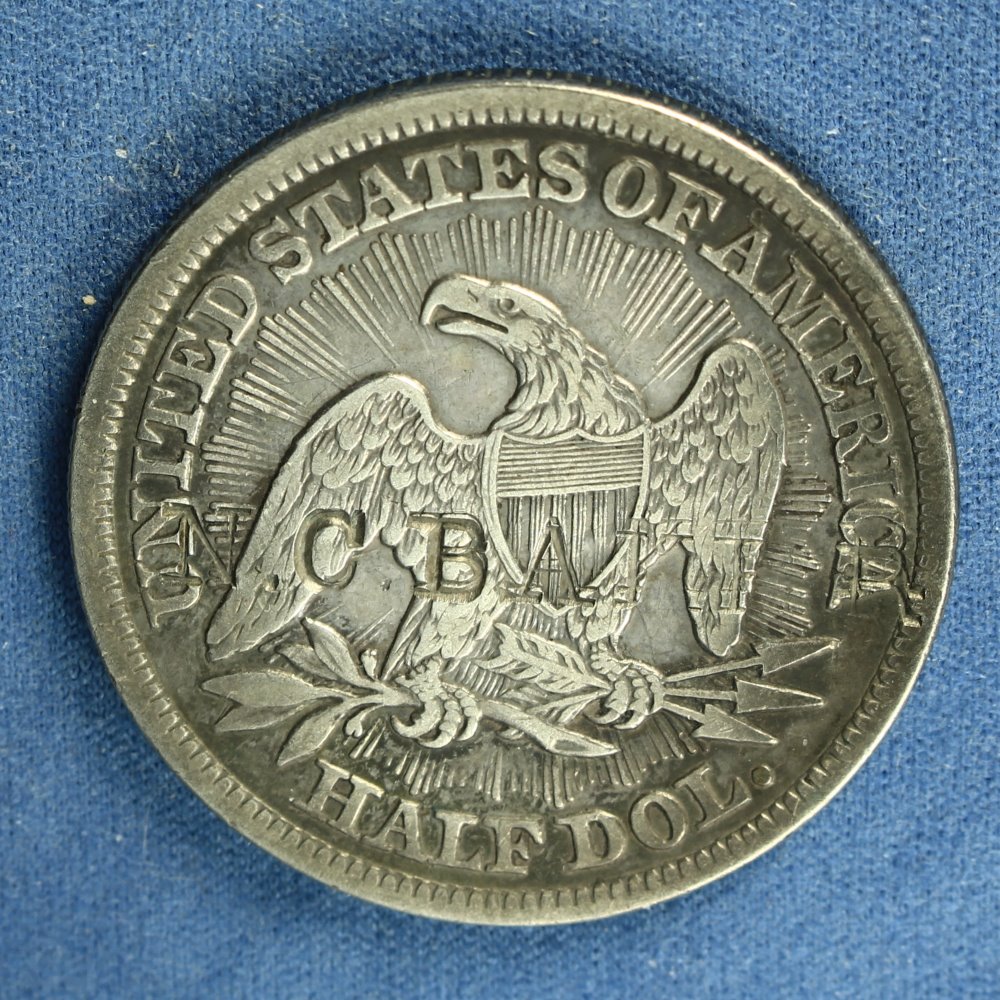 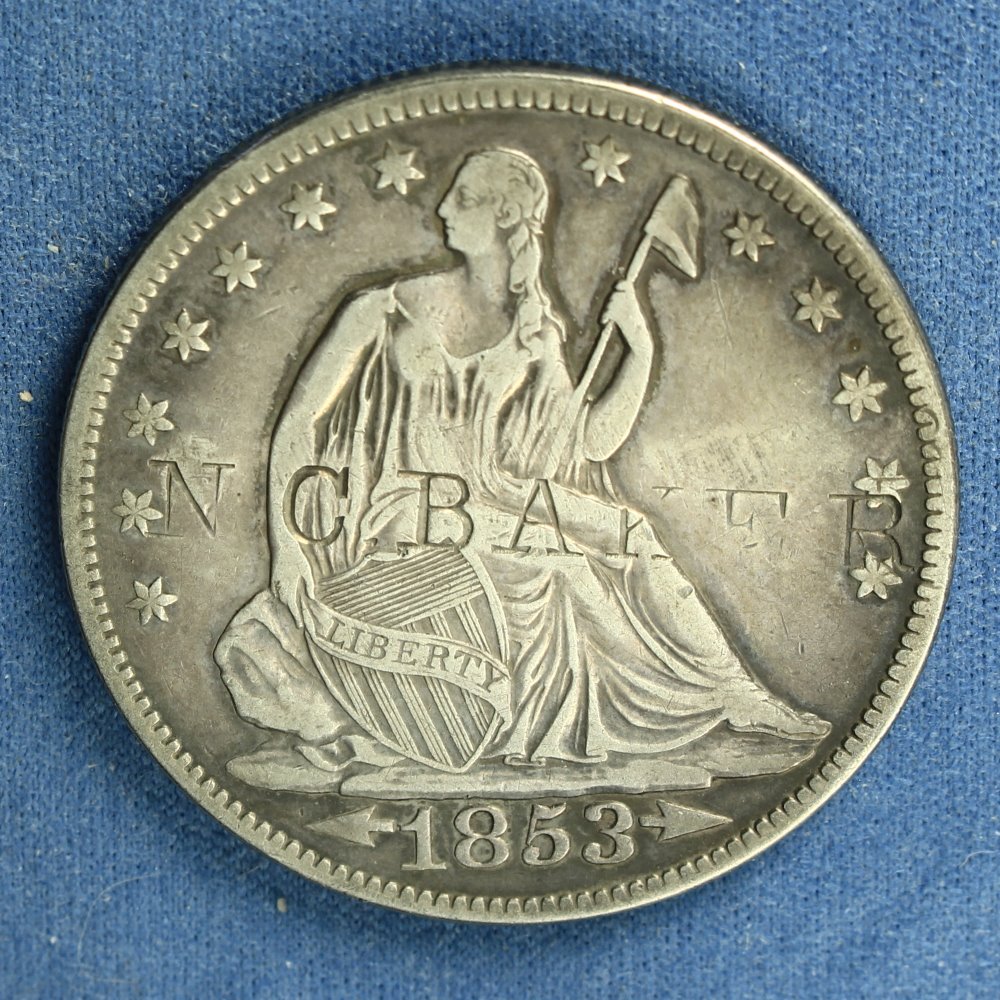 |
|
|
|
Valued Member
United States
134 Posts |
Well what a cool find !! The host coin was in like AU condition or better when counterstamped. So, it most likely was done before the 1880'S. Look back in the family tree again. I bet it's some family member who also had a small business. As to value well it's worth more to the family I would think and maybe $25-$75 to a non family member. Let's see what others say. Good Luck and nice find for sure. Louis in NC LOL
|
|
Pillar of the Community
United States
4703 Posts |
Counterstamps are considered damage, and in virtually all cases diminish the value. Otherwise the coin has nice details, too bad someone did that to it.
|
|
Pillar of the Community
United States
853 Posts |
Counterstamps are always interesting! No doubt, the counterstamp is "damage", but it's also an interesting bit of history, like chop marks. It might be an advertisement like RaleighCoinDeal said, or it might be a political candidate or someone who just stamped their name on things, etc etc. Anyway, some people collect counterstamped coins like this, so even though it loses a bit of value from the "damage" it is still collectible. Look at this page for more counterstamped coins: http://goccf.com/t/126486BTW: In some cases, if you figure out who or what "NC Baker" is that might actually add a bit of value to it for some collectors. Edited by jeffbuckes
01/28/2019 09:42 am
|
|
Moderator
 United States
195203 Posts |
Very interesting.  Quote:
Counterstamps are considered damage, and in virtually all cases diminish the value. Otherwise the coin has nice details, too bad someone did that to it. I know one member who will disagree.   |
|
Pillar of the Community
United States
4432 Posts |
Quote:
Counterstamps are considered damage, and in virtually all cases diminish the value. Otherwise the coin has nice details, too bad someone did that to it. With all due respect, this opinion is patently false. While it does hold true for a large percentage of counterstamped coins, it's certainly DOES NOT apply to "virtually all" as stated. My own collection consists of many hundreds of counterstamped coins whose value is assuredly enhanced by an attributed stamp that has history attached to if. My avatar is but one example of a counterstamp enhancing a coin's value. Lemuel Pomeroy was an early gunsmith in Pittsfield, Massachusetts. The stamp matches those applied to his firearms. Without the counterstamp, this coin would be valued around $125. The stamp, given its history, easily doubles the coin's value to a counterstamp collector. To my knowlege, but two specimens of this gunsmith counterstamp have been recorded. A bit of trivia here .... The most expensive U.S. coin to change hands was counterstamped. Can anyone name the coin? BTW,  to the CCF, Quartergeek! I'll check my books and see if I can attach any significance to your piece. While "Baker" is a most common name, knowing his pair of initials surely helps. Probability suggests that Baker's first name may have been Nathan. |
|
Pillar of the Community
United States
2529 Posts |
Quote:
A bit of trivia here .... The most expensive U.S. coin to change hands was counterstamped. Can anyone name the coin? A Brasher Doubloon |
|
Pillar of the Community
United States
4432 Posts |
|
|
Moderator
United States
195203 Posts |
Quote:
I know one member who will disagree. Quote:
With all due respect, this opinion is patently false... And here he is.  |
|
Pillar of the Community
United States
4432 Posts |
|
|
Bedrock of the Community
United States
17884 Posts |
Quote:
A bit of trivia here .... The most expensive U.S. coin to change hands was counterstamped. Can anyone name the coin?
The most expensive US coin to change hands was the SP66 1794 dollar which was NOT counterstamped. The Brasher Doubloon was not a US coin it was a privately made "token", and was "counterstamped" by the same person that made it. I'm not sure I would consider that a true counterstamp. The most expensive counterstamped US coin was the Dexter specimen of the 1804 dollar. |
|
Pillar of the Community
United States
4432 Posts |
@ Conder .... I was unaware of the 1794 coin. Prior to that, 2017, the Brasher Doubloon was the most expensive coin sold. I'm old, and so is my info.  From now on, I'll say that a counterstamped coin was once the most valuable coin sold. Here's the info on the 1794 .... https://www.PCGS.com/news/PCGS-to-d...-dollars-setThe Brasher Doubloon is not a coin? PCGS and the top auction houses refer to it as a coin. It was gold specie, was it not? Doubloons are a denomination .... double dollars. In effect, I can regard these doubloons as pattern coins but coins, nevertheless. Brunk listed Brasher Doubloons in his books on merchant countermarks. The EB, Ephraim Brasher's initials, was his hallmark, recessed and set within an oval. Hallmarks are one form of counterstamp, are they not? There's a school of thought that presumes a coin, once counterstamped, ceases to become a coin and magically becomes a token. The reason I don't subscribe to that "school of thought" is that counterstamped coins continued to circulate, despite the stamp. Indeed, many served as small, circulating billboards for merchants; in effect, generating word-of-mouth advertising. Granted, counterstamped coins are damaged coins, but STILL coins. |
|
Moderator
United States
195203 Posts |
Quote:
Hey jbuck, you now rival Punxsutawney Phil as the prognosticator of prognosticators!  |
|
New Member
 Canada
10 Posts |
Thank you all for your advice and the historical information concerning counterstamps. It seems that this post stirred up and old but very interesting debate. I will advise my niece to keep this particular coin and keep searching her family tree.
Thanks Again
|
|
Pillar of the Community
United States
4432 Posts |
Quote:
I'll check my books and see if I can attach any significance to your piece. I found no listing for the N.C. BAKER counterstamp in Brunk's 2003 book. That's not unusual though. I have many hundreds of as yet unlisted pieces, myself. I did find two directory listings for an N.C. Baker .... links provided .... 1877 Chicago - Baker, N.C., clerkhttps://books.google.com/books?id=o....%22&f=false1871 Whitehall, NY - Baker, N.C., Railroad Agent https://books.google.com/books?id=h....%22&f=falseMany counterstamps were made by machinists who were active in some masonic order. Machinists had the ability to create stamps that "brothers" in the fraternal order might want for personal or business use. Sometimes, a simple pocket piece was wanted for use as a "calling card" to show brother masons. Another use was due to an individual needing a patent stamp. I was unable to locate any patents sought by an "N.C. Baker." I also searched for "Baker, N.C.," "Baker, Nathan C." and "Nathan C. Baker." When searching, I use quotation marks to narrow search results and add the word "PATENT." My inability to locate a patent doesn't rule out that possibility, as I did a cursory search from books in my online Google library. Many books are not yet available in digital form. This holds true for early city directories, too. I tend to lean toward the possibility of the Whitehall railroad agent having use for a counterstamp, as opposed to the Chicago clerk. Many railroad employees secured patents for improvements to that service. They were more likely affiliated with a masonic order than say, a clerk. If this N.C. BAKER counterstamp is to ever be positively attributed, either a product that bears a matching mark or another counterstamped coin that bears additional info like an address or occupation will need be located. While this seems akin to finding the proverbial "needle in a hatstack," I know from experience that this occasionally happens. Given the higher grade of our OP's coin, I would say that this counterstamp does indeed lower the value. That said, if N.C. Baker is discovered, and some meaningful history can be attached to him, the value with the stamp could well exceed that of the coin. |
|
Bedrock of the Community
United States
17884 Posts |
Quote:
@ Conder .... I was unaware of the 1794 coin. Prior to that, 2017, the Brasher Doubloon was the most expensive coin sold. I'm old, and so is my info. From now on, I'll say that a counterstamped coin was once the most valuable coin sold.
Brasher sold for 7+ million in 2017, the 1794 dollar sold for $10 million in 2014. Quote:
The Brasher Doubloon is not a coin? PCGS and the top auction houses refer to it as a coin. It was gold specie, was it not? Doubloons are a denomination .... double dollars. In effect, I can regard these doubloons as pattern coins but coins, nevertheless. No in my opinion it was not a coin. It was not produced by any governmental authority it was made by a private individual for his own use. To me that makes it a token. It was gold specie but that does not make it a coin anymore than a gold bar is a coin. Doubloon IS a denomination, it is two escudo equal to four spanish milled dollars. The Brasher's weight and size actually makes it a 4 doubloon piece, 8 escudo or 16 dollars. (A common mistake often seen in books, movies, and coin discussions where the gold 8 escudo is referred to as a "doubloon" when it is not.) As the Brasher was not intended to be a model for a future coin but rather a way to get merchants to readily accept the gold piece as an "unfamiliar coin" without a lot of haggling. (Brasher was a "licensed" regulator of gold and possibly silver coins. It was his job to examine coins and adjust their weight up or down to the proper weight, and then counterstamp them to indicate that they were of legal weight. There were at least three or four people licensed to do this officially. By applying his recognised counterstamp to his tokens they would be accepted in commerce without question.) I do not consider it to be a pattern. What I don't really understand is why he went to that design rather than stick to the Lima Style "doubloon" that he made earlier. Quote:
There's a school of thought that presumes a coin, once counterstamped, ceases to become a coin and magically becomes a token. The reason I don't subscribe to that "school of thought" is that counterstamped coins continued to circulate, despite the stamp. I would agree with you on that, a counterstamp does not stop a coin from being a coin. Quote:
Granted, counterstamped coins are damaged coins, but STILL coins.
Agreed, but the Brasher was never a coin to start with. It was a token when Brasher made it, and it was still a token after he counterstamped it. but one that would be widely accepted without question. Edited by Conder101
01/30/2019 4:02 pm
|
| |
Replies: 20 / Views: 3,915 |







 Posted 01/27/2019 8:40 pm





