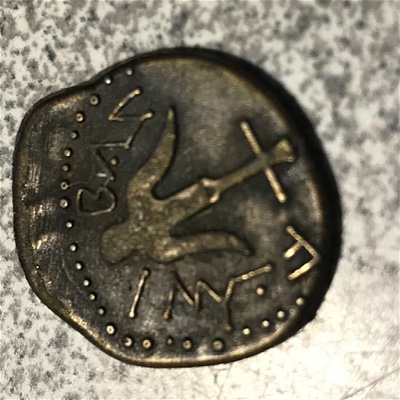
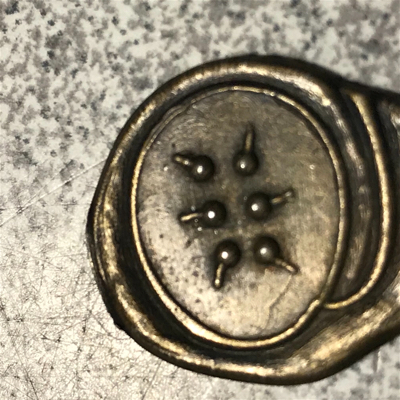
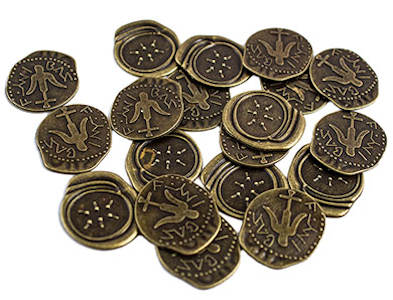
Yep, it's a replica "WIdow's Mite". Mass-produced and sold in bulk through religious supplies stores.
The design very,very crudely imitates the "wheel and anchor" prutah struck by Judean king Alexander Jannaeus, the coin most ancients dealers usually sell as "widow's mites".
The example pic on Wikipedia is a good example. The name of course refers to the story in the Bible (Mark 12:41-44) where a widow places "two lepta, worth a quadrans" into the temple treasury. The quadrans is the smallest coin in the Roman monetary system; the lepta, or "mite" (from the King James version) was the smallest coin in the Greek-based monetary system and was reckoned at being worth half of that. "Prutah" is the Hebrew name for the same coin. The prutah is the smallest coin commonly found in Judaea from roughly the same time period as Christ (although the coins of Jannaeus actually date from 100 years before the Biblical story took place). The genuine coins are extremely common, though are usually sold for much higher prices than similarly common ancient coins, because of the Biblical connection.
I think the theory behind the replicas is that a preacher or Sunday school teacher can buy a whole bunch, and give one out to each of their listeners as a tactile reminder of the lesson or message. Unfortunately, this method of distribution does mean that an awful lot of them are floating around out there, with their owners (or inheritors) having no idea what it is. We see several of them posted here on the forum every year.
The design is sufficiently crude and two-dimensional that I would assume the manufacturer was working off a black-and-white drawing of a prutah, rather than an actual coin.
Don't say "infinitely" when you mean "very"; otherwise, you'll have no word left when you want to talk about something really infinite. - C. S. Lewis








 Posted 02/04/2019 11:23 pm





 to the Community!


