| Author |
 Replies: 19 / Views: 4,077 Replies: 19 / Views: 4,077 |
|
Valued Member
Canada
304 Posts |
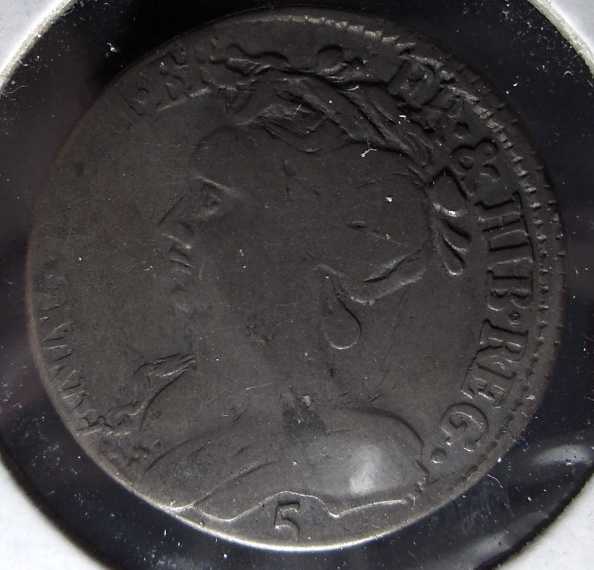
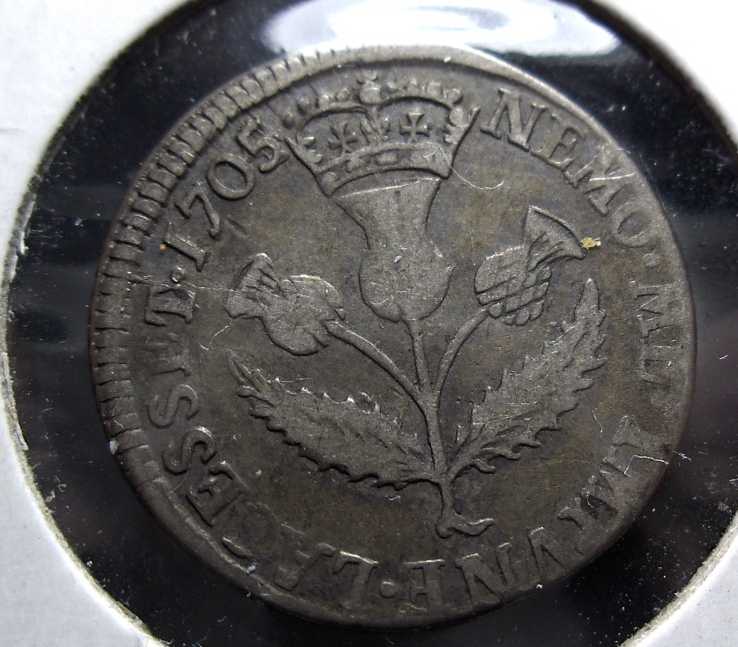
does anyone know what the "5" under Anne's bust signifies? i.e. which mint? I have read that after the Act of Union in 1707 they used "E" for the Edinburgh Mint. Image:  Scotland6p1705Obv.jpg Scotland6p1705Obv.jpg34.13 KB Image: Scotland6p1705Rev.jpg90.64 KB? |
|
|
|
Pillar of the Community
United States
819 Posts |
Are you certain it's a sixpence? It seems to me that '5' mark denominates it, rather than marks a mint.
[not an expert on Scottish coins.]
|
|
Pillar of the Community
United Kingdom
2217 Posts |
A scottish fivepence?
no way...
|
|
Pillar of the Community
United States
819 Posts |
No, a five shillings, not a fivepence.  Those didn't come about until 1971! Edited by ElleKitty
08/10/2008 4:54 pm
|
|
Pillar of the Community
United Kingdom
2217 Posts |
|
|
Pillar of the Community
Poland
3201 Posts |
Wouldn't 5 shillings be larger?
|
|
Pillar of the Community
United Kingdom
2217 Posts |
How can you tell the size of it?
|
|
Pillar of the Community
United States
819 Posts |
The coinage for Queen Anne (1702-1714) was confined to just two denominations (5 and 10 shillings) minted in 1705 and 1706. After the Union of Scotland and England in 1707 the mint at Edinburgh continued for a time producing crowns, half crowns, shillings and sixpences marked with the letter E.
|
|
Pillar of the Community
Poland
3201 Posts |
Does it look like a Thaler-sized coin? To me it does not although I'm no expert.
|
|
Pillar of the Community
United Kingdom
2217 Posts |
Where are you getting visual clues for perspective? i.e. how do you work it out without having any trees or mountains to compare it with?..
Edited by NumisMattyUk
08/10/2008 5:39 pm
|
|
Pillar of the Community
United States
819 Posts |
Well, I'm pretty sure it's not Thaler sized because it doesn't fill the 2x2 window. However beyond that, size is any one's guess!
|
|
Pillar of the Community
Poland
3201 Posts |
Even if the 2x2 is 38.5 mm in diameter (the largest you can get here), there is still some free space, at least 3 mm. So 35.5 at most. Less if the 2x2 is one of the smaller sizes. Still this discussion doesn't really lead anywhere as we'd only excluded Thalers so far  Edited by DL20K
08/10/2008 5:59 pm
|
|
Moderator
 Australia
16985 Posts |
The "5" is indeed the denomionation, 5 shillings. Quote:
Wouldn't 5 shillings be larger?
Does it look like a Thaler-sized coin? To me it does not although I'm no expert. Since the OP calls it a "sixpence", I assume it's roughly sixpence-sized. Don't forget, the Scottish shilling was equivalent to the English penny, so a Scottish 5 shilling coin would be 5 English pence - a bit smaller than a sixpence. Example on CoinArchives. Don't say "infinitely" when you mean "very"; otherwise, you'll have no word left when you want to talk about something really infinite. - C. S. Lewis
|
|
Pillar of the Community
United States
819 Posts |
 Regardless, it is a lovely coin and you should be proud to own it :) Edited by ElleKitty
08/10/2008 6:50 pm
|
|
Pillar of the Community
United Kingdom
2217 Posts |
From my copy of Seaby's Standard Catalog, Sap has just answered the question academically. Thanks for posting an interesting coin malibu! Edited by NumisMattyUk
08/10/2008 7:20 pm
|
|
Valued Member
 Canada
304 Posts |
Ack! I went away for dinner and watched some Olympics (go Canada go!!)and already 14 replies! Sorry about the oversight in my OP, its about 18mm in diameter which is almost 6p size and I had always just assumed it was a 6p and that the 5 below Anne was an E! In re-reading Peter Seaby's "Story of the English Coinage" (1952), and armed with a 10x magnifier instead of a 3x I used to swear by, the 'E' magically turned into a '5' this morning.
This is not covered by this book... he only states "One of the articles of the Act of Union was that the English and Scottish coinages should be equated. Previously the Scottish denominations were only one-twelfth the value of the English, but between 1707 and 1709 crowns, halfcrowns, shillings and sixpences were made at the Edinburgh mint similar in type to the English coins but distinguished by en E or E* below the queen's bust. In 1709 the Scottish mint was closed down."
So Sap is (as usual) right on the money!
|
| |
Replies: 19 / Views: 4,077 |







 Scotland6p1705Obv.jpg
 Scotland6p1705Rev.jpg


 Posted 08/10/2008 4:48 pm



 But you're just tooo clever..


