| Author |
 Replies: 11 / Views: 2,186 Replies: 11 / Views: 2,186 |
|
|
Pillar of the Community
2087 Posts |
My latest arrival Its the Florentine "imitation" of the Venetian Grosso. I purchased it from a dealer and without any useful references, I am a bit "blind" on this one. The dealer gave the date range as 1189-1252, but I would like to narrow that date range if it's possible. The dealer states it is Biaggi 783. Reading directly from the coin I see the legend as: ob: + FLORENTIA rev:+ S IONANNE B Weight = 1.753g 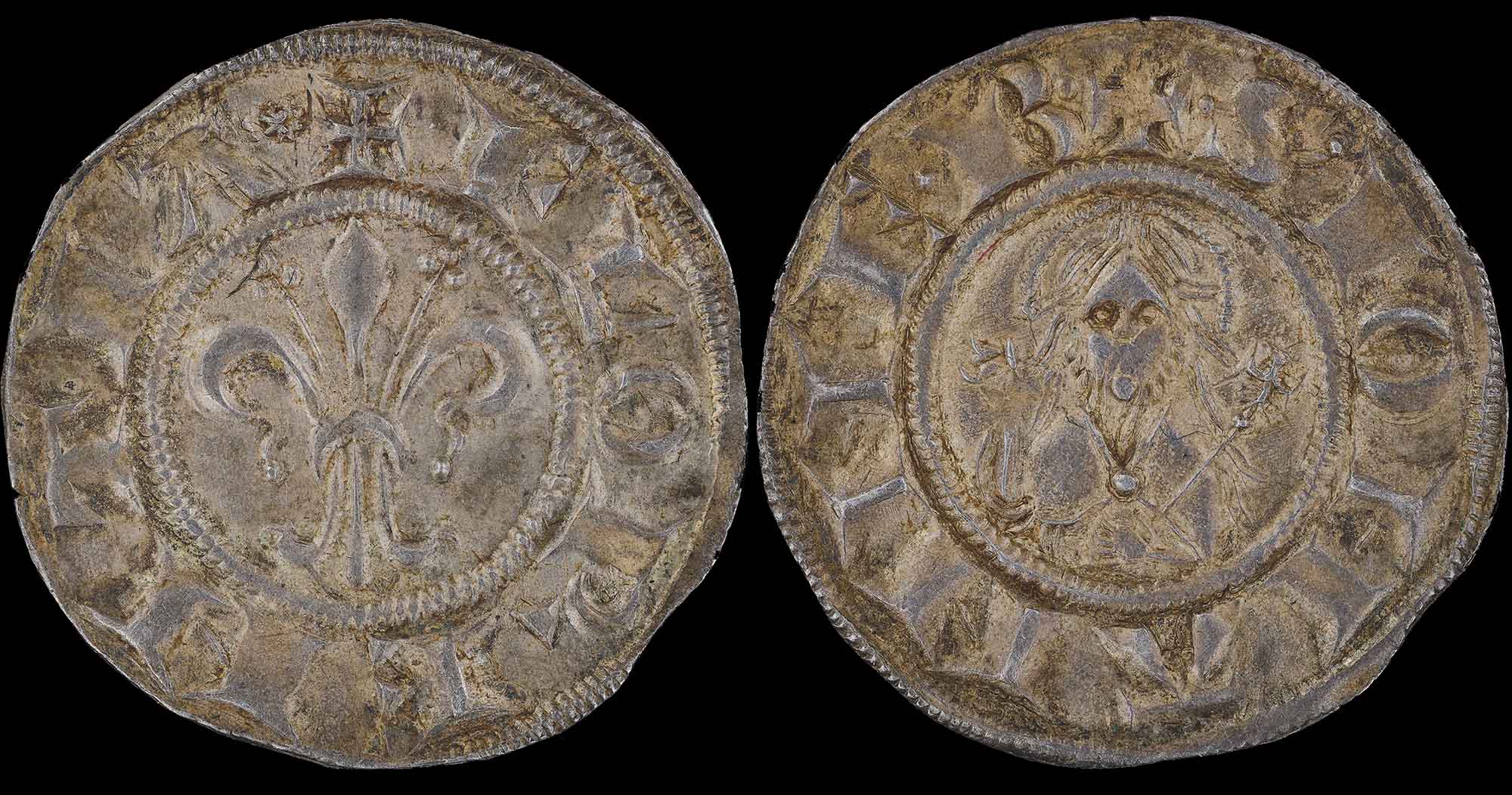 |
|
|
|
Pillar of the Community
 United States
8052 Posts |
I see a similar type in CoinArchives (also with a star after the A in FLORENTIA) with a Biaggi number of 738 and a date estimate of 1250-60 from Spink. SO that first leads me to wonder whether someone has a mistaken Biaggi citation ... I have no access to that reference.  |
|
Pillar of the Community
 2087 Posts |
thanks for that. I was trying to work out what the splodge after Florentia is... soon as you said star it was obvious. Obviously, the dealer transposed some numbers. It would be great if someone else can confirm Edit: Heritage is selling one at that moment. Heritage also lists the coin as Biaggi 783. So My guess is coin archives has the catalogue number numerals transposed. Interestingly the date range is slightly different, in the Heritage listing. https://www.sixbid.com/browse.html?...&lot=4850490Edited by austrokiwi
02/26/2019 01:25 am
|
|
Moderator
 United States
23731 Posts |
It's nice to see all these medieval coins, making me want to get more involved in collecting them.
|
|
Pillar of the Community
United States
8052 Posts |
@austrokiwi, I was able to turn up a couple of examples in CoinArchives by searching under "Firenze fiorino" rather than "Florence fiorino" (seems their algorithms do not pick up the actual Italian names of the city states?).
You will see the example that went unsold at Spink (date range attributed was circa 1250-60 within the broader range 1182-1532), and an example that sold at Ranieri in November with only the broad date range 1189-1532.
This latter example has a dot after the A.
When I get a chance, I will try to go into CNI online and see if I can find anything.
|
|
Pillar of the Community
United States
8052 Posts |
OK, if this coin has been correctly attributed to the first date range for the fiorino, CNI does not provide any help with narrower dating. CNI (Volume XII, p. 2-5) gives this first date range as "1182?-1252" and lists 7 groups of fiorini totalling 18 sub-varieties, but no narrower date ranges for any of these.
SO, if it is possible to determine a narrower date range, this must come from some other reference.
Interestingly, the gold fiorino starting in 1300 can be attributred to specific years (but this will be a rather costly way to fill out one's OFEY collection).
|
|
Pillar of the Community
2087 Posts |
tdziemia thanks for that. I think the date range is estimated from the periods of gvt type. I am already assuming the coin was struck after 1194. The reason for that assumption is: the Venitian Grosso was the model for this type of coin. so any florentine issue would have to be after the earliest striking date of the Grosso. Genoese numismatists claim that Genoa produced a Grosso before the Venetians. However, the early Genoan Grosso was only worth 4 denari, while the Venetian( and Florentine) were worth 24-26 Denari
|
|
Pillar of the Community
United States
8052 Posts |
I am not quite sure how CNI attributions get written, but yours is Section II, No.12 in CNI Vol. XII (Tuscany). Maybe it's just written CNI II/12? It's the only variety with IOHANNE instead of IOHANNES and single dots before and after the B. It's the 5th of seven "groups" of this type identified by the author between the beginning of the type and 1252. It's clear that the author thinks that group 1 is the earliest ("primitivo"), but after that it's less clear. He calls groups 2, 3, 4 "more developed," and groups 5 (where yours lies),6, 7 "even more developed." But I'm not sure what we are to make of that chronologically. It would make me think your variety is closer to 1252 than 1194, but other than this, it's hard to say. CNI description reads like this: Obv: + FLORENTIA * Il giglio fiorito (lily flower), cerchio rigate (reeded circle?) Rev: + S IOHANNE . B . Mezzo busto del Santo con nimbo perlato, barbuto e di fronte, benedice con la destra e tiene la croce con la sinistra. Cerchio rigate (Facing half bust of the saint, bearded and with beaded halo, giving a blessing with his right hand, and holding cross with his left. Reeded circle) Here's a link to the volume with this coin. Your coin is on p.4; the whole range of varieties for the type are covered in p. 2-5. Plates with some photos are near the end of the volume (these early soldini are on Plate XV). https://www.numismaticadellostato.i...ction=invokeEdited by tdziemia
02/26/2019 9:39 pm
|
|
Pillar of the Community
2087 Posts |
thanks, that's great. I think I will download CNI to my Kindle. one minor comparison I conducted was to look at this coin with the 1335 Gold Florin I recently purchased. I saw what I expected which may be an error of logic( but I don't think it is). As I am also cognizant of the minting technology, I have thought that the gold ducat, gold florin and genovino could be understood as off-metal strikes of the Grosso. When you compare these coins to the silver Grosso you find they are of the same dimensions. Gold, particularly of the purity used at this time, is easier to strike than silver. It seems to me it was an easy step just to use the same techniques to produce the gold coins. this Silver Florin is exactly the same dimensions as the gold florin. The only difference is the gold coin is of slightly thicker fabric, other than that the diameter is exactly the same. As I understand the development of Genovino and Gold florin were produced to provide a denomination of the same value as the money of account; the lira. For the mint, it would have been a simple matter just to produce slightly thicker plate, while keeping everything else the same as the silver Grosso they were already producing. Certainly, this silver coin matches up with the gold Florin nicely when compared in hand. Although the 1335 gold coin was struck much later it was no different in size and weight to the first of the type struck in 1252. I know the Venetian Tron is regarded as the first Lire, I would only preface that with "silver".
Edited by austrokiwi
02/27/2019 05:02 am
|
|
Pillar of the Community
United States
8052 Posts |
Very interesting information on the silver florin and gold florin in medieval Italy.
I've gotten confused by this nomenclature and any links between the two, because in early 16th century coinage of Brabant, there is a silver florin which is a large thaler-like coin (about 23 grams), with designs unlike those on the gold florin of the time.
It is indeed not difficult to see the minor evolution in design between your florin (fleur-de-lis/half length bust of St. John) to that ubiquitous gold florin (fleur-de-lis, full length image of ST. John).
|
|
Pillar of the Community
2087 Posts |
Edited to correct some errors:
The later silver Florins are named after the fiorino d'Argento. I am still doing some digging so some of this is subject to change. The original silver florin was effectively a 2 shilling piece ( 1/10 Gold florin) a schilling being 12 pennies. The florins of Germany were worth 100 kreutzers and in the Netherlands, a silver florin was 28 Stuivers.. in both cases, these amounts were still equivalent to 2 shillings. However, the amount of silver within the coins increased over time( as silver devalued with respect to gold). In 1849 the Brits introduced a florin. It also was 2 shillings and was 1/10 of a pound. That was not a significant change in the terminology but was one of the actual value and pound was worth double what it had been( 2 dollars = pound). Now 5 brit florins were equivalent to a half pound represented by a half-sovereign, a coin very close in weight to the original gold florin.
Please someone else jump in and make corrections if necessary
Edit: now tracking the gold florin is also interesting. In Germany, it was called a gulden penning ( or Pfennig) that became shortened to Gulden. what fascinates me is the USA dollar was, when it was instituted, a coin equivalent to a gold florin/ ducat/ gulden/Escudo.
Edited by austrokiwi
02/28/2019 02:46 am
|
|
Moderator
United States
34549 Posts |
@AK, sorry that I am hopping on this thread a little late, but I can confirm that this coin is a Biaggi #783 and not a Biaggi #738. Yours has a slight variation in the rev inscription in that Biaggi plate coin has + IOHANNES.B rather than + IOAHANNE.B. Other information is that the denomination is listed as "fiorino d'argento da 1 soldo" and sorry, but the date range is listed as 1182 to 1252 AD. I'm not sure that we can narrow down that 70 year range of potential striking dates.
"If you climb a good tree, you get a push."
-----Ghanaian proverb
"The danger we all now face is distinguishing between what is authentic and what is performed."
-----King Adz
|
| |
Replies: 11 / Views: 2,186 |
|










 Posted 02/25/2019 10:18 am


